CREDIT: RECIRCULATE
Recirculate, an EU-funded project focused on advancing innovations for second-life batteries, driving a more sustainable and circular battery economy across Europe, is developing a state-of-the-art electric vehicle (EV) battery disassembly system using artificial intelligence (AI) and robotics. The project has successfully completed its first phase: the creation of a set of tools and machine learning models for the robotized dismantling of an EV battery from pack to cell level. This innovation addresses one of the battery industry’s most pressing bottlenecks: safe, efficient, and automated disassembly.
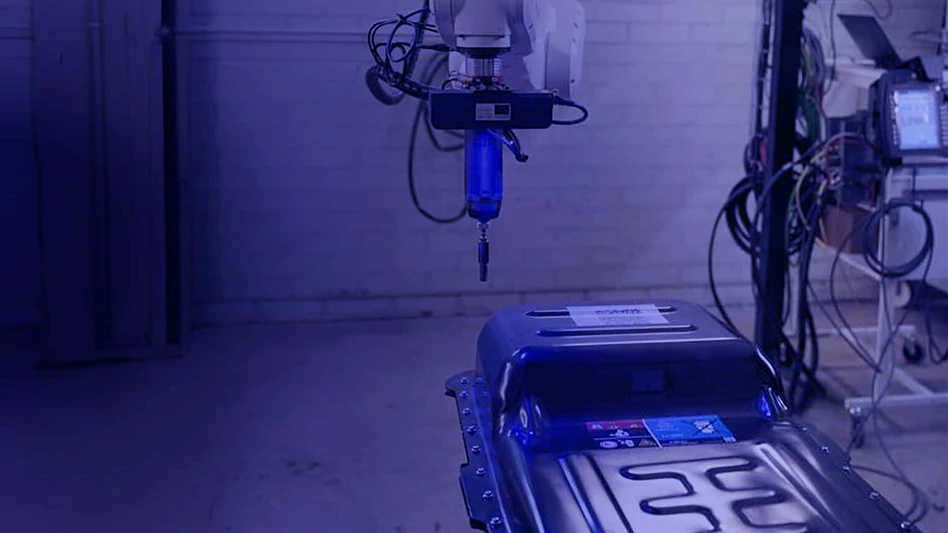
The system is designed to dismantle batteries in two key phases – from battery pack to module, and from module to cell level. Centria University of Applied Sciences’ team that leads work on this innovation within Recirculate created a purpose-built robotic cell using a KUKA KR10 industrial robot. This robot, equipped with specially designed tools and a mobile linear track, can autonomously detect, unscrew, and remove components of high-voltage battery packs.
“There are approximately 50 screws on the lid alone,” says Tomi Pitkäaho, Principal Lecturer in Research, Centria University of Applied Sciences. “We’ve trained a machine learning model to locate and identify each screw, extract their exact coordinates, and send this data to the robot. With a depth camera installed directly on the tool, the robot can precisely determine not just the x and y position, but also the z-depth for each component.”
The system uses multiple machine learning (ML) models to identify and extract critical components including screws, connectors, and wiring. Once the lid is removed using a vacuum gripper, specialized robotic tools are used to dismantle internal components. The models not only recognize the elements but also analyze wire orientations to determine optimal disassembly strategies.
“We’ve developed tools that can detect and manipulate parts with remarkable precision,” Pitkäaho explains. “From training datasets to model architecture and deployment, it took 18 months of dedicated work by our team of robotics, AI, and ML experts.”
Beyond disassembly, the team has created a battery identification model that can recognize batteries even in the absence of QR codes or digital product passports. Currently, the model can identify battery types from manufacturers such as Ford and Tesla with nearly 100% accuracy, enabling the system to automatically select the correct disassembly program.
“This is one of the first working, real-world examples of battery disassembly using machine learning and robotics,” Pitkäaho states. “Until now, most efforts have been purely academic. We’re proud to bring this into industrial application through Recirculate.”
To scale the solution and extend compatibility to other battery types, the team is focused on expanding its proprietary training dataset.
Latest from EV Design & Manufacturing
- Powering homes with EV batteries could cut emissions, save thousands of dollars
- Meviy introduces stainless steel passivation option for CNC, sheet metal parts
- December Lunch + Learn webinar with Fagor Automation
- December Lunch + Learn webinar with LANG Technik + Metalcraft Automation Group
- EVIO makes public debut with hybrid-electric aircraft
- Redesigned pilot step drill triples performance
- Green Energy Origin expands battery electrolyte manufacturing in North America, Europe
- What’s next for the design and manufacturing industry in 2026?