Derq
As the Consumer Electronics Show (CES) in January sparked a new wave of autonomous vehicles (AVs) coming to the automotive market in the next few years, much focus has been on the technology of these vehicles. The technology embedded in road infrastructure is beginning to see more conversation between service providers and municipalities.
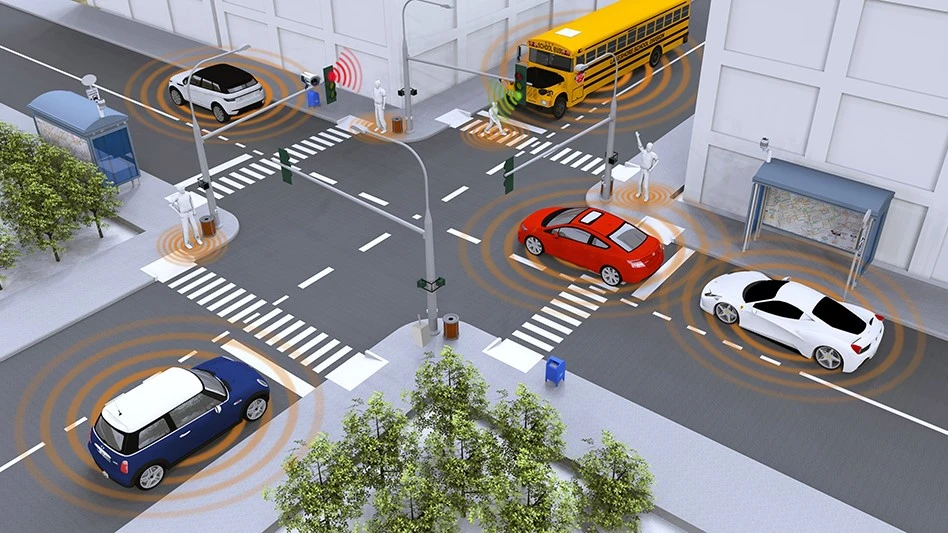
With advancements in artificial intelligence (AI) and 5G network connectivity, smart-road infrastructure technology offers the promise of being added to many different roads, bridges, and other transit systems across the U.S. in hopes of improving real-time traffic analytics and tackling the most challenging road safety and traffic management problems. One technology at the center of this discussion is the present-day use of AI-enhanced cameras and tomorrow’s promise of LiDAR technology.
Artificial intelligence will enhance camera sensing performance
There are hundreds of thousands of traffic cameras deployed in the US and millions more when CCTV cameras are considered. They are mainly used for road monitoring and basic traffic management applications (e.g., loop emulation). Bringing the latest advancements of AI to these assets can immediately improve basic application performance and unlock more advanced software applications and use-cases.

AI and machine learning deliver superior sensing performance over traditional computer vision techniques found in legacy cameras. They enable more robust, flexible, and accurate detection, tracking and classification of all road users with algorithms that can automatically adapt to various lighting and weather conditions. In addition, they allow for predictive capabilities to better model road user movements and behaviors and improve road safety. Agencies can immediately benefit from AI-enhanced cameras with applications such as road conflict detection and analysis, pedestrian crossing prediction, and infrastructure sensing for AV deployments.
LiDAR technology can’t fully replace cameras
LiDARs can provide complementary and sometimes overlapping value with cameras, however there are still several safety critical edge cases where LiDAR technology doesn’t perform well, and where cameras have been proven to handle better. LiDAR technology remains expensive to deploy at scale due to its high unit price and limited field of view. It would take multiple LiDARs at a hefty investment to be deployed in a single intersection, where just one 360-degree AI-camera can be a more cost-effective solution.
For many budget-focused communities, AI-cameras remain the proven technology of choice. Over time, as the cost of LiDAR technology moderates, communities should evaluate augmenting their infrastructure with such sensors.
Eventually, sensor fusion drive results
When the cost of LiDAR technology eventually sees an anticipated reduction, it’ll be viewed as a strong, viable addition to the AI-enhanced cameras being installed. Similar to autonomous vehicles, sensor fusion would be the go-to approach for smart infrastructure solutions and would allow to maximize the benefits of both technologies.
See chart below:

The use of a cost-effective and performing AI-powered camera today, combined with the great potential of LiDARs in the coming years could help communities and municipalities achieve a win-win scenario today and tomorrow.
At the end of the day, the goal is clear in improving overall traffic flow and diminishing vehicle crashes and fatalities, but the technology and implementation strategy must be right in doing so. The technology monitoring our roads needs to change too, thus calling for the consideration of AI-powered cameras today with the promise of LiDARs tomorrow.
About the Author:
Dr. Georges Aoude is the co-founder of Derq, an MIT spinoff powering the future of connected and autonomous roads, making cities smarter and safer for all road users, and enabling the deployment of autonomous vehicles at scale. Derq provides cities and fleets with an award-winning and patented smart infrastructure Platform powered by AI that helps them tackle the most challenging road safety and traffic management problems.
Latest from EV Design & Manufacturing
- Ford partners with Renault Group to expand European electric vehicle presence
- Analysis, trends, and forecasts for the future of additive manufacturing
- BlueForge Alliance Webinar Series Part III: Integrate Nationally, Catalyze Locally
- Wolfspeed’s silicon carbide components to power Toyota’s onboard EV charger systems
- Sunnen enhances e-commerce platform for precision honing equipment
- QuantumScape moves forward with automated battery cell pilot production line
- Dürr introduces next-generation low-pressure spray gun
- #56 Lunch + Learn Podcast with Techman Robot + AMET Inc.