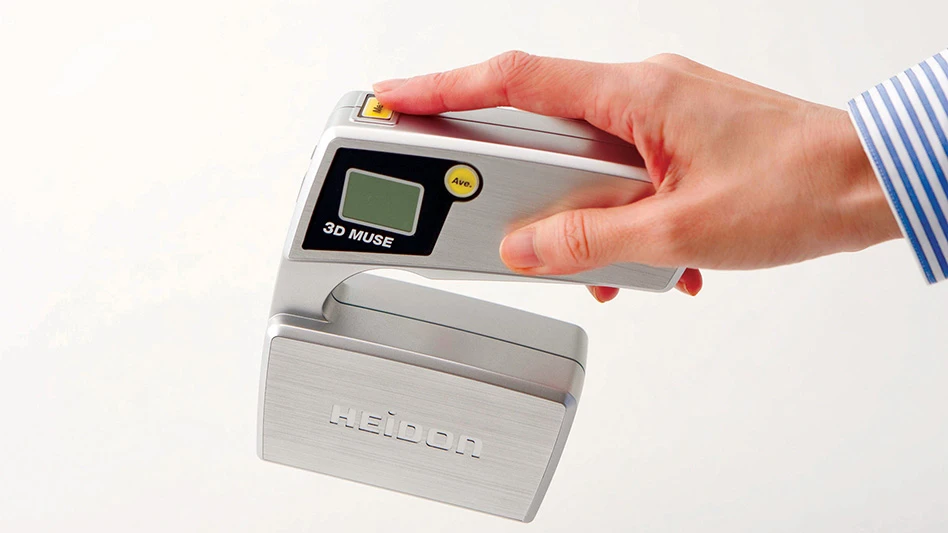
CREDIT: KETT US
It may not capture the attention of the average motorist, but friction has a huge impact on the automotive industry. While a certain level of friction is necessary for traction and safe operation, excessive friction creates significant challenges. It reduces fuel efficiency, increases energy losses, and generates unwanted heat. It can also lead to galling, seized parts, worn edges, and other defects that undermine reliability and safety.
According to some estimates, friction and wear can account for nearly 10% of an automobile’s total fuel consumption. As a result, manufacturers and engineers spend significant time and resources addressing it.
Fortunately, portable tribometers, also known as friction analyzers, can precisely analyze friction and wear, allowing manufacturers to refine the materials and surface finishes of their components. These handheld friction testers can produce fast, lab quality, non-destructive testing by essentially anyone without specialized training. With this capability, in situ testing of various materials and surfaces can be completed in seconds, even at an angle, upside down, or with contours.
“Friction can be measured on metal surfaces when receiving raw materials, in production to adjust lubrication, or during QA checks further downstream,” says John Bogart, managing director of Kett US. “For auto manufacturers, the result is greater reliability, improved safety, and a potential 3% to 5% boost in fuel efficiency.”
Friction testing in the automotive industry
According to Bogart, few industries are as impacted by rigorous testing standards as those in the automotive sector.
“Almost every component of an automobile undergoes thorough and extensive testing, from the engine parts to the accelerators, clutches, brakes, tires, seatbelts, and more. Each one is tested for its tribological properties to meet global standards,” explains Bogart.
Parts such as crankshafts and camshafts, which must meet specific requirements and hold up to proper functioning under a broad range of service conditions, undergo testing at every level. Their base materials, heat-treated parts, surface coatings, and even the lubricants used must all be evaluated for friction and wear. These tests are run with a diverse array of loads, velocities, lubricants, liquids, and temperatures to mimic the service conditions these parts may experience in the real world.
Other automobile components go through the same level of material testing, including door handles and locking mechanisms, which are also tested as base materials, at different heat treatments, and are evaluated for their surface coatings and lubricants as well.
Testing is a crucial way to measure the friction of the engine and the other automotive components for safety and to continue to improve the performance and lifespan of each component. Tribometers and friction testing can help automotive manufacturers quantify friction and investigate how different materials, components, lubricants, and lubricant additives affect the performance of the vehicle.
The challenge is that traditional friction testing equipment is not always up to the task. Most traditional testing equipment is not portable, requires removing a sample to the lab area, and is limited to analyzing horizontal surfaces.
Traditionally, friction testing was limited to occasional lab checks using incline methods. This required destructive testing in which a portion of metal was cut from a sample and mounted on a flat plane of a second metal, with careful measurement of the inclination angle required for relative movement to start. The time-consuming process also required considerable technical expertise.
In addition to testing automotive parts, tribometers are used in the basic, foundational elements of making a new automobile.
For example, in metalforming – a core manufacturing process in the automotive industry –nearly every step requires contact between the forming tool and the metal being deformed. For this reason, tribometers are essential for measuring the resulting stress and friction. This means that effective friction testing methods must be capable of operating on angled or contoured surfaces and at multiple locations.
However, even this can be a challenge. To reduce the friction during metalforming, lubricants are often used but this can further complicate testing. Friction is frequently tested to evaluate the effect of various lubricant properties and control the results on the forming process.
“The application of lubricants essentially changes the equation of how much friction and force is applied in certain areas and processes of metal forming, so friction must be accurately and reliably measured to maintain consistent quality,” says Bogart.
Examples of tribometers
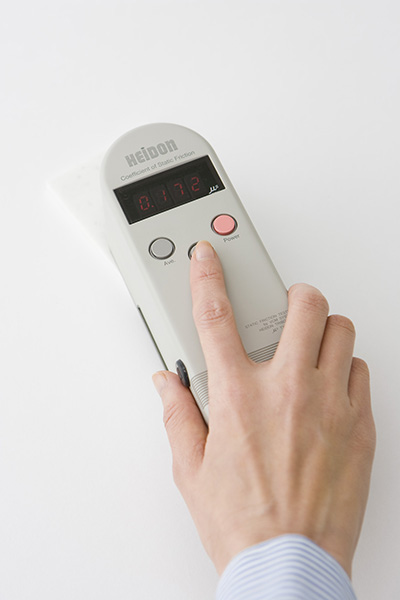
Two examples of friction analyzers, which are widely used in the automotive industry, are handheld battery-operated models: the Heidon H94Ai Handheld Portable Friction Tester and the Heidon H37 3D Muse Tribometer by Kett. Both units can measure the static coefficient of friction (SCOF) on dry, wet, or lubricated metal surfaces.
According to Bogart, “the operator places the unit on the surface to be tested, presses the ‘measure’ key, and the static coefficient of friction is measured to 0.001 precision in seconds. They’re comparable to lab models as far as accuracy and reliability.”
“Basically, a technician can pull a workpiece from the production line and test the friction in multiple places with these portable units,” adds Bogart. “If the item is in spec, they can put it right back on the line. If not, they can quickly adjust on the fly.”
For testing flexibility, the ability to exchange test fixtures allows the unit to simulate the interaction of multiple surface materials (i.e.-steel to steel, steel to aluminum, aluminum to aluminum) by simply swapping out the fixture. This is important not only when forming various metals but also when the metal surface of the equipment and tooling differs from that of the formed material.
“Measuring friction is completely dependent on the two interface materials. So, quickly changing out the fixture to accommodate the testing of different metals is important,” says Bogart.
He notes that exchanging test fixtures can be used to simulate solid/solid interfaces and solid/liquid interfaces, which can be helpful in determining the frictional interaction of metals with lubricants or other liquids.
While the H94Ai must be held level when measuring, the newer H37 3D has integrated angle adjustments that allows it to be used at any angle – from horizontal to vertical in three dimensions, even upside down.
The combination of the H37 3D’s integrated angle adjustments, along with the ability to exchange test fixtures, enables measuring friction in angled, contoured, and rounded metal surfaces. This facilitates more versatile SCOF measurement of metal surfaces, machinery, and tooling, which can improve production quality and equipment longevity.
“By being able to hold the instrument at any angle, you can get accurate measurements without having to worry about either orienting the piece or orienting your hand to make sure that the instrument is completely horizontal,” says Bogart. He adds that portable friction analyzers like these can be used to evaluate test panels, finished products, and coatings.
As the automotive industry develops, with stricter safety regulations and higher efficiency standards, the value of friction testing continues to grow. Tribometers provide the precision data necessary to improve reliability, extend component life, and reduce wasted energy. In an industry where efficiency and safety are critical, regulating friction is an essential part of the automotive process.
About the author: Chris Manning, a Los Angeles-based technical writer, has more than 18 years of experience writing in the telecommunications and industrial sectors. He enjoys transforming complex topics into clear and engaging content.
Latest from EV Design & Manufacturing
- Powering homes with EV batteries could cut emissions, save thousands of dollars
- Meviy introduces stainless steel passivation option for CNC, sheet metal parts
- December Lunch + Learn webinar with Fagor Automation
- December Lunch + Learn webinar with LANG Technik + Metalcraft Automation Group
- EVIO makes public debut with hybrid-electric aircraft
- Redesigned pilot step drill triples performance
- Green Energy Origin expands battery electrolyte manufacturing in North America, Europe
- What’s next for the design and manufacturing industry in 2026?