CREDIT: BATTERY X METALS
Battery X Metals Inc., an energy transition resource exploration and technology company, announces that, after the successful completion of a preliminary trial on a real-world naturally imbalanced battery pack from the second most common out-of-warranty electric vehicle (EV) model in the United States – the Nissan Leaf – it has unveiled its second-generation, patent-pending lithium-ion battery rebalancing machine, Prototype 2.0, developed by its wholly owned subsidiary, Battery X Rebalancing Technologies Inc.
The trial marks the first real-world application of Prototype 2.0, validating the company’s proprietary rebalancing technology outside of controlled laboratory environments. The results demonstrated 100% recovery of imbalance-related capacity loss, confirming Prototype 2.0’s ability to rebalance cell-level voltages and restore usable ampere-hour capacity in aging battery packs.
“This milestone represents a significant inflection point in our validation journey,” says Massimo Bellini Bressi, CEO of Battery X Metals. “With Prototype 2.0, we’ve not only confirmed the technology’s ability to detect and correct cell imbalances with precision, but we’ve now proven it can perform in real-world conditions. We believe this is the first of many major validations that will drive adoption of rebalancing as a viable solution for electric vehicle battery longevity.”
Prototype 2.0 unveiled during live reveal event
On May 30, 2025, Battery X Metals hosted its previously announced Exclusive Live Investor Reveal Event where it formally presented Prototype 2.0 to the public for the first time. The Live Reveal Event featured a live walkthrough of the system, a dedicated corporate video showcasing Prototype 2.0’s design and functionality, and commentary from management on the Company’s development roadmap and upcoming milestones.
Attendees were also shown an explanatory summary video about battery rebalancing, which outlines how lithium-ion cell imbalances affect battery performance and emphasizes the critical role of rebalancing in prolonging battery life.
Summary of trial results
The trial results were performed using Prototype 2.0 on the Nissan Leaf Battery Pack, which was first charged at 12A using Battery X Rebalancing Technologies’ cycling module to simulate a standard EV charging cycle. Once the first cell reached the voltage target of 4.20V, a rebalancing current between 0A and 3A was applied individually to the remaining cells until all 96 battery cells successfully reached the target. The voltage target lies within the standard operating range for LMO and LNO lithium-ion cells of 3.0V to 4.20V, with 4.20V commonly recognized as the full capacity in the industry.
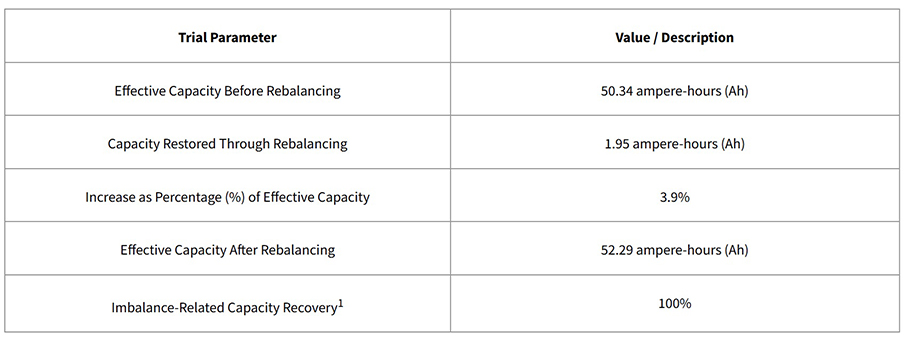
According to the diagnostic report provided by the vendor of the Nissan Leaf Battery Pack, the reported measured effective Ah capacity of the battery pack prior to rebalancing was 50.34Ah. This served as the baseline capacity for the trial. Following the trial, Prototype 2.0’s integrated software determined that 1.95Ah of additional capacity had been successfully restored. While the battery vendor diagnostic report did not quantitatively indicate a loss of capacity, it indicated that the Nissan Leaf Battery Pack was operating at 50.34Ah with minor voltage imbalance that placed the voltage below the target. Rebalancing the cells to the voltage target achieved a 3.9% improvement in usable capacity.
The restored 1.95Ah corresponds to the full theoretical rebalancing increase based on the voltage target achieved and represents full recovery of the minor voltage imbalance indicated on the battery vendor diagnostic report. These results were determined by the trial based on achieving the voltage target across all 96 battery cells, along with a software feature of Prototype 2.0 that shows the Ah capacity restored through rebalancing for each individual cell, with the largest discrepancy being 1.95Ah, based on the voltage target. Battery X Rebalancing Technologies interprets this result as confirmation of Prototype 2.0’s ability to restore all imbalance-induced lost capacity through precise voltage alignment and battery-cell level rebalancing.
Results
Latest from EV Design & Manufacturing
- Powering homes with EV batteries could cut emissions, save thousands of dollars
- Meviy introduces stainless steel passivation option for CNC, sheet metal parts
- December Lunch + Learn webinar with Fagor Automation
- December Lunch + Learn webinar with LANG Technik + Metalcraft Automation Group
- EVIO makes public debut with hybrid-electric aircraft
- Redesigned pilot step drill triples performance
- Green Energy Origin expands battery electrolyte manufacturing in North America, Europe
- What’s next for the design and manufacturing industry in 2026?