Blainjett Aviation
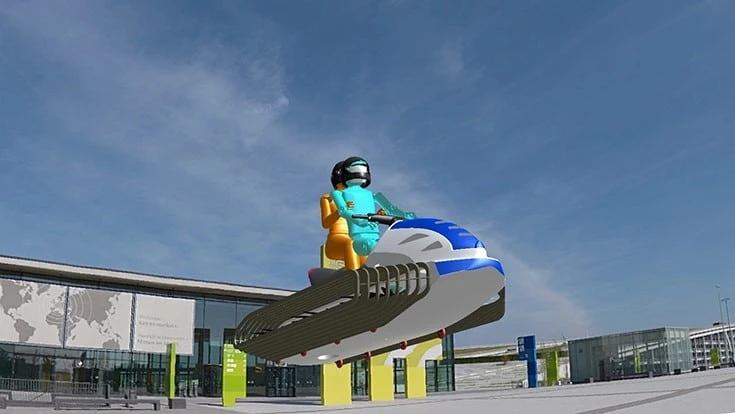
Blainjett Aviation, an aerodynamic propulsion technology startup, conceived a lift-rotor configuration which promises to deliver significant efficiency and thrust improvements for eVTOL and other vertical-lift designs. Blainjett's discovery was made through work on a joint venture with Horizon Aeronautics, refining the design of Horizon's Hoverbike, a proposed short distance commuter vehicle.
With outer mold lines and a size similar to a jet ski, Horizon searched for a compact, powerful thrust-generating system for its hybrid/electric hoverbike. Horizon turned to Blainjett after learning about its patented Dynamic Variable Pitch (DVP) technology enabling rotorcraft to generate vectored thrust (and thus higher speeds) while in level, forward flight without resorting to large rotating assemblies like a tilt-rotor.
Instead of changing the angle-of-attack of a helicopter or eVTOL rotor to create forward thrust, Blainjett's DVP concept changes the pitch of the rotor blades through one half of the rotor arc using a proprietary cam and flexible plate mechanism. Horizon's hoverbike needs to remain level to accommodate its riders.
While conceiving a thrust generation system for the 9-foot long, four-foot wide hoverbike, Blainjett president, Cary Zachary, began evaluating digital models pairing rotor configurations with an electric powertrain.
"Horizon Aeronautics has real space and power constraints," explains Zachary. "When we realized that we could nest the lift rotors in a certain way that maximizes space available and combine their placement with our vectored thrust concept, we knew we had something unique."
Zachary came up with a design that situated rotors in-line along the belly of the hoverbike. Rather than having each rotor fully exposed as on a helicopter or eVTOL, he decided to enclose half of each multi-blade rotor within the body of the hoverbike. The idea employs DVP, increasing blade pitch as rotors pass through the exposed outer-half of the spinning rotor arc and returning rotor pitch to neutral as they pass through a fairing within the hoverbike body.
Lift and vectored thrust are generated by one-half of the rotor. This hemispherical lift-rotor configuration produced surprising results. Compared to complex many-rotor or ducted fan designs, Blainjett achieves greater thrust and power distribution efficiency with a small number of larger hemispherical rotors.
"When we compared our thrust output and efficiency to ducted fans and smaller rotors, we were 2-3 times more efficient with 2-3 times more power density while fitting in the same available space,” says Zachary. “There's also a reduction in aerodynamic drag in forward flight."
Horizon Aeronautics plans to roll out a fully functional prototype integrating Blainjett's patent-pending hemispherical rotor design in late 2022. Blainjett is embarking on additional proof-of-concept work for hemispherical rotor application in the burgeoning Advanced Air Mobility market.
"Our ambition in the future is to perfect this innovation for Horizon Aeronautics as well as to license it for applications outside the specific ground-effect hover-vehicle market," concludes Zachary.
Latest from EV Design & Manufacturing
- Ford partners with Renault Group to expand European electric vehicle presence
- Analysis, trends, and forecasts for the future of additive manufacturing
- BlueForge Alliance Webinar Series Part III: Integrate Nationally, Catalyze Locally
- Wolfspeed’s silicon carbide components to power Toyota’s onboard EV charger systems
- Sunnen enhances e-commerce platform for precision honing equipment
- QuantumScape moves forward with automated battery cell pilot production line
- Dürr introduces next-generation low-pressure spray gun
- #56 Lunch + Learn Podcast with Techman Robot + AMET Inc.