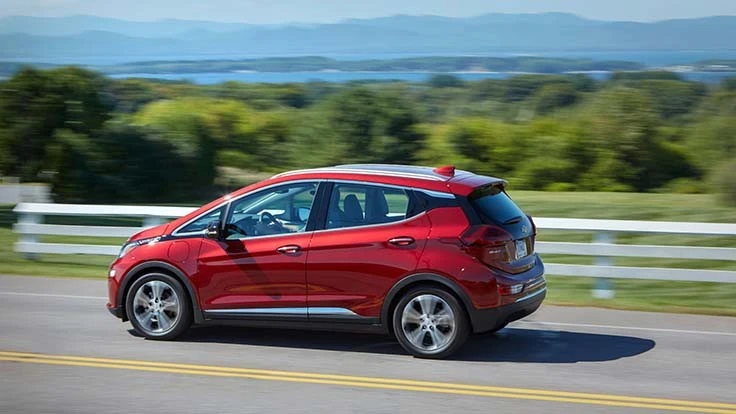
Cleveland, Ohio – Fiddling with battery chemistry boosts the range of the 2020 Chevrolet Bolt electric vehicle (EV) to 259 miles, a 21-mile increase that puts it ahead of the base model Tesla Model 3 and several other EVs.
Small, targeted changes to cell electrodes boosted the Bolt’s battery to 66kWh, a 10% gain from the 2019 model’s 60kWh, without adding weight or cost. Starting at $38,500, the Chevy is less expensive than the 240-mile-range Tesla ($39,000 starting price). The Tesla can be ordered with a 310-mile battery, but that boosts the price to $48,000.
“The Bolt EV set the benchmark for long-range, affordable electric vehicles, and we’re excited to raise the bar by offering nearly 10% more EPA-estimated range for the 2020 model year,” said Tim Grewe, director of Global Battery Cell Engineering and Strategy.
Chevy beat Tesla to the less-than-$40,000 EV market, but Bolt production is significantly lower than the Model 3, a vehicle that quickly became the world’s most popular electric last year. Tesla has struggled to meet production targets, and Model 3 sales have been inconsistent, but the vehicle generates significantly more demand than the Bolt.
GM is investing heavily in fully electric vehicles while other mass-market automakers offer a mix of hybrids, plug-in hybrids, and EVs. The automaker cancelled its Volt plug-in hybrid this year but has several new EVs planned for the next two years.
Industrywide, sales ofEVs have increased rapidly in the past 18 months, almost entirely due to the rapid production increases for the Tesla Model 3, while offerings from GM, Nissan, and BMW have grown slowly.
About the author: Robert Schoenberger is the editor of Today's Motor Vehicles and a contributor to Today's Medical Developments and Aerospace Manufacturing and Design. He has written about the automotive industry for more than 19 years at The Plain Dealer in Cleveland, Ohio; The Courier-Journal in Louisville, Kentucky; and The Clarion-Ledger in Jackson, Mississippi.