Bosch Rexroth
After more than a century of the world’s automotive systems being powered and driven by gasoline and diesel internal combustion engines, the irreversible transition to electric vehicles (EVs) is underway.
All the major global automotive car and truck manufacturers are committed to transitioning the bulk of their vehicles to full electric transport by the mid-2030s. As a result, the performance and efficiency of the EV’s battery pack and its electric motor powertrain (the e-axle) now makes them two of the most critical vehicle systems.
An EV’s battery pack is much more than just a power storage unit. It’s a complex system composed of batteries in modules or sub-packs, combined with advanced wiring technology and sophisticated battery management systems (BMS). This enables the storage and fast movement of power in two directions: discharge to the powertrain and other EV systems and efficient, repeated recharge, capturing energy from regenerative braking of the vehicle and fully recharging from charging stations.
Testing and verification of battery and e-axle performance
The Environmental Protection Agency (EPA) rates EVs for their energy efficiency and operating range on a charge. This operating range is a critical performance metric used by vehicle manufacturers, industry experts, and consumers to value an EV and to compare different makes and models. The certified operating range will become a vital number for buyers to assess if they are concerned about “running out of juice” mid-journey.
EV manufacturers are making major investments in high-performance testing platforms for their battery packs and e-axle systems. The testing systems leverage the latest digital tools and use advanced DC inverter power management technology to efficiently test and verify the charge and discharge cycles of their battery packs. They also simulate and verify the modular power conversion, energy regeneration, and energy draw of their e-axles (electric drives and motors of the EV).
Challenges for battery pack, e-axle testing
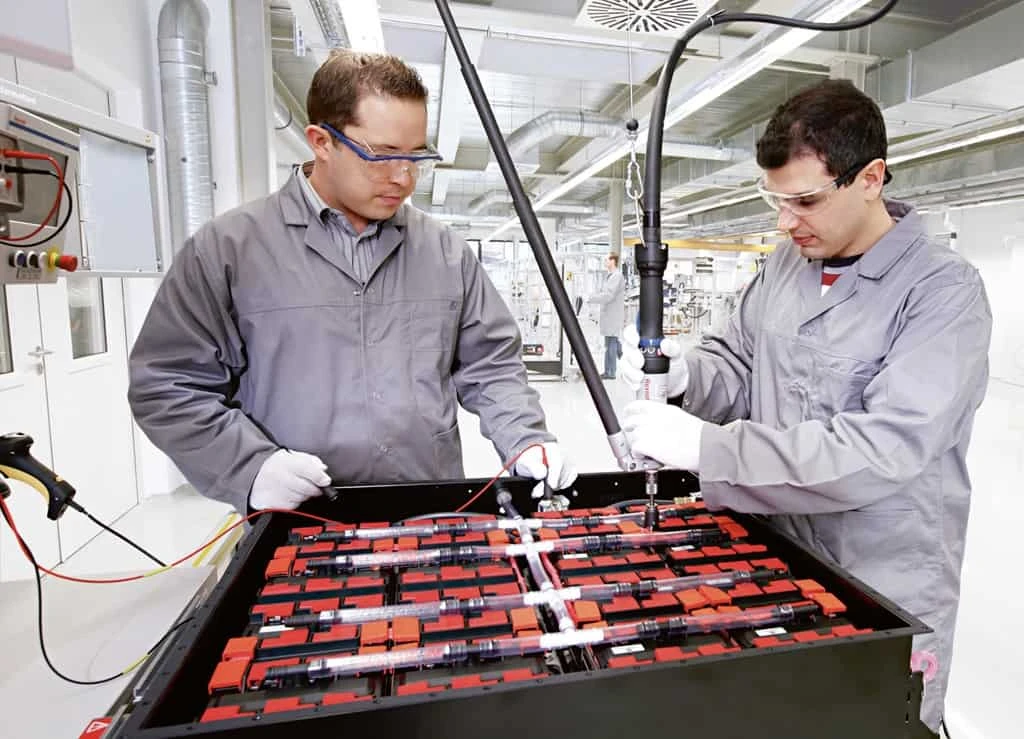
EV battery packs are composed of multiple battery modules, which are themselves composed of multiple cells; the number of modules varies, from two to eight, although battery design continues to evolve. The battery packs also include cooling technology and advanced BMS controllers, which compute, track, monitor, and manage the available energy/charge in the pack. The BMS also controls the energy discharge when the EV demands energy and recharge when power is fed back into the battery via regeneration or full charging.
End-of-line battery and e-axle testing systems must take into consideration the challenges associated with high-output mass production of vehicles using them — by one estimate, a plant producing 50 EVs per hour would have a new battery pack to test every 72 seconds. Battery packs and e-axles are complex devices, with size and weight dimensions that require careful handling to move efficiently through testing systems.
A new generation of battery and e-axle testing systems is being developed in response to these challenges, built around a combination of advanced testing software modules and the latest generation of high-performance industrial inverter drives. These high-power inverters, such as the modular and scalable Bosch Rexroth IndraDrive ML, provide the safe, controlled, and rapid delivery of DC power to the test stands, in order to supply/remove the correct amount of power to battery packs and e-axles according to the testing program’s requirements.

Bosch Rexroth’s IndraDrive ML scalable range of inverters enables effective solutions for battery pack and e-axle testing, with a versatile DC/DC drive design that provides the smallest footprint and weight to save valuable control cabinet space.
The system topology for the battery charging and e-axle testing systems is similar. The EV manufacturer creates the master testing program, which typically runs on an industrial PC and controls the specific charge and load cycles. The cycles are designed to match real world demand specifications for driving, regeneration, and charging, and to verify the e-axle and battery perform as designed, by comparing the command and actual data point and EV equipment data.
The high-power inverter technology is crucial to the testing platform. It provides the modular power conversion, taking the plant’s main AC power and converting it to DC, then delivering power efficiently to DC/DC inverters on a common DC bus. DC/DC inverter sets are connected to the battery pack being tested, interfacing with the test computer and BMS to carry out the discharge, recharge, and full charge cycles as dictated by the testing program.
The DC/DC inverter and the BMS provide the real-time data the testing system needs to evaluate whether the battery pack or e-axle is performing according to specifications: the BMS computes, tracks, and monitors the available energy/charge and the EV’s computer computes the available range based on the vehicle’s drives and electric motors.
The testing system inverter power supply can report real-time voltage, current, and power as each battery pack or e-axle is cycled through the testing sequences.
Key inverter features for EV testing systems
To support the rigorous, high-throughput testing demands for these systems, the scalable inverter technology and system play a central role. They need to be efficient to support very dynamic current ramps into the EV inverters and battery, charging and discharging power at the required voltage, and exercise tight control of the power flow.
The most crucial performance for testing system inverters is their ability to support a broad range of DC output voltages and currents. EV manufacturers have been increasing their battery pack storage and output capacities. Older battery packs were often limited to approximately 420VDC and the charging systems were limited in power (typically 11kW to 50kW). These could take too long to charge from 20% to 80%.
EV manufacturers are moving to more powerful packs in the 800VDC to 900VDC range so it’s important to select testing system inverters that can deliver broader output voltage ranges, from 20DCV to 1,150VDC, and increasing DC output current demands. Equally important is the inverter control mode: how tightly can it control the required output by providing constant voltage, current, and power according to the power cycling required in the testing.
The Rexroth IndraDrive ML inverter provides very precise and accurate control, with less than 0.1% ripple. EV DC power systems have virtually no ripple due to the high dynamics in its power stage and controller section, and the closed loop measurement at the DC/DC converter output.
Numerous battery and e-axle test stands are needed to support high-volume automotive manufacturing so inverters that support reliable and clean DC power and efficient bus sharing are important. Inverter cooling is equally important, given that banks of inverters will need to support multiple test stands in a high-throughput, end-of-line testing environment. Liquid-cooled inverters can support high power density and effective heat dissipation, helping make the testing equipment more energy efficient while minimizing floor space. In addition, liquid cooling is also the cooling method used for batteries and e-axles.
One final consideration is safety: Inverters with industry-standard, well-designed safety disconnects and safe motion/safe torque-off capabilities (integral software elements of the inverter controller) make it much easier to implement safety protocols to protect workers and testing equipment.
Work with experts in electric drive technology
Battery pack and e-axle test stands will be critical production tools that EV manufacturers will depend on to ensure the vehicles they deliver to customers leave the plant with the set state of charge (SOC), discharge, and full charge performance customers expect.
Suppliers of industrial electric drives and inverter technology have experience creating inverters engineered to meet demanding automation requirements. EV manufacturers and their production equipment suppliers can benefit as they further evolve their testing capabilities. This can accelerate the creation of systems that can efficiently and accurately complete testing cycles and enable them to meet the rapidly rising demand for electric vehicles.