CAPTURE 3D
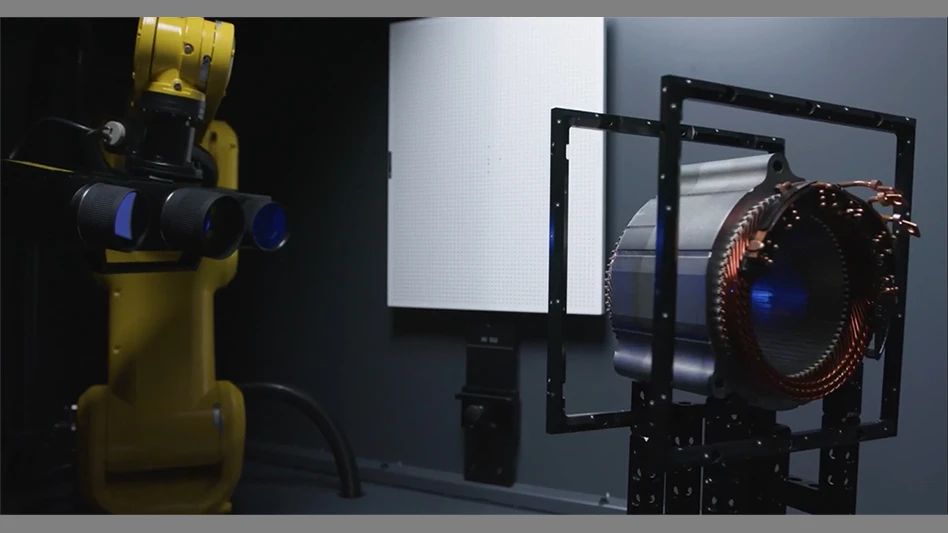
CAPTURE 3D, a ZEISS company and the leading provider of innovative 3D digitizing solutions in the US, announced the ZEISS ScanBox for eMotors, an automated 3D scanning solution for the fast and accurate inspection of complete electric motor hairpin-stator assemblies and multiple or individual hairpins. With an integrated ZEISS ATOS Q-EV blue light 3D scanning sensor, the ZEISS ScanBox for eMotors quickly captures high-resolution 3D measurement data from an electric motor hairpin assembly for rapid, reliable, and efficient dimensional inspection.
In the effort towards decarbonization within the automotive industry, ensuring effective quality assurance of these components is critical to performance and sustainability. Hairpin-stator assemblies from an electric motor consist of more than 100 integrated hairpins that must be inspected accurately to ensure maximum efficiency and functionality. These copper hairpins are shiny, coated, and flexible, causing deformation and presenting challenges for dimensional inspection. As a non-contact solution, ZEISS ScanBox for eMotors solves these combined challenges by quickly capturing complete, accurate measurement data from the assembly for alignment, GD&T, crown, twist, and radial analysis to support better decision-making and cost savings.
Fast, user-friendly automated 3D inspection of stators and hairpins
From data acquisition to inspection and reporting, the ZEISS Quality Suite is the all-in-one software that operates the ZEISS ScanBox for eMotors. Users automatically program the solution with the Virtual Measuring Room (VMR) within the ZEISS Quality Suite. The VMR simulates the measuring environment, and the built-in Smart Teach function automatically determines the optimal sensor positions to execute the measurement plan. To increase repeatability, users can evaluate and compare all positions to previously imported CAD data or an offline reference model. Users activate the ZEISS ScanBox for eMotors by inserting the component, selecting the measuring program from the user-friendly Kiosk Interface, and pressing the start button.
Full-surface digitalization for a geometric digital twin
The ZEISS ScanBox for eMotors collects millions of XYZ coordinates from electric motor stators and single or multiple hairpins without any prior surface treatment. The software uses that data to generate a complete geometric digital twin. This detailed 3D model enables the rapid and precise evaluation of the complex geometric elements that comprise these electric motor components by aligning with the nominal data from the CAD model using a common feature, such as the inner cylinder of the sheet metal package, a face, notch, or connecting hole. In addition to identifying deviations and defects, this nominal-actual comparison also reveals insights regarding process stability.
Efficient quality assurance in stator and hairpin production
The complete data captured by the ZEISS ScanBox for eMotors can be used to perform simple and complex inspection tasks critical to these electric motor components. For example, hairpin inspection typically includes form, angle, and position tolerances, bending points, radii, and leg lengths, in addition to identifying deformation. Stator inspection often includes identifying GD&T deviations, cracks, deformations of the winding basket or connection points, flatness of the front ends, and roundness of the inner cylinder. Manufacturers can also use the data to digitally assemble the stator and rotor to ensure accurate fitting.
Latest from EV Design & Manufacturing
- Ford partners with Renault Group to expand European electric vehicle presence
- Analysis, trends, and forecasts for the future of additive manufacturing
- BlueForge Alliance Webinar Series Part III: Integrate Nationally, Catalyze Locally
- Wolfspeed’s silicon carbide components to power Toyota’s onboard EV charger systems
- Sunnen enhances e-commerce platform for precision honing equipment
- QuantumScape moves forward with automated battery cell pilot production line
- Dürr introduces next-generation low-pressure spray gun
- #56 Lunch + Learn Podcast with Techman Robot + AMET Inc.