ClearMotion
Christian Steinmann, CEO of ClearMotion, spoke with EV Design & Manufacturing in an exclusive interview discussing what’s happening currently in autonomous mobility, where the industry is headed, and how their software-defined chassis system is helping EV companies get there.
EV D&M: How many autonomous vehicles are currently on the road?
CS: Obviously, there's a wide range, a big debate, what is autonomous? Is driving assist already autonomous? Then we obviously have a huge range that's already autonomous. If you say I want to have a true hybrid chauffeur application that scale shrinks quite a bit because of liability issues and legislative aspects. And then true point to point autonomous, it's really still in the development phase right now.
EV D&M: Are autonomous vehicles only being used for driverless deliveries? Or are there some like a taxi where it's fully automated?
CS: So obviously there's that question. In your definition, are they limited to only public roads? Or private roads like university campuses or even agriculture because in agricultural areas, a lot of driving is taking place as well. And then in mining, there's a strong move on that side too. It all comes down to the definition. If you say on the road itself with delivery vehicles, they still are teleoperated or have safety drivers on it. If you have the pavement, sidewalk specific areas, sort of geo fenced not public road, there are multiple applications.
EV D&M: Can you make pretty much any vehicle autonomous or throughout the entire production of the vehicle do you need to keep in mind that it will become autonomous? Or is it able to be retrofitted
CS: TheClearMotion system isn't a unit which makes a vehicle autonomous per se. With an active suspension, as we integrate, as we take the passive elements out and integrate the active systems, we can be integrated into really any kind of vehicle, whether it's autonomous or not.
I think this is an important element. If I would like to have a chauffeur or a limousine service coming from here to the airport, and I'm sitting in the rear, still using traditional automobiles or cars, they're really more developed for a driver centric experience. While I'm sitting in the rear, I'm actually wanting a passenger centric experience. When you get the shuttle to or from the airport, some of those cars, especially if the roads are bad, are not designed for that. You sit there, you get bounced around, and say you're trying to have an interview, or you want to get ready for an interview, taking your notes and you get these scribbles all over the iPad or paper, it doesn't matter. That's really the thing we want to bring, regardless of whether it's a chauffeur autonomous application, or a truly autonomous application, we want to give this ability, while you are in motion from A to B, to be either productive or having a different degree of comfort, perhaps enjoy the ride with a movie or something like that. This is really one of the mega trends. Chauffeur rides were limited to a certain group in the past, the ones who are using it just for shuttle service on a temporary basis. But with more truly autonomous vehicles going forward, more of the general public will experience it. And why spend money on an (autonomous) vehicle, if I cannot do something with the time I gained?
EV D&M: Are US cities currently set up for autonomous vehicles? Or do we need to see some changes for the autonomous vehicles to be safe on the roads?
CS: Obviously, a good infrastructure on the 5G network is pretty essential for most autonomous systems. When you drive into areas where the coverage is getting spotty, this becomes a connectivity issue. But our system is not reliant on that because we are taking the road data and the acceleration data up from the road, we're building a three-dimensional map. And out of that map, we can then localize the vehicle relative to an event on the road. In collaboration with a camera system, we can make that information more comprehensive to cover autonomous driving. At that moment, with our RoadMotion software, we could actually support autonomous driving software stacks to cover those areas where you don't have good 5G coverage. Right now, they switch off the autonomous drive at that moment when you lose the cell. If that cell has been recorded by our system, we can seamlessly operate in autonomous mode.
EV D&M: Can autonomous vehicles work if there’s a construction zone, if there are potholes and hazards in the road, how do they work to avoid them? Also are there any kind of environmental hang-ups whether it's too hot or too cold outside?
CS: Too hot or too cold? Not an issue. This is a standard automotive product designed for a global application. But with visual or surface changes, you can ignore rain, for us, it's not a big deal but if you have packed up snow, at that moment, since we measure the acceleration from the road coming into the tire, that is different than when I have a dry or wet road situation. We will detect the situation and say, 'Watch this road, I know by the GPS where I am, but it doesn't fit to the profile.' It will trigger an alert, a software code in that moment suggests (switching off) autonomous driving system and take control.
EV D&M: What products do you offer for autonomous vehicles, is it software? Is it hardware? Do you make complete autonomous vehicles? What is the product line people can expect from ClearMotion?
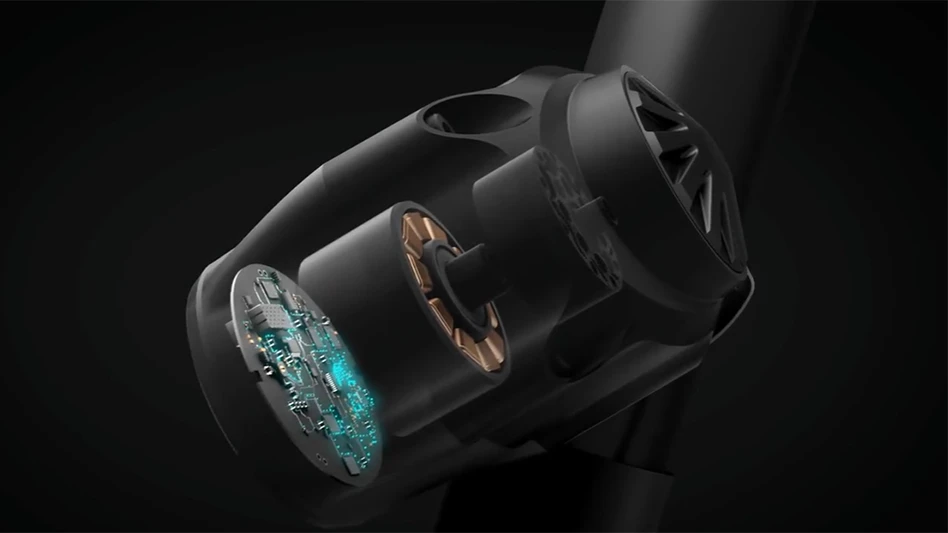
CS:ClearMotion makes the active suspension in the vehicle consisting of the actuator, which is like the damper you have today. We're taking that out and making an actuator, then we have a smart pump. This gets attached to the actuator. And all of that then gets installed into the four corners of the vehicle. And with this, you can eliminate or add movements of the chassis. To operate those four units, you have a control unit. On top is a PCB, which runs the electric motor and the hydraulics below, that’s developed and designed by us. And then through the wiring harness, it's connected to the chassis domain controller of the OEM, which has software from us, which is the embedded active master controller software. This now coordinates the four legs, because, like a horse, someone must connect the four legs and make them coordinate the movements. Say you want to jump a hurdle or something like that, it’s a function. We could say we want to overcome a certain shake or pitch or braking. That's a functionality, which resides in that software stack. So, the answer is, we do both hardware AND software.
EV D&M: ClearMotion announced you’re getting a $32 million investment and you’re also getting a production order from an EV maker for your active suspension technology. What do those two announcements mean to the future of ClearMotion?
CS: First of all, active suspension has been developed in different schemes one way or the other before. But the way we're doing it, we're highly integrated into the suspension area in the corner of the vehicle. So therefore, the integration of the system is way easier. That’s a completely new approach. This enables us to scale the business to higher volumes, to general vehicles, so the vehicle doesn't have to adapt to the active suspension, it fits into existing vehicles. With that new approach it was important for us that an OEM would sign up to do this and see the true value of our system because we're improving comfort, improving performance by adding safety, and we're doing entertainment functionalities. If you're parked and you want to watch a movie, we can move the vehicle according to the movie. That becomes a really cool feature, especially with electric mobility, people spending more and more time at the charging station and wanting something to do. So, you sit there, wait, now you watch the movie, and you could have the 4D experience. We expand this user experience and make a car more than just the A to B device, we make it more like a smartphone, it becomes an entertainment feature. This is a pretty broad concept for a product range and traditional OEMs really don't look that way normally. We needed to have an entrepreneurial view, this user experience point of view, to look into the future of how users will use a mobility device. And therefore, going into production in 2024 is very important. That answers the question of what we’ll be doing with the money we’ve raised. We’re on track right now to open a facility where we manufacture this product. We actually refurbished a facility; we're putting in production equipment right now and putting further testing capabilities into the facility. We've reached a certain pivot point within our product development so we feel comfortable and confident that we can go out there and go to others and say, 'I think we have something really cool in our head, you better look at it.'
EV D&M: Where do you see the autonomous vehicle market headed in the next 20 years?
CS: That's a pretty big crystal ball out there right now. It's not only about moving from ICE (internal combustion) engine to EV, we see growth of vehicle manufacturing, we're going to hit north of 100 million any day. This isn't going to be sustainable; we're probably going to move away from individual mobility to have a shared mobility because, otherwise, it's just not affordable long term. And as this comes, autonomous driving is going to be inevitable. It's going to be very important to have that feature available. So, if you go down 20 years, you're going to have cells moving around all the time that are completely autonomous at that moment. The question is always what’s the breakpoint. With electrification, at least in Europe, I would say without theDieselgate Scandal with Volkswagen, we would still be at a very low adoption rate on electrification. But it's sort of like a catalytic event which then propels such a situation. And then it's suddenly, 'Oh, I always told you we need to do that.' It really depends on that catalytic event whether it happens in five years, 10 years, or 15 years.
EV D&M: Any final thoughts?
CS: Today's vehicles are designed if you hold your steering wheel, you're looking out on the road, your attention is primarily focused on traffic control. As this is moving away or if you're putting yourself into the rear seat, today's suspension systems aren't designed for that new use. Especially if you're having perhaps giant displays in the rear seat or even in front of your dashboard, and you want to do a task, the motion of the vehicles won't allow that. People are thinking about driving performance and acceleration but most of us going forward will probably put the steering side of the attention span away from traffic. At that moment, the need for the technology is out there, and people will understand how a calm body will give you more relaxing driving. I think that's a key element. People will be saying, 'why didn't that come out earlier?'
Latest from EV Design & Manufacturing
- Powering homes with EV batteries could cut emissions, save thousands of dollars
- Meviy introduces stainless steel passivation option for CNC, sheet metal parts
- December Lunch + Learn webinar with Fagor Automation
- December Lunch + Learn webinar with LANG Technik + Metalcraft Automation Group
- EVIO makes public debut with hybrid-electric aircraft
- Redesigned pilot step drill triples performance
- Green Energy Origin expands battery electrolyte manufacturing in North America, Europe
- What’s next for the design and manufacturing industry in 2026?