Dassault Systèmes
If you haven’t been to a new car dealership recently, you’re in for a big surprise. Cars have gotten crazy complex. Bluetooth-enabled infotainment systems. Heads-up displays once reserved for fighter jets. Driver-assist features like automatic emergency braking, lane departure warnings, and birds-eye view cameras that display the vehicle’s top, sides, and surrounding area. There's a lot going on.
These are just a few of the convenience and safety features that car and truck buyers have come to expect over the past few years, with more on the way. This makes what was a hugely complicated undertaking, the design and mass production of passenger vehicles, even more challenging.
The average automobile contains roughly one mile of electrical wire, 30,000 or so individual components, and more than 100 million lines of computer code. A serious failure in these can mean product recalls, loss of revenue, and loss of life. Car making is serious business.
Meet the system of systems
The bad news? It’s about to get even more serious. Plug-in electric vehicles (PEVs) and self-driving cars are coming down the turnpike, and a host of supporting infrastructure such as charging stations along with smart cities and roadways which carmakers must then interface. Add an increasingly competitive marketplace, skilled labor shortages, and ever shorter development cycles, and what was once crazy complex could soon become completely chaotic.
Fortunately, there is a solution. It's called model-based system engineering (MBSE). Think of it as product lifecycle management (PLM) on steroids. But where PLM relies on the integration of disparate software applications through a series of custom interfaces, each of which attempts to make information in one system accessible to the others, MBSE relies on a single version of the truth. It’s a comprehensive platform connecting every aspect of vehicle development, the wiring, the code, and the myriad components, is based on digital models of the end product rather than individual files and data extracted from multiple software systems.
The result is greater efficiency throughout the automaking process. Designers and engineers have seamless access to the information needed to do their jobs, along with increased visibility of the product requirements and stakeholder expectations. The electrical engineers work from the same model used by the mechanical designers; the software developers understand the needs of the project management team. Development times are far shorter, costly rework and changes of design direction are eliminated, and interdisciplinary collaboration is made easier.

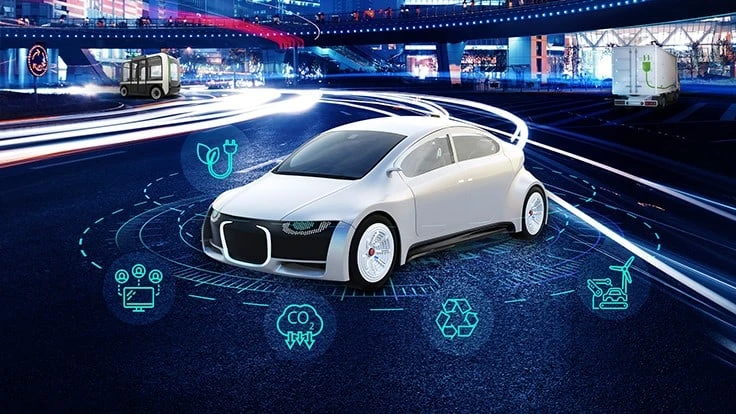
Sustainable Mobility Electric Bus: Model-based system engineering (MBSE) will play a crucial role in the centralized coordination of tomorrow's vehicles—autonomous or otherwise—as they navigate our smart cities and roadways.
The virtual twin meets the same goals in a less comprehensive manner. There’s a reason for this. Because MBSE and the virtual twin are both based on digital models of the component, assembly, or finished product, and because they go far beyond traditional 3D models by incorporating engineering, procurement, manufacturing, and lifecycle data, these two systems are like siblings spawned from the same digital parents. MBSE has a much broader, all-encompassing role.
Conquering complexity
The virtual twin is not especially new. Nor is MBSE. According to a recent NASA report, “it has been increasingly embraced by both industry and government as a means to keep track of system complexity.” Lockheed Martin “really took off” after a ten-year digital transformation that included MBSE and 3D-modeling system implementations. And ThyssenKrupp Marine Systems was able to “cut through complexity” five years after its MBSE rollout, with users enjoying “complete openness to the full knowledge of the industry.”
Automakers and their suppliers are picking up the MBSE baton. For instance, Bosch Car Multimedia, a division of Bosch Mobility Solutions, began to struggle with real-time visibility as its customers’ mobility requirements grew more complex. The company launched an MBSE proof of concept project and found access to holistic digital models promoted collaboration between departments, and teams could test and validate without physical prototypes.
These were significant gains, resulting in shorter development cycles, reduced design costs, and greatly increased worker efficiency. It also provided Bosch with full end-to-end traceability of its products, raw materials, and manufacturing processes. The company launched a model-based systems engineering approach on a far broader basis.
Stories like these will become more common as cars and trucks grow in complexity, especially PEVs and those with autonomous capabilities. The reasons are obvious. Both types of vehicles (which will eventually become one type of vehicle—the autonomous PEV) require significant advancements in electronics, including advanced sensors and power management functions.
Vehicle architectures will change as designers eliminate conventional powertrains, shift to lighter weight materials such as composites, and because the word “driver” will become as obsolete as internal combustion engines, place increased emphasis on passenger experience and comfort. In these examples, MBSE will keep costs manageable and assuring that development lead times remain competitive.
Taking it to the streets
And what about the infrastructure mentioned earlier? Here’s where MBSE will truly shine, in two respects. For automakers, it means simplified integration with and use of the broad spectrum of mobility applications, most from independent vendors, that will be needed to keep cars connected, their passengers entertained, and the surrounding roads and traffic control infrastructure apprised at all times of their speed and heading.
Now for that last part, traffic control, consider that a typical large city might have dozens or perhaps hundreds of individual departments and governing parties, each making decisions independently with only high-level coordination. Add autonomous PEVs to the mix, which utilize the mobility applications mentioned, and the situation will quickly become chaotic. The smart cities of our future will be built over years from the bottom-up, but to function as the key governing part of this very complex system of systems they need to be designed from the top down. This system architecture needs to be maintained with continual optimization. MBSE, with its fundamental ability to manage tasks, coordinate activities, and provide visibility into complex environments, will help avoid that chaos.
MBSE is the only tool enabling simultaneous consideration of product development, including functionality, cost, sustainability, and customer experience. It allows automakers and other manufacturers to optimize for the best solution in the program's early stages and maintain those benefits throughout its lifespan. Taken to the next level, MBSE will also play a crucial role in the centralized coordination of tomorrow's vehicles, autonomous or otherwise, as they navigate smart cities and roadways. The defense, aviation, and automotive industries have already selected MBSE as their tool of choice to create systems of systems. MBSE will be the “magic” that makes the mobility of our smart cities of the future a functioning, productive, safe reality. MBSE will drive a better future for all of us.
Latest from EV Design & Manufacturing
- Ford partners with Renault Group to expand European electric vehicle presence
- Analysis, trends, and forecasts for the future of additive manufacturing
- BlueForge Alliance Webinar Series Part III: Integrate Nationally, Catalyze Locally
- Wolfspeed’s silicon carbide components to power Toyota’s onboard EV charger systems
- Sunnen enhances e-commerce platform for precision honing equipment
- QuantumScape moves forward with automated battery cell pilot production line
- Dürr introduces next-generation low-pressure spray gun
- #56 Lunch + Learn Podcast with Techman Robot + AMET Inc.