Datwyler
The mobility sector is undergoing a transformation, propelled by several drivers such as new powertrain systems, a decrease in traditional combustion engines in favor of electric powertrains, the trend towards more integration of software and electronics within a vehicle, and shifts in society’s mobility behavior. Changing customer needs give manufacturers and suppliers much to consider.
Traditional and established automotive manufacturers are facing structural change and striving to keep and expand their leading role in the future supply chain. New technologies are emerging, products are becoming more complex, timelines are tightening, and quality requirements are increasing. Completely new products must be brought to market maturity within short time frames. Manufacturers are dependent on the support of competent suppliers facilitating these challenges through efficient development processes and by using a wide range of advanced engineering techniques such as virtual product development based on numerical simulation.
The goal of virtual product development is creating accurate digital representations of a system and its components and parts, creating a digital prototype of a product reflecting reality in design, material, and functional details. Its future performance under application-specific loads can be calculated realistically using numerical simulations. The manufacturing process of the different components and parts of a product can be simulated, so production-related geometric imperfections, process-related residual stresses or material inhomogeneities and anisotropies can also be realistically reproduced.
The concept of a digital prototype, can be understood in broader sense and ultimately leads to the concept of a digital twin. Although each company has its own definition, a digital twin is usually understood as a fully defined model that can simulate the entire behavior of a product. In an even broader and more modern concept, a digital twin is a model that resembles the real product and obtains its data from sensors of the real product, i.e. it also contains the interfaces between the real and the virtual world and thus also enables the integration and application of artificial intelligence. The digital twin provides valuable insights into the real performance of products and processes as well as in its control and optimization.
In this context, the use of digital prototypes, i.e. digital replicas of real products that contain all information on the design, surface finishes, manufacturing processes, material properties and occurring loads, is of outstanding importance. Such digital copies of products enable an easy exchange of information between the development partners involved and very efficient product development through joint processing, modeling and functional optimization. By working closely together with our customers at an early stage of the product development process, we can co-engineer the right solution, jointly achieve the set goals and develop functional, cost optimized solutions in a short time.
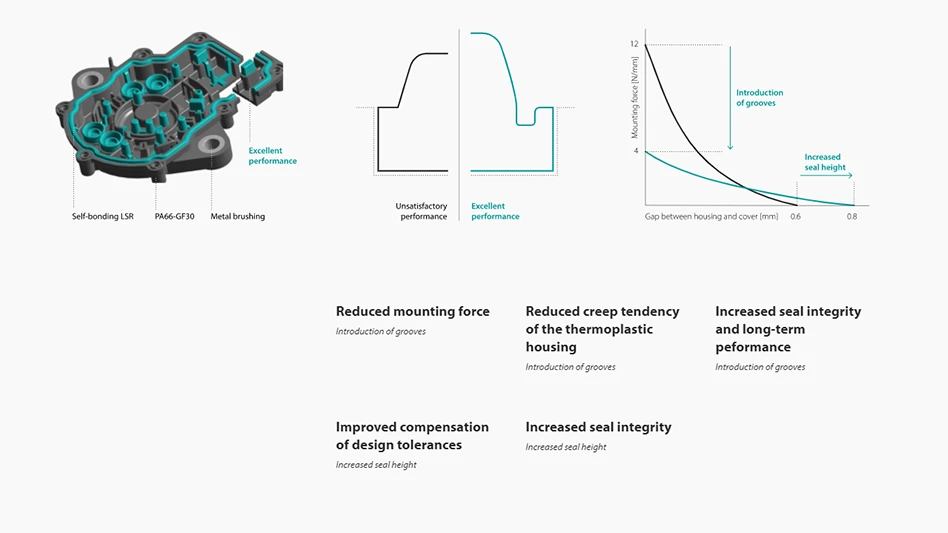
Typically, specialist suppliers have greater expertise in the specific applications than their customers and can meet the necessary requirements much better and faster. For example, if a customer provides a digital prototype of a system, assembly, or component, we as a sealing supplier can focus on a detailed solution for the specific sealing system by creating a digital prototype of the sealing area, which we then integrate into the overall design. At the same time, the customer can focus on optimizing other parts of the digital prototype. In this way, we can collaborate on adapting and optimizing the solution and manage the increasing complexity more effectively.
Newcomers to the industry often lack the necessary experience in the relevant applications and therefore need our support to develop not only suitable, but the best possible sealing solutions for their systems. They rely much more on the capabilities of us as a specialist supplier and need stronger and closer collaboration to enter and succeed in the new markets and application fields. Here, too, advanced numerical simulation via digital prototypes helps us to work closely and purposefully on the same topic.
A key element of virtual product development is proof of concept, which aims to show how systems or ideas will work in a real-world environment. A digital prototype enables early verification of its functionality and performance, as expensive or even impossible real-world tests can be performed in virtual spaces. Simulations help to disentangle complex dependencies and reduce them to a few relevant key components and processes, ultimately reducing the need for physical prototypes. Digital prototypes enable straightforward changes to the design, materials, and boundary conditions, as well as rapid iterative optimization steps, reducing the scope and effort of engineering changes and engendering a right-first-time attitude.
Other aspects include the prediction of possible failure modes and modifications to reduce failure tendency, anticipating possible processing problems and resolving them during the design of the parts and molds. Digital prototyping combined with simulation significantly reduces time-to-market, lowers development costs, improves manufacturing process efficiency, increases product quality, and enables efficient collaboration throughout the supply chain.
Material knowledge adds crucial value to overall simulation process
In the field of rubber components or, more generally, sealing components for mobility applications, a sound knowledge of the properties of the materials used and their changes during product manufacturing is crucial.
At the onset of a simulation and depending on the application, we must look at different aspects of material behavior: static or dynamic material characteristics, temperature-dependence, fluid resistance and swelling, dynamic behavior, wearing, fatigue and fracture behavior. To make all this information flow into a simulation, we must select the appropriate test methods for the decisive material properties, test our materials with the highest accuracy to ensure optimal data quality and then fit the most suitable material models to the test data to have a physical representation of the material for the simulations. We are happy to make this information available to our partners as well, because imprecise or inaccurate material models are one of the main problems that prevent simulations from being as realistic as possible.
The use of simulations is not limited to problems of product functionality and performance, also the manufacturing processes of the products can be simulated. As far as rubber processing is concerned, for molding process simulations we need not only to know the properties of uncured elastomeric materials, such as viscosity, heat capacity and thermal conductivity, but also the kinetics of the chemical crosslinking reaction (vulcanization). We perform all the necessary characterizations in-house using methods we developed ourselves. This is the only way we can ensure having the best possible data quality and the most realistic material models.
In this context, we are developing suitable lab experiments and models that allow us to transfer the results of basic material tests under simple load cases to the behavior under realistic load cases in the application. The biggest challenges for simulation continue to be fatigue behavior and product life prediction in a broad range of applications. For this reason, we see an increasing need for multi-physics simulations combining different physical phenomena and interactions (fluid-structure coupling, thermal-structure coupling etc.), simulation of embedded electronics, such as sensors, and tribological topics like fluid films acting at the interface between seals and moving counter parts.
The combination of digital prototyping with cutting-edge numerical simulations and high-end material models has enabled us to make major progress in joint product development with our customers. Now, the next step is to deploy new tools like digital twins, which represent another quantum leap in product development for us as an industry. By linking the real and virtual worlds, they enable us to use artificial intelligence to validate concepts and models for existing products and, in combination with advanced simulation techniques, to precisely engineer new products. As we move towards full automation, these approaches are becoming increasingly important, allowing for more accurate, faster, and more customized development of new products than ever before.
Latest from EV Design & Manufacturing
- Ford partners with Renault Group to expand European electric vehicle presence
- Analysis, trends, and forecasts for the future of additive manufacturing
- BlueForge Alliance Webinar Series Part III: Integrate Nationally, Catalyze Locally
- Wolfspeed’s silicon carbide components to power Toyota’s onboard EV charger systems
- Sunnen enhances e-commerce platform for precision honing equipment
- QuantumScape moves forward with automated battery cell pilot production line
- Dürr introduces next-generation low-pressure spray gun
- #56 Lunch + Learn Podcast with Techman Robot + AMET Inc.