CREDIT: HYUNDAI
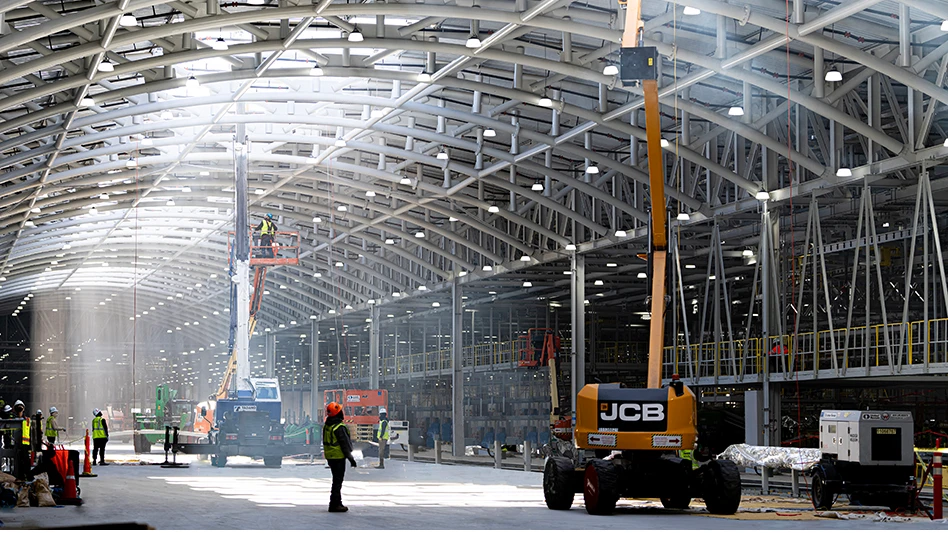
On September 4, 475 workers, including more than 300 South Koreans, were detained by U.S. Immigration and Customs Enforcement (ICE) at a Georgia electric vehicle (EV) and battery manufacturing complex operated as a joint venture between Hyundai and LG Energy Solution. It was the largest raid conducted yet by the agency, which has been descending on businesses across the United States and rounding up workers as part of the current presidential administration’s mass deportation agenda.
President Trump stated that the workers detained at the EV plant are here illegally, but Atlanta immigration attorney Charles Kuck, who represents four of the South Korean detainees, told the Associated Press that many of the workers were in the United States on B-1 business visitor visas and only planned to be in the country for a couple weeks.
According to Kuck, many of the detained South Koreans are engineers and equipment installers who were brought in for highly specialized work involving installation of machines not built by any U.S. company. Training someone in the U.S. to do this work would take three to five years, he continued, which is why it’s common practice to bring in workers from abroad for a brief period of time to get things up and running.
However, U.S. officials have claimed many of those arrested did not have proper work authorization, and investigations have shown that there’s quite a murky, gray area when it comes to how short-term work visas are often interpreted. B-1 visas, as stated by the U.S. Department of State – Bureau of Consular Affairs, allow visiting workers to “consult with business associates; attend a scientific, educational, professional, or business convention or conference; settle an estate; [or] negotiate a contract”. The definition doesn’t include manual labor, though it’s often interpreted to do so.
"It's extremely difficult to get an H-1B visa, which is needed for the battery engineers. That's why some people got B-1 visas or ESTA," Park Tae-sung, vice chairman of Korea Battery Industry Association, told Reuters.
ESTA refers to the Electronic System for Travel Authorization, which provides a visa waiver if the applicant can give a “legitimate reason” for being in the United States. Many South Korean companies have been relying on ESTA to send workers to set up their U.S.-based manufacturing facilities, and South Korea has long been calling on the United States to create a more accommodating visa system for skilled Korean workers to enter the country for short-term work.
According to The Guardian, a leaked ICE document shows at least one of the detainees was legally authorized to be in the United States. Meanwhile, the United Auto Workers union issued a statement condemning the raid as well as unsafe working conditions at Hyundai plants.
Hyundai itself has commented only minimally, saying in a statement released the day after the raid that the detainees were employed by a contractor, not directly by Hyundai.
“Hyundai is committed to full compliance with all laws and regulations in every market where we operate,” the company stated. “This includes employment verification requirements and immigration laws. We expect the same commitment from all our partners, suppliers, contractors, and subcontractors.”
Hyundai is conducting an investigation to ensure all suppliers and subcontractors are in compliance with regulations; in the meantime, North America Chief Manufacturing Officer Chris Susock will take over governance of the entire Georgia megasite.
LG Energy Solution said 47 of its employees were arrested, and has told its other workers using ESTAs to return home immediately. The company also stated that it has paused construction on the site.
The detained South Korean workers are currently set to return to South Korea, while detainees from other countries including Mexico, Guatemala, Colombia, Chile, Ecuador, and Venezuela, are still being held at detention sites.
Latest from EV Design & Manufacturing
- Powering homes with EV batteries could cut emissions, save thousands of dollars
- Meviy introduces stainless steel passivation option for CNC, sheet metal parts
- December Lunch + Learn webinar with Fagor Automation
- December Lunch + Learn webinar with LANG Technik + Metalcraft Automation Group
- EVIO makes public debut with hybrid-electric aircraft
- Redesigned pilot step drill triples performance
- Green Energy Origin expands battery electrolyte manufacturing in North America, Europe
- What’s next for the design and manufacturing industry in 2026?