CREDIT: EDGE ENERGY
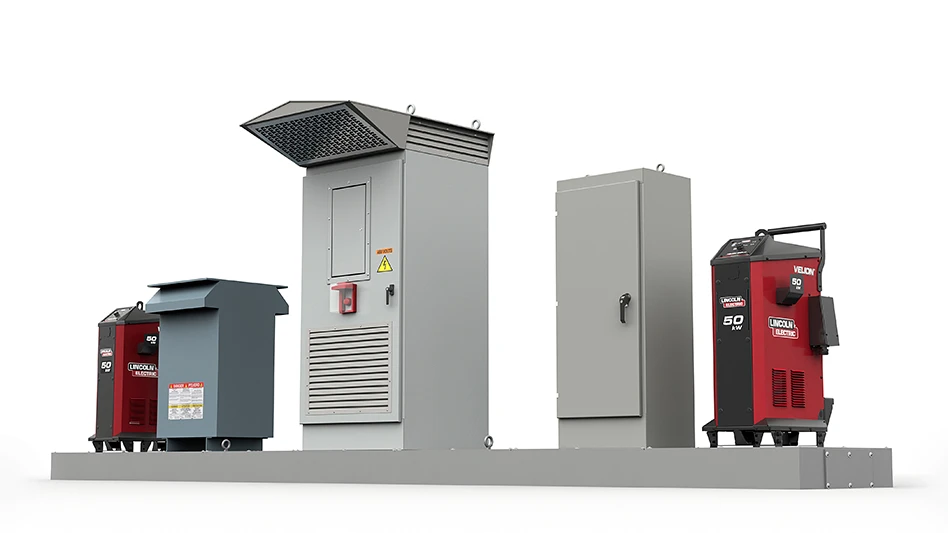
Edge Energy, developer of innovative energy solutions, announced a collaborative next-generation solution with Lincoln Electric that is designed to bring, fast reliable charging to locations that lack access to three-phase power.
Built on Edge Energy’s solid-state digital phase conversion technology, the charging platform – integrating Lincoln Electric’s Velion 50kW DC Fast Chargers with DC America’s robust electric vehicle (EV) charging platform – delivers high-performance fast charging through a single-phase connection.
Its modular design supports 100kW output, giving businesses, municipalities, and fleet operators a scalable solution as EV adoption accelerates. The charging platform allows for fast and easy installation, reducing costs and improving return on investment.
“This collaboration represents a significant step forward in our mission to accelerate the adoption of sustainable energy solutions,” says Shaun Shuler, CEO of Edge Energy. “By unlocking fast charging in places where it was previously impossible, we’re helping communities and companies embrace the EV transition with greater speed, flexibility, and efficiency.”
The single-phase 100kW collaborative charging platform offers a compact, versatile design that simplifies installation and reduces infrastructure costs. It is engineered for commercial, industrial, and public charging applications.
Deployments of the Edge Energy charging skid are expected to begin in Q4 2025, with units now available for order.
Latest from EV Design & Manufacturing
- Powering homes with EV batteries could cut emissions, save thousands of dollars
- Meviy introduces stainless steel passivation option for CNC, sheet metal parts
- December Lunch + Learn webinar with Fagor Automation
- December Lunch + Learn webinar with LANG Technik + Metalcraft Automation Group
- EVIO makes public debut with hybrid-electric aircraft
- Redesigned pilot step drill triples performance
- Green Energy Origin expands battery electrolyte manufacturing in North America, Europe
- What’s next for the design and manufacturing industry in 2026?