CREDIT: ELEVENES
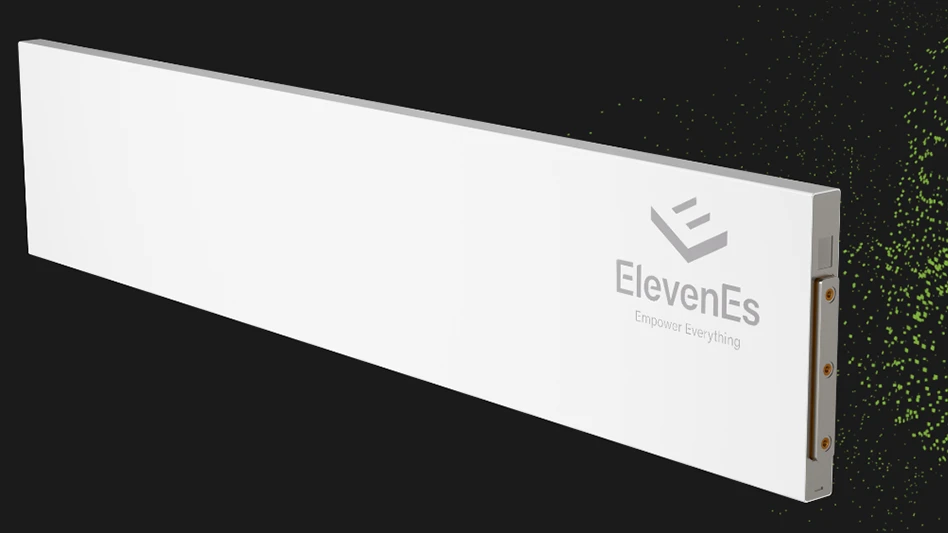
ElevenEs, a European manufacturer of lithium iron phosphate (LFP) battery technology, announced the launch of its Edge574 Blade Cell. This next-generation battery cell addresses critical industry demands and sets new standards for performance, longevity, and efficiency.
Key performance features:
- 12-minute fast charge from 10% to 80%
- 10C charging possible
- Cycle life of at least 500,000km (310,000 miles)
- From cell-to-pack to cell-to-body
- Increased energy density
The development of the Edge574 involved a critical strategic decision: the establishment of clearly defined realistic, measurable, and achievable performance targets. Overcoming unexpected complexities, ElevenEs’ commitment to these targets has solidified a disciplined approach to product development as a cornerstone of the company’s strategy.
A pack with potentially 210 cells can reach a peak charging power of 1MW. At the heart of the Edge574 Blade Cell’s innovation is its ability to deliver ultra-fast charging, from 10% to 80% in 12 minutes (at temperatures ≥ 25°C). This translates to the potential for a vehicle to gain 1.1km of driving range for every second of charging, or 66km of range in just one minute of charging.
It’s important to note that charging performance is influenced by temperature. At 10°C, the Edge574 Blade Cell can achieve an 18-minute charge time, adding 44km of range for every minute of charging, with a peak charging power of 650kW. Even at 0°C, the cell maintains a strong charging capability, providing 25km of range per minute of charging, with a peak charging power of 415kW. This robust performance across a range of temperatures demonstrates the cell’s versatility and reliability.
Beyond fast charge, the Edge574 Blade Cell is engineered for endurance. Understanding the importance of battery lifespan, ElevenEs has designed this cell to support a cycle life that translates to a range of at least 500,000km. This focus on longevity not only enhances the value proposition for consumers but also contributes to a more sustainable approach by extending the usable life of batteries.
The Edge574 Blade Cell demonstrates adaptability through its optimized design for both cell-to-pack (CTP) and cell-to-body (CTB) integration. This design flexibility maximizes space utilization within the vehicle, leading to increased energy density at the pack level and ultimately contributing to greater driving range, all while achieving impressive gravimetric and volumetric densities of 190Wh/kg and 420Wh/l at cell level.
ElevenEs’ Edge574 Blade Cell is designed for a wide operating temperature range, with discharge capabilities from -30°C to 60°C. This ensures consistent performance in diverse environmental conditions, which means that the cell maintains nominal capacity all the way up to 55°C. At -10°C, the achievable range would be 75% of its nominal capacity.
ElevenEs has achieved this performance through a series of key technological advancements, notably a significant 15% reduction in DCIR (direct current internal resistance), compared to the company’s previous-generation cell, which already had very low internal resistance. This stems from an improved mechanical design as well as the optimization of electrode materials and a new electrolyte. The cell features an enhanced design that boosts charging efficiency, enabling rapid and effective energy transfer.
The Edge574 Blade Cell also boasts optimized space utilization, delivering greater energy and capacity within a compact structure. Moreover, the use of upgraded materials enhances both the performance and safety characteristics of the cell, while new safety measures are specifically tailored to support the demands of fast charging.
The design refinements extend to the cell’s physical structure. An improved housing, featuring a thinner yet robust sheet metal design, ensures optimal durability and efficiency. Enhanced lids with larger terminals facilitate higher current delivery, crucial for fast charging. The refined dimensions of the cell, now thinner and taller, offer improved design flexibility for vehicle manufacturers.
Latest from EV Design & Manufacturing
- Powering homes with EV batteries could cut emissions, save thousands of dollars
- Meviy introduces stainless steel passivation option for CNC, sheet metal parts
- December Lunch + Learn webinar with Fagor Automation
- December Lunch + Learn webinar with LANG Technik + Metalcraft Automation Group
- EVIO makes public debut with hybrid-electric aircraft
- Redesigned pilot step drill triples performance
- Green Energy Origin expands battery electrolyte manufacturing in North America, Europe
- What’s next for the design and manufacturing industry in 2026?