CREDIT: FORD MOTOR COMPANY
Ford Motor Company has announced plans to bring a new family of affordable, high-quality electric vehicles (EVs) within reach for millions around the world. The new Ford Universal EV Platform and Ford Universal EV Production System introduced Monday were born from a team that combines the discipline, expertise, and scale of a company with 122 years of experience with the speed, innovation, and first-principles thinking of a California-based electric vehicle hardware and software skunkworks team.
The result: a simple, efficient, flexible ecosystem to deliver a family of affordable, electric, software-defined vehicles – the first of which is a midsize, four-door electric pickup that will be assembled at Ford’s Louisville Assembly Plant for U.S. and export markets. Its launch is scheduled for 2027.
“We took a radical approach to a very hard challenge: Create affordable vehicles that delight customers in every way that matters – design, innovation, flexibility, space, driving pleasure, and cost of ownership – and do it with American workers,” says Ford president and CEO Jim Farley.
“We have all lived through far too many ‘good college tries’ by Detroit automakers to make affordable vehicles that end up with idled plants, layoffs, and uncertainty. So, this had to be a strong, sustainable, and profitable business. From Day 1, we knew there was no incremental path to success. We empowered a tiny skunkworks team three time zones away from Detroit. We tore up the moving assembly line concept and designed a better one. And we found a path to be the first automaker to make prismatic LFP batteries in the U.S.”
The Ford Universal EV Platform
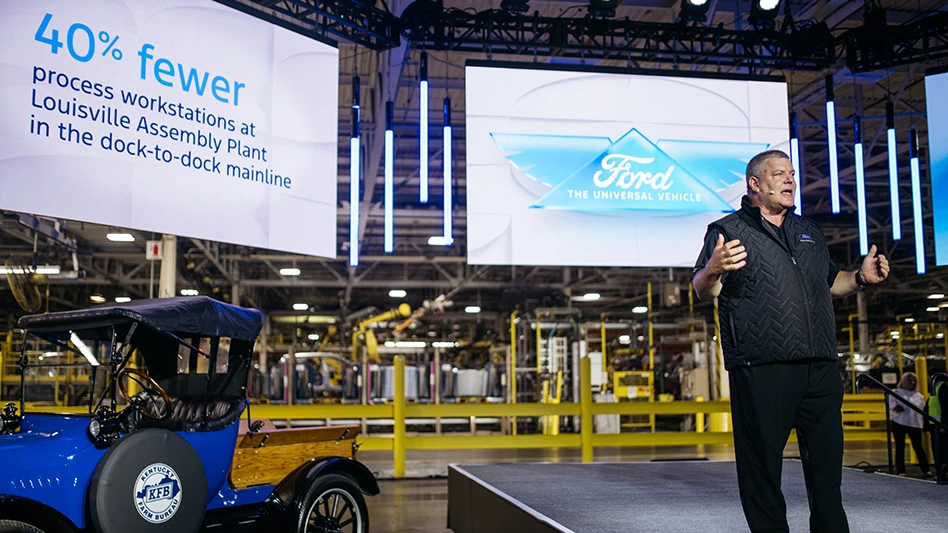
The numbers tell the story, Farley says. The platform reduces parts by 20% versus a typical vehicle, with 25% fewer fasteners, 40% fewer workstations dock-to-dock in the plant and 15% faster assembly time. Lower cost of ownership over five years than a three-year-old used Tesla Model Y.
Take for instance the wiring harness in the new midsize truck; it will be more than 4,000ft (1.3km) shorter and 10kg lighter than the one used in Ford’s first-gen electric SUV.
Lithium iron phosphate (LFP) prismatic batteries also enable space and weight savings, while delivering cost reduction and durability for customers. The platform’s cobalt-free and nickel-free LFP battery pack is a structural sub-assembly that also serves as the vehicle’s floor. This low center of gravity improves handling, creates a quiet cabin, and provides a surprising amount of interior space. The midsize truck will have a targeted 0-60 time as fast as a Mustang EcoBoost, with more downforce.
“We took inspiration from the Model T – the universal car that changed the world,” says Doug Field, Ford chief EV, digital and design officer. “We assembled a really brilliant collection of minds across Ford and unleashed them to find new solutions to old problems. We applied first‑principles engineering, pushing to the limits of physics to make it fun to drive and compete on affordability. Our new zonal electric architecture unlocks capabilities the industry has never seen. This isn’t a stripped‑down, old‑school vehicle.”
Additional specifications for the midsize electric truck – including reveal date, starting price, EPA-estimated battery range, battery sizes and charge times – will be communicated later.
The Ford Universal EV Production System
The Ford team obsessed about efficiency in manufacturing, too, transforming the traditional assembly line into an “assembly tree”. Instead of one long conveyor, three sub-assemblies run down their own lines simultaneously and then join together.
Large single-piece aluminum unicastings replace dozens of smaller parts, enabling the front and rear of the vehicle to be assembled separately.
The front and rear are then combined with the third sub-assembly, the structural battery, which is independently assembled with seats, consoles, and carpeting, to form the vehicle.
Parts travel down the assembly tree to operators in a kit. Within that kit, all fasteners, scanners, and power tools required for the job are included – and in the correct orientation for use.
The Ford Universal EV Production System improves ergonomics for employees by reducing twisting, reaching, and bending, allowing them to focus on the job at hand.
Because of the integration between the Ford Universal EV Production System and Platform, assembly of the midsize electric truck could be up to 40% faster than Louisville Assembly Plant’s current vehicles. Some of that time will be reinvested into insourcing and automation to improve quality and cost, ultimately netting a 15% speed improvement.
“We put our employees at the center and re-created the factory from scratch,” says Bryce Currie, Ford vice president, Americas Manufacturing. “We live and breathe continuous improvement, but sometimes you need a dramatic leap forward. We expect ergonomic breakthroughs and complexity reduction – through elimination of parts, connectors, and wire – will flow through to significant quality and cost wins.”
Continued investment in American manufacturing
Ford builds on its strong legacy of investing in U.S. vehicle assembly, planning to invest nearly $2 billion in Louisville Assembly Plant to assemble the midsize electric truck, securing 2,200 hourly jobs.
The project is supported by an incentive offer from the Kentucky Economic Development Finance Authority.
“Today, Ford and Team Kentucky are introducing the world to the future of automotive production with nearly $2 billion being invested to transform the Louisville Assembly Plant, which will also secure 2,200 jobs for Kentuckians,” says Kentucky Gov. Andy Beshear. “This announcement not only represents one of the largest investments on record in our state, it also boosts Kentucky’s position at the center of EV-related innovation and solidifies Louisville Assembly Plant as an important part of Ford’s future. Thanks to Ford’s leaders for their continued faith in Kentucky and our incredible workforce. Ford and Kentucky have been a tremendous team for more than 100 years, and that partnership has never been stronger than it is today.”
Louisville Assembly Plant will expand by 52,000ft2 in order to move material more efficiently. Digital infrastructure upgrades will give Louisville Assembly Plant the fastest network with the most access points out of any Ford plant globally, enabling more quality scans.
Ford’s investment in Louisville Assembly Plant is in addition to its previously announced $3 billion investment in BlueOval Battery Park Michigan, which will build the prismatic LFP batteries for the midsize electric truck starting next year. Together, the investments total approximately $5 billion, and between the two plants, Ford expects to create or secure nearly 4,000 direct jobs while strengthening the domestic supply chain with dozens of new U.S.-based suppliers.
Latest from EV Design & Manufacturing
- Powering homes with EV batteries could cut emissions, save thousands of dollars
- Meviy introduces stainless steel passivation option for CNC, sheet metal parts
- December Lunch + Learn webinar with Fagor Automation
- December Lunch + Learn webinar with LANG Technik + Metalcraft Automation Group
- EVIO makes public debut with hybrid-electric aircraft
- Redesigned pilot step drill triples performance
- Green Energy Origin expands battery electrolyte manufacturing in North America, Europe
- What’s next for the design and manufacturing industry in 2026?