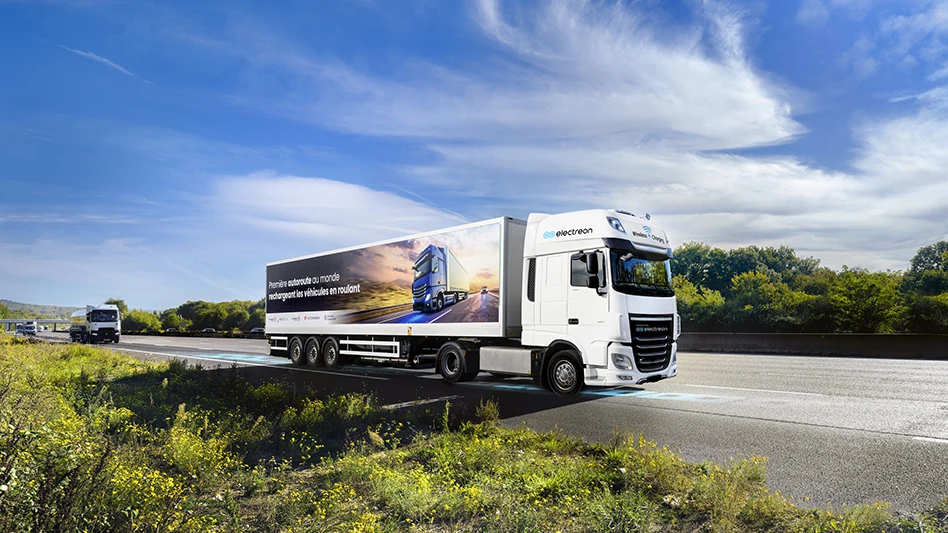
CREDIT: VINCI AUTOROUTES/CAROLINE GASCH
On the A10 motorway, around 40km southwest of Paris, a consortium led by VINCI Autoroutes in collaboration with Electreon, VINCI Construction, Gustave Eiffel University, and Hutchinson, has launched the Charge as you drive project – the first in the world to implement a dynamic induction charging system on a motorway in live traffic. The system enables electric heavy-duty vehicles – and any electric vehicle (EV) equipped with receivers – to recharge directly from the road while driving.
At scale, this solution could significantly reduce vehicle battery size, which would improve the overall performance of heavy electric mobility in several ways. Vehicles would become less expensive, lighter, and more energy-efficient, with greater carrying capacity, and no downtime for charging. The environmental benefits would also be substantial, with lower raw-material needs and a smaller carbon footprint from battery manufacturing.
Following laboratory tests to prequalify materials and mechanical durability trials on a closed site, induction coils were installed over 1.5km of roadway on the A10. The project is now entering a new phase, with prototype vehicles – including a heavy-duty truck, a utility vehicle, a passenger car, and a bus – driving on the motorway under real traffic conditions.
Real-world tests confirm the promise of dynamic induction charging
Winner in 2023 of a Bpifrance call for projects, the dynamic charging pilot for electric vehicles is now entering its operational deployment phase: the four vehicles equipped with receiver coils are driving on the A10 section to test and evaluate the charging capacity of this Electric Road System (ERS).
Three laboratories from Gustave Eiffel University conducted on-site test campaigns under real traffic conditions. Their initial analysis of the collected data is already promising: the installed inductive system can safely deliver peak power above 300kW and average power above 200kW under optimal steady-state conditions.
"The initial results of the ongoing trials on a section of the A10 motorway confirm the findings of previous studies. Deploying this technology on France's main road networks, in addition to charging stations, will further accelerate the electrification of heavy-vehicle fleets – and thereby reduce greenhouse gas emissions from the freight and logistics sector, which alone accounts for more than 16% of the country's total emissions," says Nicolas Notebaert, chief executive officer of VINCI Concessions and president of VINCI Autoroutes.
"This is a pivotal moment in the global development of electric roads," says Oren Ezer, Electreon's CEO. "The system's outstanding performance, demonstrated through the project and verified by independent laboratories in France, shows that our technology is the only one capable of delivering dynamic vehicle charging with such power and reliability – without any competitors able to match its standard. Electreon's technology meets, and even exceeds, all the requirements set by the French government. I believe these results pave the way for the deployment of thousands of kilometers of wireless road using our technology in France, and later across Europe."
Real-world driving on the A10 follows extensive testing and validation
These road trials build on nearly two years of work by the consortium, which began in September 2023, to verify all operational and safety requirements before installing the inductive system on the A10.
Several stages made it possible to progress toward driving under real traffic conditions:
- Material testing: Numerous tests were conducted at VINCI Construction's Road Research Center in Mérignac to identify materials suitable for the experiment. Mechanical tests were performed on the components of the inductive system and their interfaces with the pavement layers to prequalify the most suitable materials for deployment on the A10.
- Full-scale trials were then conducted on a closed site at the LAMES laboratory of the Materials and Structures Department (MAST) at Gustave Eiffel University in Bouguenais (Loire–Atlantique). Using traffic simulators (the fatigue carousel and the FABAC machine) capable of reproducing in a few weeks the equivalent of at least 25 years of heavy-truck traffic, the consortium confirmed the absence of premature wear on pavement sections equipped with inductive systems. Once the necessary mechanical and safety conditions were met, regulatory and ministerial authorizations for motorway deployment were granted, and installation on the A10 was completed.
In parallel, at the request of VINCI Autoroutes, French consulting firm Carbone 4 carried out a study of the environmental benefits of dynamic charging in the form of a lifecycle analysis of the carbon and material footprints of vehicles and infrastructure. This study confirms the strong potential of ERS in terms of carbon-emission savings and raw-material requirements.
The prototype vehicles used for the trials can now drive on the equipped section while blending seamlessly with everyday traffic on this stretch of the A10.
Electric road: a mature technology to decarbonize transport and logistics
The transport sector accounts for one-third of France's greenhouse gas emissions, 95% of which come from road mobility. With almost 90% of goods transported by road, and, according to France's projections in the National Low-Carbon Strategy, this share is expected to remain dominant in the coming decades – despite growth in rail freight and more efficient logistics. Therefore, decarbonizing heavy road transport through electrification has become a critical priority.
Current solutions rely on multi-tonne batteries and ultra-high-power charging stations up to 1MW to ensure sufficient range (so that truck drivers can recharge during their journeys).
The initial results of the A10 project demonstrate that dynamic wireless charging is one of the most promising solutions to accelerate decarbonization of road freight transport, corroborating the study published by the Ministry of Transport in 2021. Electric Road Systems (ERS) can substantially reduce the size of batteries in electric heavy trucks, limiting costs and dependence on raw materials, as well as the CO₂ emissions associated with battery manufacturing.
At scale, the system under trial would significantly cut CO₂ emissions from road freight transport compared with both diesel use and with heavy trucks using oversized batteries that depend on stationary charging.
Dynamic wireless charging is also the subject of pilots and demonstrators in the U.S., China, South Korea, Germany, Italy, Sweden, Norway, and Israel, and is reaching industrial maturity. Its deployment on a motorway – for the first time in the world – marks an essential new step toward future developments.
The technology is particularly promising for economic and industrial sovereignty, with the potential to reduce Europe's dependence on imported batteries and raw materials, while creating skilled jobs and fostering regional manufacturing in Europe of ERS components.
Latest from EV Design & Manufacturing
- Powering homes with EV batteries could cut emissions, save thousands of dollars
- Meviy introduces stainless steel passivation option for CNC, sheet metal parts
- December Lunch + Learn webinar with Fagor Automation
- December Lunch + Learn webinar with LANG Technik + Metalcraft Automation Group
- EVIO makes public debut with hybrid-electric aircraft
- Redesigned pilot step drill triples performance
- Green Energy Origin expands battery electrolyte manufacturing in North America, Europe
- What’s next for the design and manufacturing industry in 2026?