American Honda Motor Company
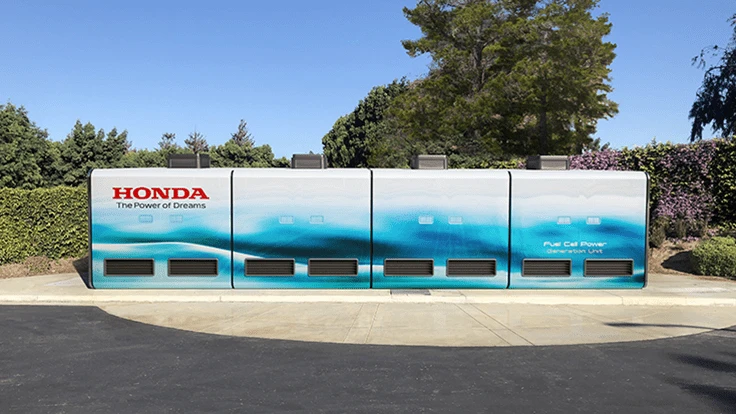
Honda plans to install a stationary fuel cell power station on its corporate campus in Torrance, Calif. by early 2023. The station will serve as a proof of concept for the future commercialization of a power generation unit for use as a zero-emission backup power source for facilities such as data centers, which require reliable and clean auxiliary power generation to continue operations even in emergency situations. This new initiative will leverage Honda's fuel cell technology expertise as part of the company's global goal to achieve carbon neutrality for all products and corporate activities by 2050.
Honda's proof of concept fuel cell power station will utilize fuel cell components from Honda Clarity Fuel Cell vehicles in a flexible, four-quad parallel stationary fuel cell power generation system capable of generating up to 1152kW-DC/1MW-AC from an inverter. A unique advantage of the four-quad design is the flexibility to change the layout of the four individual fuel cell units to suit the installation environment, accommodating a cuboid, L-shape, Z shape or other packaging requirements.
The station will be connected to the data center on the American Honda campus in early 2023, providing a real-world power generation application to verify performance. This will enable Honda to advance its know-how in the power supply area, as well as supply chain development, grid connection access, construction specifications, AC/DC connection requirements and other critical areas.
"We will leverage the expertise Honda has established in creating multiple generations of fuel cell systems for the development of a fuel cell power generation station," said Mitsuru Kariya, senior vice president in charge of the R&D Business Unit of American Honda. "This project is an opportunity to further utilize our strengths in fuel cell technology to more quickly create, assess, and advance a clean power generation system for potential commercial customers."
While Honda remains committed to developing fuel cell systems for passenger vehicles, the market for fuel cell systems to power larger trucks and transport ships, as well as stationary generation, is expanding rapidly in the U.S. and is expected to grow to over $86.7 billion annually by 2030. Data centers require high-quality and reliable power, where any disruption in power supply can lead to downtime or problems such as data corruption and damage to servers.
Typical stationary backup generators rely on diesel fuel, which result in higher carbon emissions and local air pollutants. Backup power systems utilizing hydrogen fuel cells offer a promising future for clean, yet reliable and high-quality power generation, especially when operating on so-called "green" hydrogen made from renewable sources, with water vapor as the only emission.
Latest from EV Design & Manufacturing
- Powering homes with EV batteries could cut emissions, save thousands of dollars
- Meviy introduces stainless steel passivation option for CNC, sheet metal parts
- December Lunch + Learn webinar with Fagor Automation
- December Lunch + Learn webinar with LANG Technik + Metalcraft Automation Group
- EVIO makes public debut with hybrid-electric aircraft
- Redesigned pilot step drill triples performance
- Green Energy Origin expands battery electrolyte manufacturing in North America, Europe
- What’s next for the design and manufacturing industry in 2026?