
AdobeStock | 291487348
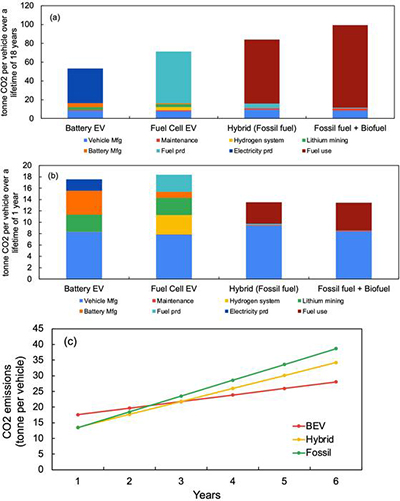
After two years of use, lithium-ion battery electric vehicles (BEVs) result in a reduction in cumulative carbon dioxide (CO₂) emissions compared to fossil-based internal combustion engine (ICE) vehicles, according to a new study published in the open-access journal PLOS Climate by Pankaj Sadavarte of Duke University and colleagues.
The transportation sector accounts for 28% of U.S. greenhouse gas emissions and growing consensus supports electric vehicle adoption to address climate and air quality challenges. However, ongoing debate surrounds whether lithium-ion batteries are truly cleaner when considering their complete manufacturing and operational lifecycle.
In the new study, researchers used the Global Change Analysis Model (GCAM) integrated assessment model to evaluate CO₂ and air pollutant emissions across four scenarios of increasing electric vehicle adoption in the United States through 2050. The analysis included emissions from fuel production, battery manufacturing, vehicle assembly, and operation for both electric and gasoline vehicles.
The study concluded that during the first two years of operation, electric vehicles produce 30% higher CO₂ emissions than gasoline vehicles when all lifecycle factors are considered. The higher initial emissions stem from energy-intensive lithium mining and battery manufacturing processes. However, after the second year of on-road use, electric vehicles begin reducing cumulative emissions compared to gasoline alternatives. Moreover, as battery output increases over time, each additional kWh of lithium-ion battery output leads to an average reduction of 220kg of CO₂ in 2030 and 127kg of CO₂ in 2050. Accounting for both air pollution and climate change impacts, the economic value of environmental damage from ICE vehicles over their lifetime currently ranges from 2x to 3.5x that of BEVs.
Co-author Dr. Drew Shindell summarizes: “Internal combustion vehicles lead to about 2-3 times more damage than EVs when considering both climate and air quality.”
The authors point out that several assumptions were made regarding the mileage of the passenger car, life of a vehicle, and average battery size of the passenger car in the U.S. Moreover, the study did not consider the associated emissions due to infrastructure required to meet the increasing demand for electric charging. However, they conclude that relative benefits of BEVs are expected to increase over coming decades as electricity generation becomes cleaner through reduced fossil fuel use.
Lead author Dr. Pankaj Sadavarte adds: “Our research shows that transitioning from fossil fuel vehicles to battery electric vehicles (BEVs) can significantly improve climate and air quality over time. While BEVs initially have higher lifecycle emissions due to extraction and battery production, our analysis using the Global Change Analysis Model demonstrates that they quickly outperform internal combustion vehicles – cutting carbon dioxide emissions and reducing harmful air pollutants. As the U.S. electricity grid becomes cleaner, the economic and environmental advantages of BEVs will only grow stronger.”