CREDIT: SHERWIN-WILLIAMS

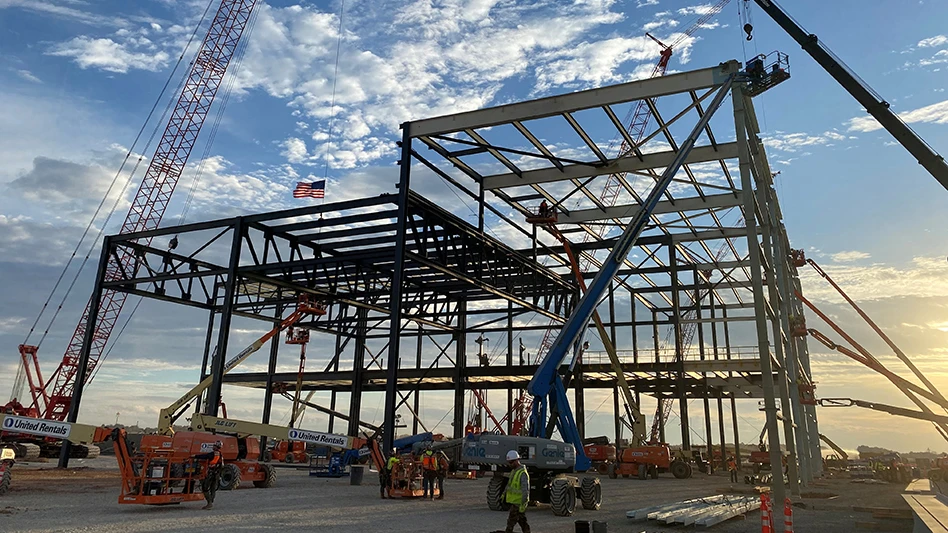
For OEMs and their construction teams, designing and building the next generation of electric vehicle (EV) battery facilities isn’t just about speed, it’s about building smarter, more efficient operations that can deliver the performance the market now demands. In a recent survey of close to 200 construction professionals, 87% noted experiencing construction delays on one or more of their construction projects. To succeed in 2025 and beyond, construction leaders need to embrace new strategies and rethink the materials that make up the backbone of their facilities.
Coatings: A functional piece of the facility
EV battery manufacturing plants can’t be treated like traditional industrial sites. These are highly controlled, precision-driven environments where every material choice matters – and coatings play a much bigger role than many realize.
High-performance coatings aren’t just a protective layer applied at the end of a project. They’re a functional part of the facility itself, directly impacting how the facility performs day to day. Whether it’s providing critical chemical resistance, enabling electro-static discharge protection in sensitive cleanroom areas, or delivering fire resistance that keeps employees and equipment safe, coatings help ensure the facility operates smoothly, efficiently, and without costly downtime.
The growing adoption of shop-applied coatings, especially shop-applied fireproofing, is a perfect example. By moving coatings application off-site into controlled environments, project teams speed up construction timelines (sometimes by as much as 33%), improve quality control, and eliminate many of the weather and site risks that can derail the construction schedule.
Three strategies for staying competitive
- Leverage offsite manufacturing efficiencies
Offsite and modular construction methods are now proven strategies that many companies are leaning into. By shifting key steps, like coating steel, to a controlled shop environment, teams can reduce errors, avoid weather delays, and keep projects on track. The survey indicated that 84% of respondents, many responsible for EV facility construction, would consider using shop-applied fireproofing if it could reduce the project timeline by 10 weeks. In an industry where speed to production is everything, those time savings are an important competitive edge.
- Engage expert partners early
The most successful projects are those where EV facility owners bring in the right expert partners early, especially when it comes to coatings and material selection. Early collaboration allows you to spot potential roadblocks before they turn into delays, optimize procurement, and build a realistic schedule that gets you to market faster.
- Integrate sustainability from the ground up
Sustainability is now an expectation throughout the industry. In the same survey, 85% of respondents listed ‘Environmental and/or Regulatory Compliance’ as extremely important or important. Facility owners who incorporate sustainable practices, like selecting low-VOC coatings or materials that support LEED certification, don’t just meet regulatory demands; they position themselves as future-focused leaders in the EV space. The key is working with partners who know how to balance sustainability with performance and speed.
Smarter construction starts with smarter materials
At the end of the day, coatings help protect more than just surfaces, they help protect your schedule, your budget, and your reputation. With solutions designed for the unique demands of EV battery manufacturing, Sherwin-Williams partners with owners and contractors to deliver smarter, safer, and faster projects.
In today’s market, where quality, speed, and sustainability are non-negotiable, having the right materials, and the right team behind them, makes all the difference.

About the author: Jacob Allard is a construction executive for Sherwin-Williams Construction Solutions. He has been with Sherwin-Williams since 2008 and currently helps automotive manufacturers build safer, faster, simpler electric vehicle battery cell plants. He has provided his industry expertise to help with the build of 13 EV battery factories since 2019. He spoke at the Advancing Integrated Project Delivery Summit in 2022 and the Advanced Manufacturing Facility Conference in 2023 to share insights about EV plant construction with other industry leaders. He can be reached at Jacob.D.Allard@sherwin.com.
Latest from EV Design & Manufacturing
- Ford partners with Renault Group to expand European electric vehicle presence
- Analysis, trends, and forecasts for the future of additive manufacturing
- BlueForge Alliance Webinar Series Part III: Integrate Nationally, Catalyze Locally
- Wolfspeed’s silicon carbide components to power Toyota’s onboard EV charger systems
- Sunnen enhances e-commerce platform for precision honing equipment
- QuantumScape moves forward with automated battery cell pilot production line
- Dürr introduces next-generation low-pressure spray gun
- #56 Lunch + Learn Podcast with Techman Robot + AMET Inc.