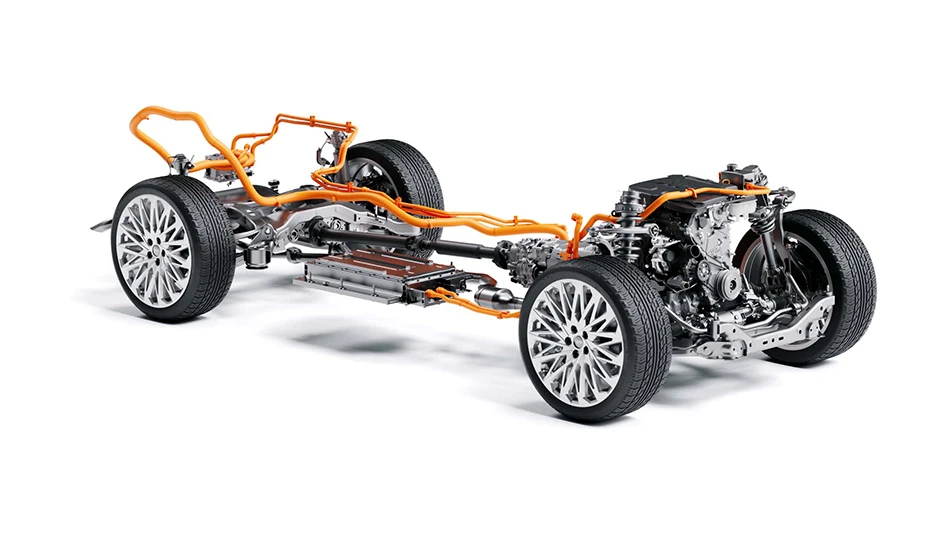
Hyundai Motor Group (the Group) has unveiled its next-generation hybrid powertrain system with which it plans to offer a range of new products within the hybrid vehicle segment.
The system features a new transmission with two integrated motors that can be paired flexibly with a range of internal combustion engines, allowing for optimized performance and fuel efficiency across a range of vehicle classes. Additionally, various electrification-focused technologies have been incorporated into the hybrid system to enhance driving performance, refinement, and ride comfort.
“We have developed an innovative new hybrid system that integrates our long-accumulated engine, transmission, and hybrid system development experience with the electrification technology applied to our world-class electric vehicles,” says Dong Hee Han, executive vice president and head of Electrified Propulsion Test Center, Hyundai Motor Group. “We will continue to develop innovative technologies that actively utilize electrification capabilities during the transition to EVs, providing customers with eco-friendly vehicles that offer superior performance.”
Enhanced performance, efficiency, and packaging
The newly developed transmission includes a new P1 motor that handles starting, battery energy generation, and energy deployment to assist propulsion. The transmission’s P2 driving motor is responsible for propulsion and regenerative braking. This integrated dual-motor setup improves power, performance, and fuel efficiency while achieving smooth shifting and reduced noise and vibration for a more refined driving experience.
The transmission can be paired flexibly with internal combustion engines across the Group’s lineup, delivering a system output from the low-100 PS range to the mid-300 PS region, allowing for broad application from sub-compact to large vehicles.
The hybrid system also integrates convenience features commonly found in the Group’s electric vehicles (EVs), such as Stay Mode, Vehicle-to-Load (V2L) functionality, and Smart Regenerative Braking.
Improved engine design, advanced compression and injection strategies increase efficiency
The first powertrain to use the next-generation hybrid system uses a newly developed gasoline 2.5-liter turbo hybrid unit, enhancing the design and control technology of the existing 2.5 turbo gasoline engine to maximize efficiency. A new gasoline 1.6-liter turbo hybrid powertrain will also be available.
By reassigning the 2.5 engine’s starting and generating tasks to the newly added P1 motor, the turbo hybrid powertrain minimizes power losses. Combined with enhanced cylinder flow within the engine and the adoption of a high-efficiency cycle optimized for hybrids, fuel efficiency has been improved.
Typically, internal combustion engines generate power through four strokes: intake, compression, combustion, and exhaust. The 2.5 turbo hybrid system utilizes an over-expansion cycle, intentionally delaying intake valve closure during compression to lower the effective compression ratio of the mixed gas in the cylinder while maintaining a high expansion ratio during the combustion process.
This technique reduces power consumption during mixture compression while maximizing energy generated after combustion, significantly enhancing engine efficiency.
Additionally, an improved piston design and a significantly expanded triple fuel injection range enhances combustion speed, stabilizes combustion, and suppresses detonation, improving engine efficiency further still.
Transmission and engine enhancements improve fuel efficiency and driving experience
Focusing on the P1+P2 parallel structure and combustion engine improvements, fuel efficiency and power performance have been enhanced while achieving smoother shifting and improved powertrain refinement.
By connecting the P1 motor directly to the engine, the system reduces engine start time. Precise control of engine load and the driving force of the P1 and P2 motors ensure that the engine operates within a high-efficiency range.
The gasoline 2.5 turbo hybrid system used in the all-new Palisade delivers maximum fuel efficiency of 14.1km/l, a maximum system output of 334 PS, and maximum torque of 460 Nm, offering approximately 45% greater fuel efficiency, 19% more maximum power, and a 9% improvement in maximum torque compared with a 2.5 turbo gasoline model.
The next-generation gasoline 1.6 turbo hybrid improves fuel efficiency by more than 4% in a mid-size SUV compared with previous models, increasing the system’s maximum rated torque output from 367 Nm to 380 Nm and improving acceleration response.
Additionally, by incorporating the P1 motor into the Active Shift Control (ASC) hybrid transmission logic, the system achieves faster and smoother shifting performance than before. Enhanced control of the engine clutch further reduces time taken for the engine to engage when switching from EV mode. The P1 motor is also utilized to reduce engine vibration and booming during battery charging situations while idle.
Electrification technologies enhance hybrid driving performance
Alongside the next-generation hybrid powertrain, the Group will integrate advanced electrification technologies to enhance performance, efficiency, and competitiveness in its new hybrid vehicles.
- Electric All-Wheel Drive (e-AWD) adds a P4 driving motor to the rear axle on vehicles equipped with this technology, enhancing driving performance and acceleration response. The Group plans to offer both e-AWD and conventional mechanical AWD, offering the optimal all-wheel-drive configuration according to vehicle class and regional market requirements.
- Electrification-Vehicle Motion Control (e-VMC 2.0) is available on hybrid vehicles fitted with e-AWD, enhancing driving stability and ride comfort through independent torque control of the front and rear driving motors. It comprises e-Handling 2.0, e-EHA (Electrification-Evasive Handling Assist) 2.0, and e-Ride 2.0.
- e-Handling 2.0 enhances roll prevention during cornering by independently controlling the front and rear motors, applying motor torque in opposite directions to lower the vehicle's center of gravity. While the original e-Handling system increased driving stability and responsiveness through single motor acceleration and deceleration control, version 2.0 offers even more refined control for an improved driving experience.
- e-EHA 2.0 is an emergency steering assist technology that utilizes vehicle radar and camera sensors to detect potential frontal collisions. It refines evasive maneuvers through precise braking control of the front and rear motors during sudden steering by the driver. Particularly, after emergency steering inputs, e-EHA 2.0 assists by using the front motor for forward propulsion while braking the rear motor to lower the vehicle's center of gravity, reducing roll and improving stability.
- e-Ride 2.0 maximizes ride comfort by minimizing vertical movements during speed bump crossings. It leverages changes in the vehicle's center of gravity through opposite directional control of the front and rear motors during speed bump entry and exit to minimize pitch and bounce motions.
- Stay Mode adapts the Utility Mode of EVs for hybrid vehicles, enabling a more pleasant time inside the vehicle when stationary by utilizing the high-voltage battery. Stay Mode allows the use of all in-vehicle convenience features, including air-conditioning and multimedia without starting the engine, and can be used for up to one hour when the battery’s state of charge is between 70% and 80%.
This system also includes a ‘Stay Mode Usage Reservation’ feature. This function synchronizes with the navigation system and begins charging the high-voltage battery about 2km before reaching a user’s intended destination, targeting a battery charge level of 70% to 80% upon arrival to maximize Stay Mode usage time.
- The V2L function offers a maximum output of 3.6kW, similar to EVs, allowing users to charge and power external appliances and personal tech devices. V2L can be used continuously while the engine is running, and in Stay Mode without the engine running. In this use case, up to 50% battery capacity (from 80% to 30% SoC) can be utilized.
Other new technologies introduced in conjunction with the hybrid system include Hierarchical Predictive Control (HPC) and Smart Regenerative Braking, both enhancing fuel efficiency.
HPC optimally controls battery charge by predicting the driving route and road conditions, selecting the best driving mode (e.g. EV, hybrid, regenerative braking mode etc.) along the route for improved fuel efficiency.
Smart Regenerative Braking automatically applies optimal regenerative braking force based on navigation data and distance to other vehicles ahead, reducing brake pedal inputs and increasing battery charge through regenerative braking to further improve fuel efficiency.
The Group plans to continually refine existing technologies while developing new systems to provide an even more beneficial electrification experience for customers.
Hybrid lineup to expand from compact to large and luxury models
The Group plans to combine the new hybrid transmission with various engines across a system output from the low-100 PS range to the mid-300 PS region, introducing a diverse lineup of hybrid vehicles from compact to large and luxury classes.
With this expanded system output coverage, the hybrid powertrain lineup will increase from three models to five, with the latest 2.5 turbo hybrid powertrain making its debut in the all-new Palisade hybrid, which began mass production this month. This system will be applied to other Hyundai and Kia models in the future.
The Group plans to introduce a rear-wheel-drive 2.5 turbo hybrid system in 2026 and aims to gradually expand its hybrid technology to the Genesis luxury brand by applying this powertrain to key models over time.
For all future hybrid models, the Group plans to apply the newly unveiled hybrid system and further electrification-focused technologies, tailoring these to the characteristics of individual vehicles and classes, as well as regional market requirements.
Latest from EV Design & Manufacturing
- Powering homes with EV batteries could cut emissions, save thousands of dollars
- Meviy introduces stainless steel passivation option for CNC, sheet metal parts
- December Lunch + Learn webinar with Fagor Automation
- December Lunch + Learn webinar with LANG Technik + Metalcraft Automation Group
- EVIO makes public debut with hybrid-electric aircraft
- Redesigned pilot step drill triples performance
- Green Energy Origin expands battery electrolyte manufacturing in North America, Europe
- What’s next for the design and manufacturing industry in 2026?