CREDIT: IGUS
Vehicle-in-the-loop (VIL) tests enable automotive engineers and manufacturers to evaluate the performance of vehicle components and systems in a simulated environment without the need for real-world testing. Among their many applications, VIL tests play an important role in the development of advanced driver assistance systems (ADAS), which rely on radar, LiDAR, vision systems, and other onboard sensors to gather information about a vehicle’s surroundings and provide assistance or warnings to drivers. Examples of ADAS technologies include pedestrian detection and avoidance, automatic emergency braking, lane departure correction, blind spot detection, and other safety-related functions.
To test the electromagnetic compatibility (EMC) of vehicles with ADAS technologies, TDK RF Solutions recently designed and built a special VIL test rig. This rig includes antennas that expose vehicles to high electric fields to mimic real-world driving conditions, which involve various radio frequency (RF) signals.
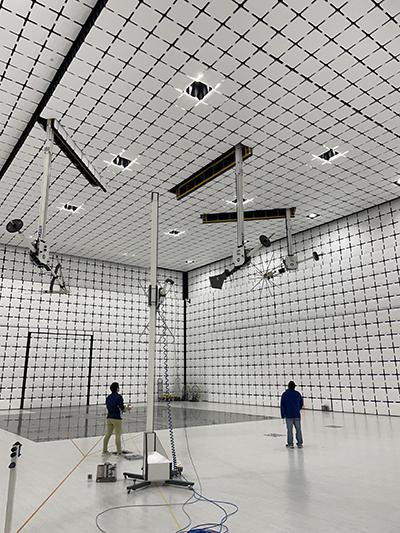
Developing this sophisticated test rig involved some engineering challenges, including how to best manage all the cables and air tubes that were fed from the ceiling down to the antenna mounts in the test chamber. Compared to alternative cable solutions, which would drive time and cost, TDK implemented an elegant cable management system composed of igus energy chains and e-spool cable carriers.
These components, which serve as an alternative to traditional cable reels and spools, were a critical part of the test rig’s design, enabling TDK to successfully deliver a solution for VIL EMC testing — and even win an award in the process.
About the VIL test rig
The testing rig included a turntable with an integrated chassis dynamometer, cooling system, and fiberoptic video monitoring system. Surrounding the testbed were antenna assemblies, which would expose the vehicle to strong electric fields. To ensure these signals wouldn’t harm the test engineers, the team enclosed the testbed in a 29 x 21 x 11m anechoic chamber.
Traditional EMC test setups often have the antennas mounted on floor masts, which are placed at varying distances from the vehicle. However, this setup would cause the vehicle’s ADAS to misinterpret the masts as roadside obstacles, causing the vehicle to prematurely brake or activate collision avoidance measures, leading to inaccurate test results. Literally turning the classic test setup on its head, TDK overcame this challenge by hanging the antenna assemblies from the ceiling, removing the sources of ADAS interference from the system’s field of view. This hanging design, however, was not without its complexities.
Each antenna assembly required 4m of linear motion along the test axis and 3m of vertical movement. Each one also had to support 30° of angular tilt and 90° of polarization at the payload. The masts upon which the antenna assemblies were mounted also had to be retractable, enabling engineers to reconfigure the chamber for other RF tests.
Cable management challenges
To protect each antenna assembly’s 5-axis motion control and rail system during the RF tests, engineers constructed an RF-shielded room in the ceiling above the testing chamber. They also designed each antenna mast to retract up and rotate into the ceiling, after which an automated hatch would close behind it.
A big challenge that emerged during the test rig’s design process involved managing the cables for the antenna assemblies — specifically, how to feed all the 10m cables and compressed air hoses from the shielded room above the chamber down to the antenna assemblies in a safe, controlled, and reliable manner.
Initially, TDK considered manually feeding the cables, however this method would prove to be too inefficient, time-consuming, and labor-intensive. Another option involved placing the cables and air tubes into a cable chain on a spool and then synchronizing multiple motors to feed the cable chain —a method that would drive significant development time.
igus to the rescue
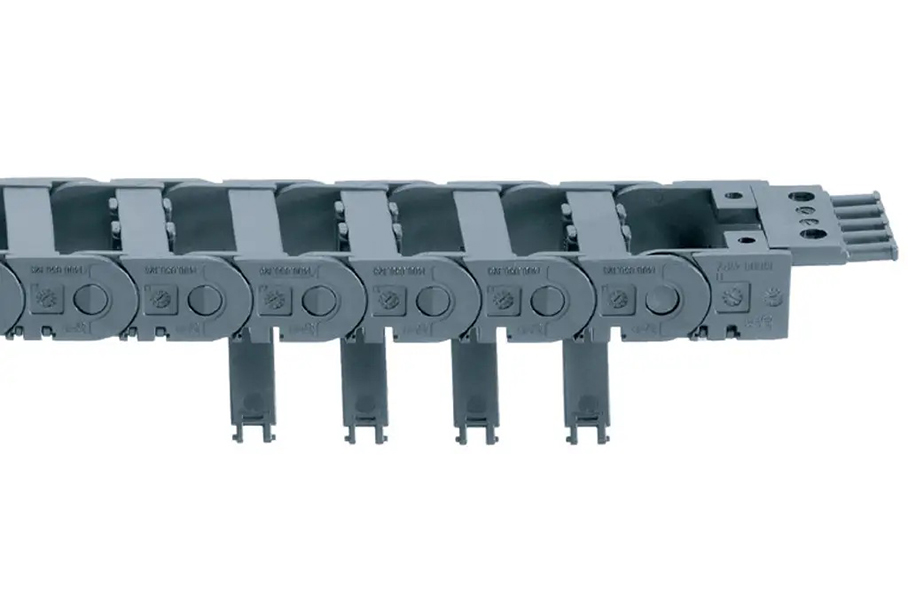
To successfully guide the control cables and compressed air hoses along the test system’s five axes, TDK implemented igus 1400 series e-chains, which were wound into spring cable reels from the igus e-spool series. Thanks to its spring-loaded activation, the e-spool cable carrier eliminated the complex and time-consuming need to synchronize various motors. At the same time, its unique “twisterband” feature enabled engineers to easily pass the cables and tubes through the spool without a slip ring, unlocking cost savings and avoiding a source of maintenance issues.
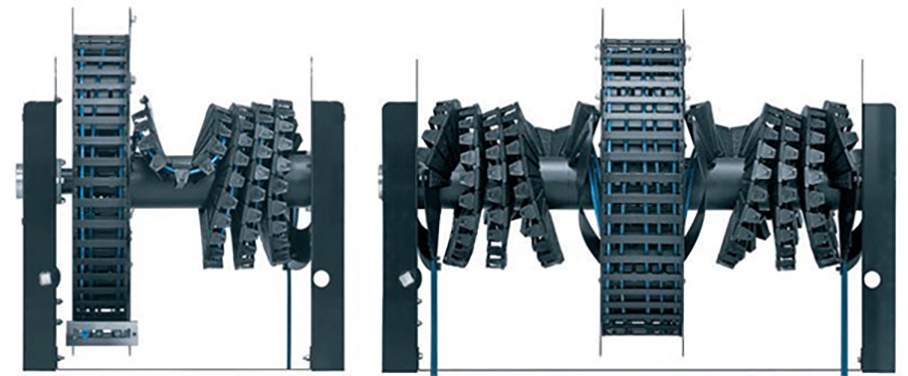
In traditional cable reels, a cable must run from the source — whether a panel box or PLC — to the fixed point of a slip ring. Then, a second cable must run from the slip ring’s point of rotation to the end effector, requiring two lengths of cable and four termination ends. The e-spool only requires a single cable that runs continuously from the source to the end effector, avoiding intermediate terminations, improving the quality of the RF signal, and minimizing the risk of failure. These features and benefits were a big reason TDK selected the igus components.
In addition, the e-chain and e-spool materials successfully met the application’s thermal and dielectric requirements. Areas of the test rig would contain high amounts of RF energy, while high-power RF cables — 28.5kW at 100mH — could experience elevated temperatures.
Working with igus
Over the course of the process, igus worked closely with TDK on designing and assembling the e-spool, which igus configured based on the required travel distances and speeds. Igus also guided TDK on how long the cables had to be; longer RF cables required more power to meet the RF field requirements — especially at higher frequencies.
According to TDK, igus engineers were easy to work with and efficiently handled additional engineering issues. For example, some cable terminations were too large, preventing the RF cables from passing through the e-spool. Solving this challenge required three-way collaboration between TDK, igus and the cable manufacturer.
In addition, igus displayed exceptional technical support during TDK’s prototyping phase while guiding engineers on how to adjust the spring tension on the e-spool. Igus also coordinated the assembly of the spools with the RF cable supplier and drop-shipped one of its units to the job site to help TDK meet a tight deadline.
A successful, award-winning rig design
The antenna masts and assemblies are currently performing as expected, deeming the VIL test rig project a big success. According to TDK, the igus engineering support and e-spool products have been an integral part of that accomplishment and allowed the company to take its design to the next level.
A testament to the rig’s innovative design, TDK even recently won a 2024 silver vector award out of 328 applications from 37 countries. The vector awards are a biennial competition that honors bold, exciting projects that incorporate igus e-chain cable carriers made of high-performance plastics.
Latest from EV Design & Manufacturing
- Powering homes with EV batteries could cut emissions, save thousands of dollars
- Meviy introduces stainless steel passivation option for CNC, sheet metal parts
- December Lunch + Learn webinar with Fagor Automation
- December Lunch + Learn webinar with LANG Technik + Metalcraft Automation Group
- EVIO makes public debut with hybrid-electric aircraft
- Redesigned pilot step drill triples performance
- Green Energy Origin expands battery electrolyte manufacturing in North America, Europe
- What’s next for the design and manufacturing industry in 2026?