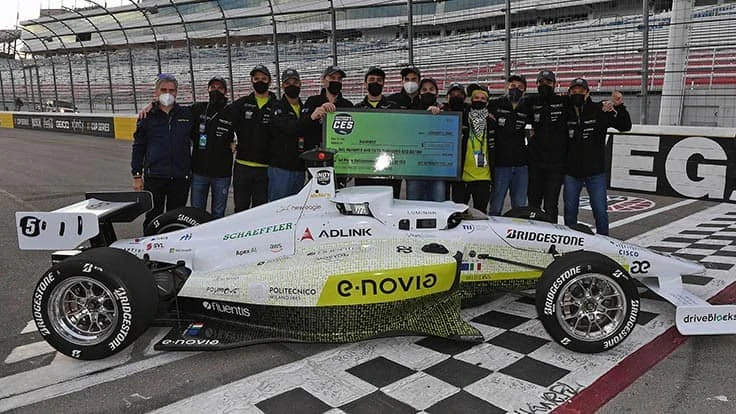
PoliMOVE - Politecnico di Milano (Italy), University of Alabama (Alabama)
The Indy Autonomous Challenge (IAC) team PoliMOVE from Politecnico di Milano (Italy) and the University of Alabama won the Autonomous Challenge @ CES, making history as the first head-to-head autonomous racecar competition champion. PoliMOVE competed at the Las Vegas Motor Speedway in a field of 5 teams from 5 countries representing 7 universities to win the $150,000 grand prize.
The rules of the IAC competition required each team to qualify in a high-speed autonomous racecar time trial competition determining their seed in the head-to-head passing competition. The IAC teams raced the Dallara AV-21, the most advanced autonomous racecar. PoliMOVE competed against TUM Autonomous Motorsport in the final round of the competition. In addition, PoliMOVE set the fastest speed record on an oval with a top speed of 173 mph.
“Today was the real birth of autonomous racing,” says Prof. Sergio Savaresi, team lead of Politecnicodi Milano. “The real high-speed multi-agent racing was pushed to its very limits. The research on autonomous cars will certainly benefit from this historic milestone.”
Organized by Energy Systems Network, the IAC hopes to solve real world problems by advancing technology that will speed the commercialization of fully autonomous vehicles and deployments of advanced driver-assistance systems (ADAS). Pushing limits for the entire autonomous community and helping to increase safety and performance is critically important, not only in motorsports, but across all modes of commercial transportation.
“We came to CES this week, the world’s most influential technology innovation event, to showcase to the world how this competition is catapulting autonomous technologies forward,” says Paul Mitchell, President and CEO, Energy Systems Network. “We’re harnessing the power of prize competitions to attract the best and the brightest minds from around the globe to further the state-of-the art technology in safety and performance of automated vehicles and the teams did just that today with another historic competition.”
Halo, a remote-piloted driverless car service operating on T-Mobile’s 5G network served as the official pace car, leading each set of IAC teams off pit lane, and completing a warmup lap at speeds of 65-80 mph before the start of each round.
Luminar and the Technology Innovation Institute (TII) served as premier sponsors. The Dallara AV-21 features three Luminar Hydra LiDAR sensors to provide 360-degree long-range sensing, enabling safe autonomy at high speeds.
Forty-one university teams initially signed up to compete more than 2 years ago, representing top engineering and technology programs from 14 U.S. states and 11 countries. The IAC first made history on October 23, 2021, when it held the Indy Autonomous Challenge Powered by Cisco, the first high-speed autonomous racecar competition at the Indianapolis Motor Speedway (IMS).
9 teams from 8 countries, representing 19 universities came to Las Vegas this week seeking to compete in the Autonomous Challenge @ CES.
- AI Racing Tech* - University of Hawai'i (Hawai’i), University of California San Diego (California)
- Autonomous Tiger Racing - Auburn University (Alabama)
- Black & Gold Autonomous Racing* - Purdue University (Indiana) and United States Military Academy at West Point (New York)
- Cavalier Autonomous Racing* - University of Virginia (Virginia)
- KAIST - Korea Advanced Institute of Science and Technology (South Korea)
- MIT-PITT-RW*- Massachusetts Institute of Technology (Massachusetts), University of Pittsburgh (Pennsylvania), Rochester Institute of Technology (New York), University of Waterloo (Canada)
- PoliMOVE - Politecnico di Milano (Italy), University of Alabama (Alabama)
- TII EuroRacing - University of Modena and Reggio Emilia (Italy), Technology Innovation Institute (United Arab Emirates)
- TUM Autonomous Motorsport - Technische Universität München (Germany)