Burghardt + Schmidt GmbH
The steady expansion of e-mobility and the legal regulations relating to conventional combustion engines are subjecting the traffic and transport sectors to comprehensive change. To reduce emissions, lighter car bodies and vehicle components are needed. Crash safety also plays a role, because the accommodation of heavy batteries in a vehicle requires appropriately designed body structures that take an accident scenario into account. While fiber composites are sometimes used in small series, materials such as high-strength steel and aluminum are asserting themselves in large series construction with continuous refinement. In addition to low costs, the recyclability is a significant advantage of metallic materials. However, their further development often poses new challenges for processing procedures and machines.
The residual stress state, flatness, and cutting quality are characteristics that must be considered for materials in the levelling and slitting technology. These criteria play a decisive role in the quality of the final product even before the final molding. In production the aim is to achieve a higher degree of automation, which can only be achieved if the semi-finished products have perfect flatness, a low level of residual stress, and a low-cut burr. If these requirements aren’t met, this can have a negative effect on handling and further processing.

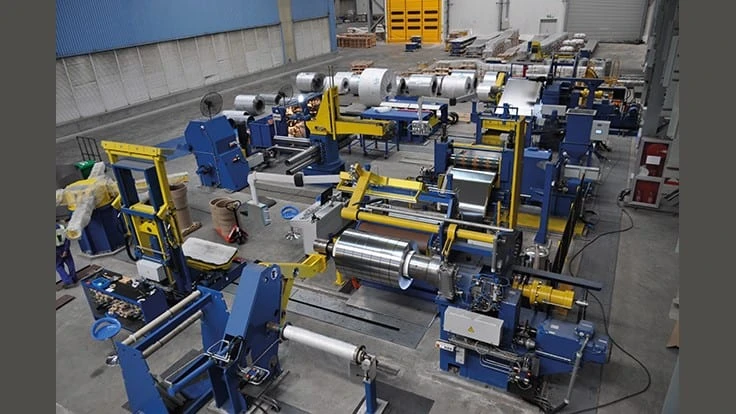
Broadband longitudinal slitting line
Wide range of applications for aluminum and high-strength steels
Modern and sophisticated materials are used in automotive engineering not only for the outer skin and structure of the car bodies but also in vehicle components such as the chassis, drive train, seats, or trim parts. Aluminum and steel are used for many components in the form of strips, sheets, or plates, which are processed and formed in various manufacturing processes from semi-finished products to finished components. Special demands are placed on the components. Due to the automated handling, good flatness and the lowest possible degree of cut are very important for a machining process without complications. If these quality criteria do not correspond to the defined specifications, there is no process reliability.
The companies of Burghardt + Schmidt (b+s group) have supported their customers with appropriate solutions for demanding tasks in the past. Thanks to the experience gained from these projects, the b+s group companies optimize their competencies in making residual stress state, flatness level, and cut quality of strips and sheets meet the highest requirements. In addition, speed and surface protection play an important role in machining and must be taken into account in all process improvements. An important prerequisite for these processes is perfectly aligned and low-burr starting material. The b+s group reacts to these challenges and problems to offer technologically mature solutions in the field of levelling and slitting technology, strip feeding systems, and automation.
Numerical simulation allows for more flexible levelling machines
Aluminum and high-strength steels place special demands on the individual processing steps. One factor that has a major influence on the quality of the product is the levelling of the respective metal. In a levelling machine consisting of several staggered levelling rolls, the coil curvature of the starting material is eliminated. Suitable machines can compensate for any edge or center waves in the strip material. The aim is to achieve the lowest possible and most homogeneous residual stress state to maintain the flatness of the material during subsequent cutting processes. An elementary measure for levelling process efficiency is the degree of plastification of the respective metal, which describes the proportion of the material cross-section that is plastically deformed during levelling. With the same yield strength and material thickness, aluminum requires greater degrees of deformation than steel to achieve comparable plastification.
The reason for this is the lower modulus of elasticity of aluminum compared to steel. However, to realize greater degrees of deformation, smaller levelling rolls must be used. With high-strength steels, a conflict of objectives arises. Their high yield strengths require enormous forming forces and torques; small levelling roll diameters are also needed here to achieve a sufficient degree of plastification. The levelling of both aluminum and high-strength steels therefore requires a forming geometry adapted to the respective product. This is determined by the number, diameter, and spacing of the levelling rolls.
The experts of the b+s group have been dealing with the numerical simulation of forming processes in levelling machines for many years. Powerful simulation programs are available for optimal configurations to be determined for the respective applications. The software has been validated for extensive experimental investigations so the optimum levelling roll diameters can be determined for a specific application. The use of cassettes with different diameters allows a levelling machine to cover a wide range of products. Schnutz GmbH developed solutions that enable efficient work. In the highest expansion stage, a cassette change therefore takes about as much time as a coil change.

Cut-to-length line 2
Precise adjustment of the slitter shafts enables exact splitting
In addition to levelling, in sheet metal fabrication, attention must also be paid to accuracy and cut quality during slitting to avoid failure batches. Although the advanced materials, such as high-strength aluminum in the automotive or aerospace industries, offer completely new possibilities thanks to their resilience and flexibility, they also pose new challenges for slitting technology. The heart of every modern slitting line is the slitting shear, which can be positioned precisely and stably by means of an extremely precise and preloaded roller bearing and a backlash-free linear guide. However, for these shears to meet the high demands of the processing procedure and to cut the strips to the desired width with little burr, tension-free cutting must be guaranteed. For this reason, when manufacturing slitting lines, the specialists at Burghardt + Schmidt attach particular importance to the precise manufacture and adjustment of the slitter shaft. To ensure a perfect cutting pattern, these must run parallel to each other, which is ensured by active repositioning during the cutting process. In this way Burghardt + Schmidt guarantees fast and trouble-free passage of the coils due to precisely manufactured belts.
The b+s group, including Schnutz GmbH und Delta Technik GmbH, presents itself in the manufacture of cutting and levelling machines and automation technology. Under the leadership of Burghardt + Schmidt GmbH, founded in 1945, b+s group is facing the challenges of the constantly changing market. In recent years, the group has developed into a manufacturer of slitting lines, stretch-bend-levelling lines, packaging lines, traverse winders, levelling machines, cut-to-length lines, coil lines, and automation solutions and has established itself in the global market. With the help of the experience gained in the process, the requirements for the use of aluminum and high-strength steels in body construction for e-vehicles can be successfully met.