L-Charge
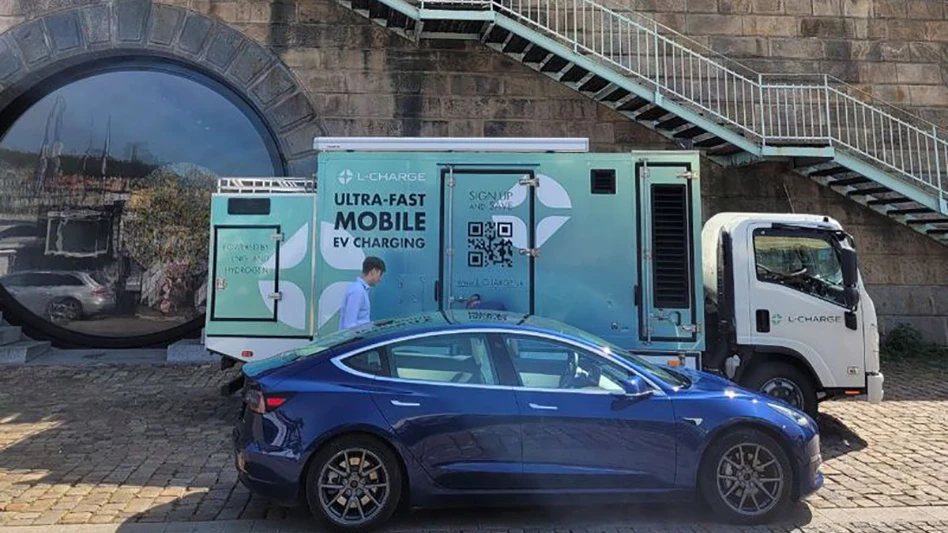
The British company L-Charge is launching its commercial operation of the world’s first mobile, ultra-fast, off-grid EV-charging service in Amsterdam. The main feature of the service is the charger could be called up as a taxi service and charge an EV in any place on demand. The company will also consider investing in the city's charging infrastructure in future.
The Dutch infrastructure for the supply of electric energy is of the highest quality and of superior performance. The infrastructure for charging electric vehicles (EVs) is well organized. Private and public parties have created an open and competitive market model for the development of the EV charging infrastructure. The Netherlands has made national agreements on interoperability, corresponding to European standards. Many charging systems in use in the Netherlands have been interoperable since the beginning of 2011. Since then, the number of public charging points has grown to almost 100,000 at the end of April 2022.
L-Charge is a global company that develops and produces unique multifuel, off-grid EV charge points that are powered by LNG, hydrogen, or a mixture of both. Their mobile charging van incorporates a mini-power station onboard that uses clean fuels to produce electricity, allowing it to roam freely around the city and be called when needed via the app, in the same manner as a taxi. It is also possible to book and assign the mobile charging van to a convenient location. The mobile charging van provides super-fast charging – from 0% to 80% in 15-25 minutes.
L-Charge is a UK-based EV-charger manufacturer with production facilities in the EU. The main feature of the L-Charge solution is the ability to convert the engine operation from natural gas to 100% hydrogen (when hydrogen becomes available). Converting charging stations to generate electricity on hydrogen will help to achieve zero CO2 emissions. This will make the generation of electricity for off-grid charging stations 100% environmentally friendly.
- With 100% H2, chargers emit zero CO2.
- With Methane, chargers emit 3 times less CO2 per 100km charge than diesel cars
- For intermediate CO2 emission, chargers can use an H2/CH4 mixture
Its mobile EV-charger is a miniature power station for the fast charging of electric vehicles. The main feature of the L-Charge solution is the ability to convert the engine operation from natural gas to 100% hydrogen, when hydrogen becomes available. It takes 10-20 minutes to charge one car up to 80%. One mobile L-Charge station can charge 24 electric cars per day.
Latest from EV Design & Manufacturing
- Ford partners with Renault Group to expand European electric vehicle presence
- Analysis, trends, and forecasts for the future of additive manufacturing
- BlueForge Alliance Webinar Series Part III: Integrate Nationally, Catalyze Locally
- Wolfspeed’s silicon carbide components to power Toyota’s onboard EV charger systems
- Sunnen enhances e-commerce platform for precision honing equipment
- QuantumScape moves forward with automated battery cell pilot production line
- Dürr introduces next-generation low-pressure spray gun
- #56 Lunch + Learn Podcast with Techman Robot + AMET Inc.