CREDIT: NISSAN
Nissan will showcase a prototype vehicle equipped with an onboard solar power generation system at this month’s Japan Mobility Show 2025.
Named the ‘Ao-Solar Extender,’ the system has been installed on Japan's top-selling electric vehicle (EV), the Nissan Sakura. Developed in-house, the solar panel system is designed to reduce reliance on the grid and enhance the convenience of EV ownership by simplifying charging. The team developing the system estimates that, on an annual basis, it can generate enough solar electricity to power up to 3,000km of driving.
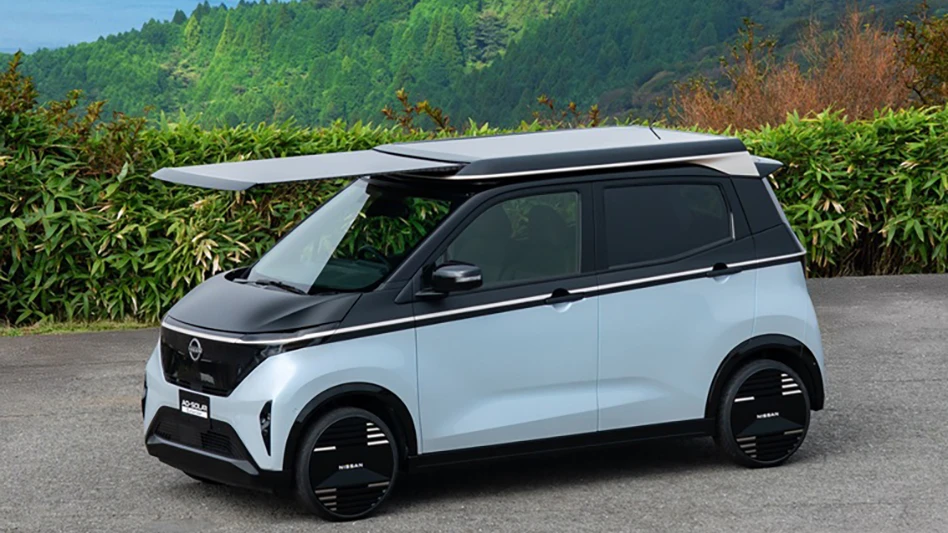
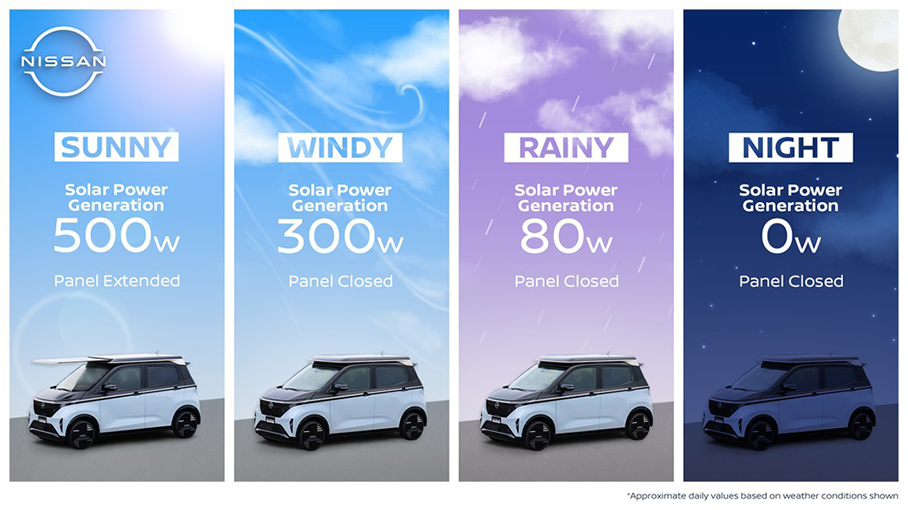
The roof-mounted Ao-Solar Extender can charge the vehicle both while driving and when parked. The fixed roof-mounted panel can capture solar energy even when the vehicle is in motion. When stationary, an additional panel extends outward from storage, increasing the solar panel surface area and power generation potential to approximately 500W. The expanded panel also creates shade and helps block sunlight from entering through the windshield, reducing cabin temperature and lowering the need for air conditioning power consumption. The system has been designed to minimize drag and integrate with the Sakura’s overall appearance.
Nissan’s Sakura was Japan’s best-selling EV for the past three consecutive years and is often praised for its sufficient daily driving range and compact, yet thoughtful, design. With the installation of the Ao-Solar Extender, the development team hopes that users can further reduce reliance on charging infrastructure. Analysis of driving data from Sakura owners shows that many primarily travel short distances for errands and school runs, suggesting that solar-generated power could nearly eliminate the need for grid-based charging for a significant portion of owners. Moreover, the solar system can serve as an emergency power source during disasters.
Visitors to the Japan Mobility Show 2025 will find the Ao-Solar Extender within the Tokyo Future Tour ‘City Life zone,’ an exhibition coordinated by the Japan Automobile Manufacturers Association, Inc. (JAMA).
The Ao-Solar Extender system concept originated within Nissan’s 2021 internal idea contest and is planned for future commercial launch. The timing will be announced at a later date.
Latest from EV Design & Manufacturing
- Powering homes with EV batteries could cut emissions, save thousands of dollars
- Meviy introduces stainless steel passivation option for CNC, sheet metal parts
- December Lunch + Learn webinar with Fagor Automation
- December Lunch + Learn webinar with LANG Technik + Metalcraft Automation Group
- EVIO makes public debut with hybrid-electric aircraft
- Redesigned pilot step drill triples performance
- Green Energy Origin expands battery electrolyte manufacturing in North America, Europe
- What’s next for the design and manufacturing industry in 2026?