CREDIT: ROCKWELL AUTOMATION
The complex and exacting nature of producing electric vehicle (EV) batteries makes optimizing quality a constant challenge. Scrap rates often exceed 10% – and that number can be as high as 30% during start-up. These high rates are costly, limit yield, and diminish the efficiency and sustainability of battery gigafactories.
To better manage quality and improve yield, battery makers need smart, integrated operations that can uncover and resolve quality issues quickly.
By connecting production processes across the entire gigafactory, battery makers can gain better visibility into what’s happening in production, spot quality issues when and where they happen, and reduce their reliance on manual processes.
Create a foundation for improvement
Many gigafactories use advanced technologies to solve key challenges in different production processes. But too often, those technologies aren’t implemented with the larger operation in mind. This creates siloed production systems that rely on inefficient manual processes and experience quality issues in production that are identified downstream rather than at the source of where they occur.
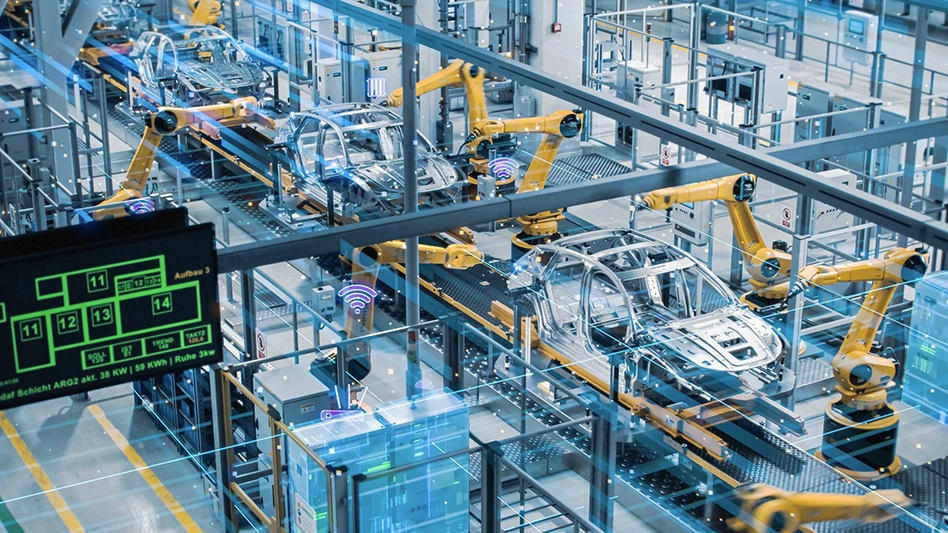
Production silos disappear when the different control systems used in a gigafactory are implemented on one integrated control and information architecture rather than with disparate technologies.
Activities in the factory – from installation to operations and maintenance – become simpler, because a single control engine and network technology are used for discrete, batch, motion, and safety control. Interfaces are common, and factory staff only need to learn one platform.
Production technologies in an integrated architecture can also talk to each other and produce a common baseline of information. This allows all the control systems in the factory to operate in unison and information to flow seamlessly throughout the factory.
This integrated control and information architecture becomes the foundation upon which battery makers can use data and technologies to improve and even transform how they manage quality.
Reduce scrap with better insights and new technologies
One of the most effective tools battery makers can use to improve quality – and other production priorities – is a manufacturing execution system (MES). With it, battery makers can harness the power of their own data to uncover quality issues and drive down scrap.
An MES provides a link between the various production processes in a gigafactory, while also enabling integration between plant-floor and business networks. It can capture and aggregate data across processes to help production staff monitor results, identify anomalies, and manage quality issues as they happen. Key activities like inline testing and visual quality inspections can also be integrated into the MES to streamline quality-management processes and reporting.
Some battery makers are evaluating MES solutions to help meet the EU’s digital battery passport mandate. But they shouldn’t look at MES as a means for checking the compliance box – they should view it as an opportunity to enhance quality and reduce scrap.
As they collect and aggregate data to track the history of where each battery came from and how it was built, they can start to analyze data in other ways, too. For example, they can compare different shifts, products, or even whole factories to see where they’re experiencing the most success and pinpoint where quality issues are occurring.
And while an MES delivers significant value on its own, it can also enable battery makers to use other technologies to optimize quality, like computed tomography (CT) solutions.
Just like CT technology can help doctors understand what’s happening in our bodies by performing a CAT scan, it can also give battery makers a glimpse into their batteries. The technology can create high-resolution scans of the interior of batteries to identify defects.
A single battery scan can be several gigabytes in size, but it can be quickly analyzed by an AI agent that has been trained to understand what a high-quality battery looks like. Any identified problem areas can then be investigated and addressed by the quality team. But in an ideal scenario, the AI agent evaluating the CT scan will communicate its findings to a separate AI agent in the MES, which can then make any necessary control changes upstream to resolve the root cause of the quality issue.
This closed-loop approach to addressing quality issues is possible using smart, integrated production systems. And it can help producers diagnose and address battery quality issues more efficiently compared to the tests, visual inspections, and tear-down analyses that are used today. Not only are those processes time consuming, but they’re also reliant on human expertise being available whenever an issue occurs.
Increase OEM involvement
Software tools can optimize every aspect of battery production today, including the machines used throughout a gigafactory. This creates new opportunities for OEMs to use capabilities such as digital twins to create higher-performing machines that can enhance quality and more.
Traditionally, changing a machine’s design has been a complex and costly process, requiring not only design work but also the building and testing of new machines. But with a digital twin, an OEM can now virtualize a machine and explore in a digital environment how changes from simple tweaks to the use of new technology can improve quality, throughput, and more. One OEM, for instance, used digital twin software to bring together robots, handling devices, and independent cart technology from different vendors to create an optimized battery assembly machine.
A key benefit of digital twin technology is that it doesn’t just visualize how a machine would operate with different design iterations or technologies – it uses physics to prove out their feasibility. This allows OEMs to test how various design scenarios would run in the real world, all without needing to do any physical testing or ordering new parts.
A machine’s digital twin can also help continuously improve battery quality even long after a machine is built.
For instance, a digital twin can be used for virtual training to help build operator competency and ultimately strengthen quality by allowing operators to learn how to operate machines in a wide range of scenarios. Battery producers can also use a machine’s digital twin to accurately test process changes or new production scenarios offline. This can enable the continuous improvement of life-long assets in their gigafactories.
Set a new standard for battery quality
Bringing together control systems in an integrated architecture brings together data from those systems, creating a clearer view of battery quality. This enhanced visibility, combined with opportunities to use technologies that accelerate defect detection and reduce reliance on manual processes, is the only way forward for gigafactories to bring down high scrap rates and keep up with EV demand.

About the author: Ted Stockburger is global director of electric vehicles & batteries at Rockwell Automation. Ted has more than 30 years of experience in automation and solutions. He has worked across multiple industries solving customers' manufacturing problems.
Latest from EV Design & Manufacturing
- Ford partners with Renault Group to expand European electric vehicle presence
- Analysis, trends, and forecasts for the future of additive manufacturing
- BlueForge Alliance Webinar Series Part III: Integrate Nationally, Catalyze Locally
- Wolfspeed’s silicon carbide components to power Toyota’s onboard EV charger systems
- Sunnen enhances e-commerce platform for precision honing equipment
- QuantumScape moves forward with automated battery cell pilot production line
- Dürr introduces next-generation low-pressure spray gun
- #56 Lunch + Learn Podcast with Techman Robot + AMET Inc.