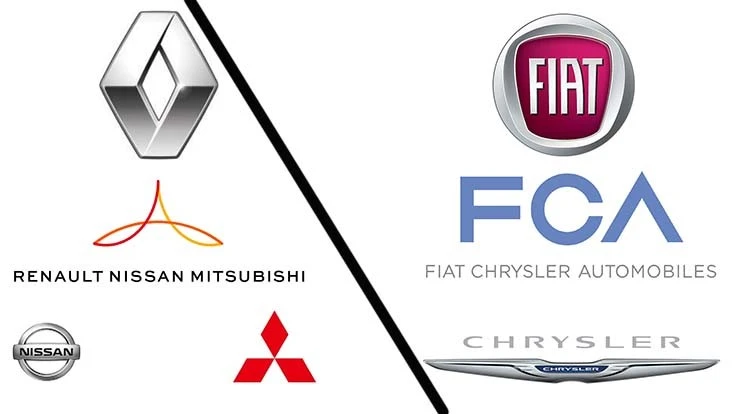
Cleveland, Ohio – Combining Fiat Chrysler Automobiles (FCA) and France’s Renault could radically reshape the global motor vehicle market, potentially creating a new No. 1 for the industry.
“Broader collaboration through a combination would substantially improve capital efficiency and the speed of product development,” FCA officials said in announcing a bid to create a 50/50 joint venture between the companies. “The case for combination is also strengthened by the need to take bold decisions to capture at scale the opportunities created by the transformation of the auto industry in areas like connectivity, electrification, and autonomous driving.”
Groupe Renault acknowledged the talks, saying only it would “study with interest” FCA’s proposal.
Former Renault CEO Carlos Ghosn (now in jail and embroiled in a legal drama in Japan) and late FCA CEO Sergio Marchionne were fans to finding partners to bolster scale – allowing automakers to invest more heavily in new platforms and technologies by spreading costs across a wider array of products and nameplates.
Rebecca Lindland, founder of rebeccadrives.com and a longtime automotive industry analyst, says the need to invest in disruptive technologies such as electric vehicles (EVs) and autonomous systems are forcing companies to pair up – although to date that has mostly taken the form of cost-sharing alliances instead of mergers.
“We’ll definitely continue to see alliances created as technology and mobility continues to evolve,” Lindland said. “The costs of development continue to climb, but the cost of getting left behind is greater.”
FCA officials say the merger could save the companies $5.6 billion per year – a figure that does not call of the closures of any plants. They estimate 90% of savings to come from reducing redundancy:
- 40% from purchasing from suppliers (bulk-buying discounts)
- 30% from research and development (R&D) cost sharing
- 20% from manufacturing and tooling efficiencies (sharing the same build processes in several locations, bulk savings from manufacturing technology suppliers)
The number of vehicle platforms used by the combined company could fall 20% and the number of different engines offered by 30%. FCA officials project that the deal would be earnings neutral in the first year and produce significant savings after that.
Combining Renault and FCA would create an automaker with about 8.7 million vehicles of annual sales, No. 5 globally behind Toyota, Volkswagen, General Motors, and Hyundai/Kia.
Adding Nissan to that mix would make the company No. 1 with about 14 million in annual vehicle sales. Mitsubishi would bring that figure to more than 15 million. However, adding those Japanese companies to a merged FCA/Renault may be difficult.
The Renault-Nissan-Mitsubishi alliance is not a formal merger. Those three companies share resources and development costs, but they maintain separate boards of directors. In addition, shared management has proven recently to be problematic.
Ghosn was CEO of Renault and Nissan until Japanese authorities arrested and jailed the executive late last year, accusing him of using Nissan funds for self enrichment. Nissan’s board then fired him as CEO. Renault has named an interim leader for its CEO but stands behind Ghosn.
Given those tensions, winning over Nissan’s board to create a tighter alliance may be difficult.
Renault and Nissan have been partners since 1999. Mitsubishi joined the group in 2017 after Nissan bailed it out and bought a controlling interest in the struggling automaker.
FCA officials said they want to work with the Renault alliance member companies, but the focus of merger talks are on FCA and Renault, not Nissan and Mitsubishi.
On a historical note, Mitsubishi has a long, storied past with Renault and Chrysler. In the early 1990s, Mitsubishi and Chrysler built a joint plant in Normal, Illinois, to produce the Mitsubishi Eclipse, Plymouth Laser, and Eagle Talon (Eagle was a sub-brand of American Motor Co. [AMC], an automaker that Chrysler bought from… Renault in the late 1980s).
“Don’t forget, years ago, AMC and Renault teamed up to create such dazzling products as the Renault Alliance before Chrysler bought AMC, so history is repeating itself in many ways with this tangled web,” Lindland said. She reiterated, however, that the deal for now appears to be limited to FCA and Renault.
About the author: Robert Schoenberger is the editor of Today's Motor Vehicles and a contributor to Today's Medical Developments and Aerospace Manufacturing and Design. He has written about the automotive industry for more than 19 years at The Plain Dealer in Cleveland, Ohio; The Courier-Journal in Louisville, Kentucky; and The Clarion-Ledger in Jackson, Mississippi.
Latest from EV Design & Manufacturing
- Powering homes with EV batteries could cut emissions, save thousands of dollars
- Meviy introduces stainless steel passivation option for CNC, sheet metal parts
- December Lunch + Learn webinar with Fagor Automation
- December Lunch + Learn webinar with LANG Technik + Metalcraft Automation Group
- EVIO makes public debut with hybrid-electric aircraft
- Redesigned pilot step drill triples performance
- Green Energy Origin expands battery electrolyte manufacturing in North America, Europe
- What’s next for the design and manufacturing industry in 2026?