CREDIT: DOW
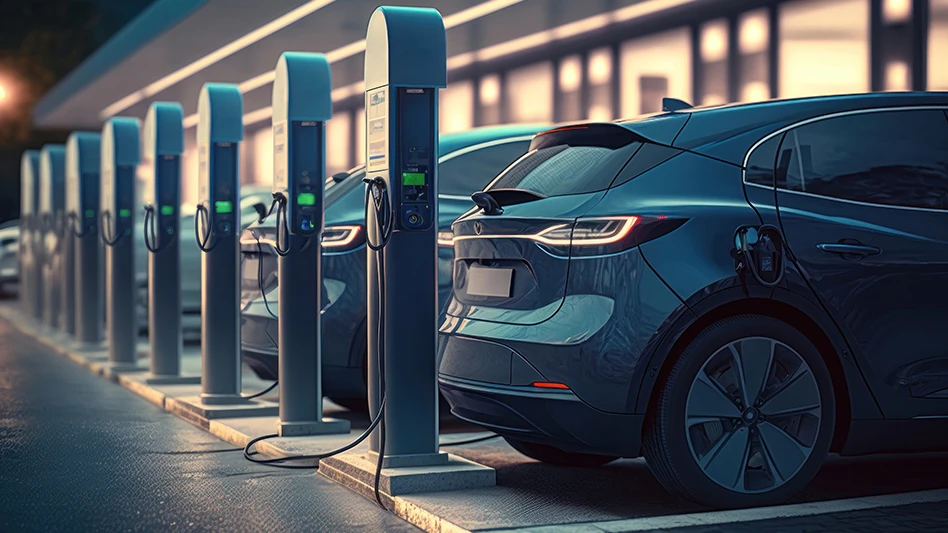
Electric vehicle (EV) batteries produce a significant amount of heat during the charging and discharging of battery cells. Without thermal management, this intense heat can reduce battery life, degrade performance, and jeopardize safety. If a battery cell enters thermal runaway, excessive heat can move to adjacent cells and cause fires or explosions. To avoid this, it is essential to protect EV batteries from overheating, not only during charging and discharging, but also in the event of short circuits, vehicle crashes, or manufacturing defects – all of which can also trigger thermal runaway.
Given these risks, EV designers need to keep the battery pack at an optimal temperature and ensure a uniform temperature distribution between all cells. Generally, the optimal battery pack temperature is between 10°C and 50°C. Temperatures below 10°C reduce energy storage performance and power capacity, and temperatures above 50°C accelerate aging and increase the risk of explosion. Improvements in battery cell chemistry have helped, but designers still need thermal management and fire protection materials between and around individual battery cells.
In addition, designers need high-performance material solutions for battery modules and the battery pack itself. Battery modules are assembled from interconnected battery cells to provide higher voltage and capacity. These modules are integrated into battery packs, which include a lidded enclosure and cooling system to further regulate temperature and ensure safety. Designers have a choice of thermal management and fire protection materials, but silicones stand out for their many beneficial properties and are available in a wide range of products to meet application-specific requirements.
The advantages of silicones
Among their many advantages, silicones resist high temperatures, have excellent thermal stability, and can be either thermally insulating or thermally conductive. In EV batteries, thermally insulating silicones are used to prevent or reduce the propagation of heat between adjacent cells. Thermally conductive silicones move or transfer heat from battery cells to the cooling system. Both types of advanced silicone materials are available with fire protection ratings such as UL 94 V-0.
In addition, silicones are stress-relieving and electrically insulating. They absorb shock and vibration during normal EV use and they can help to protect EV batteries in the event of a vehicle crash or a short circuit. Furthermore, silicones support operational efficiency through automated mixing and dispensing. They can also support rework during product assembly and provide fast, energy-efficient curing for shorter cycle times and reduced energy usage.
There are many types of silicone products for battery thermal management and fire protection, and some materials are recommended for specific types of battery cells, for use between cells in modules, or with specific parts of the battery pack such as the cooling system. By partnering with the right supplier, EV designers can select the right materials, including silicones with tailored properties to meet specific challenges.

Thermal management silicone-based materials
Thermal management silicones for EV batteries include thermally conductive adhesives, gap fillers, and cooling fluids. Thermally conductive silicone adhesives are used to bond battery cells to cooling plates, which are flat components that remove excess heat from battery cells and help keep the entire pack at an optimal temperature. Typically, the cooling plate is made from metal, such as aluminum or stainless steel, and provides high thermal conductivity and mechanical strength.
Thermally conductive adhesives can also be used to bond battery pack lids to cases. Designers can choose products based on hardness, adhesive strength, temperature resistance, and thermal conductivity (TC), a measure of the ability to move heat that is expressed in Watts per meter Kelvin (W/m·K). Among their advantages, thermally conductive silicone adhesives cure relatively quickly at low oven temperatures for faster cycle times and reduced energy usage.
Silicone-based gap fillers provide EV designers with an alternative to thermally conductive adhesives. Like thermally conductive adhesives, silicone-based gap fillers have a significantly higher TC than air, which would otherwise fill the small gaps created by surface discontinuities. Because filling these gaps promotes more efficient heat transfers, silicone-based gap fillers are used at the interface between the cooling plate and the battery cells.
Most silicone-based gap fillers are two-part thixotropic materials that are dispensed as a liquid and then stay in place. They are squeezed to achieve a thin bond line, which is essential for effective heat dissipation, and are reworkable for reduced material waste. Their tackiness ensures good surface contact and their low post-cure hardness is stress-relieving for the lifetime of the battery pack. These soft, compressible materials support tailored cure speeds and have high thermal stability, even with accelerated aging.
Silicone-based cooling fluids, another type of thermal management material, are used to dissipate heat for optimal battery performance. These dielectric fluids can be used for the immersion cooling of EV batteries, which enhances heat dissipation and allows for more compact and efficient battery designs. With their high thermal stability and electrical insulation, silicone-based cooling fluids are also suitable for EV charging guns and other charging station components that operate at high or low temperatures.
Battery fire protection silicone-based materials
Silicone-based battery fire protection materials are used atop battery covers in EV battery packs. They combine fire protection with thermal insulation and shock absorption. During thermal runaway events, these silicone-based foams help protect the battery pack against flame and particle blast, which is the ejection of solid particles from the battery cell. At high temperatures, silicone-based fire protection materials undergo ceramification, a process that forms a ceramic layer and isolates the combustible components from oxygen.
Fire-resistant coatings, which also form a ceramic layer, can resist flames at temperatures up to 1200°C. They are applied to battery pack enclosures and maintain their dielectric strength, which is the ability to withstand an electric field without becoming electrically conductive. Fire-resistant coatings can be dispensed onto metal panels and EV battery lids that have deep troughs. They can also be applied to vertical surfaces because they resist vertical sagging.
Silicone-based high consistency rubber (HCR) is also a ceramifying product that can be used for busbar protection. In EV batteries, busbars are used for power distribution because they can carry more current than cables with the same cross-sectional area. These electrically conductive bars or strips can be coated with silicone-based HCR, which prevents arcing and provides electrical insulation before, during, and after a thermal event. Fire-rated HCR is also used in EV batteries to protect coolant lines and act as thermal barriers.
Fire protection sheets for battery modules also ceramify when exposed to high temperatures or flame. These thermally insulating materials are made from two-part liquids to form silicone foams with low thermal conductivity and low density. Fire protection sheets are used between battery cells, battery modules, and in other areas where there is a risk of thermal runaway. The advantages of using these sheets are significant, including an ability to maintain a physical structure, as well as their thermal insulation and dielectric protection.
Battery fire protection sheets can also serve as compression pads that help manage battery cell expansion and contraction during charging and discharging. This is especially important with pouch cells, which are more prone to swelling. Cylindrical and prismatic battery cells have more robust casings, but the compressibility of silicone-based battery fire protection sheets can be adjusted to meet an application’s specific requirements.
Fire-resistant potting foams, another type of silicone-based fire protection material, are used to fill the spaces between individual battery cells. Typically, low-viscosity potting foams are used with cylindrical cells, while higher-viscosity foams are used with pouch cells, where flow must be tightly controlled to accommodate cell geometry. Most potting foams support automated dispensing and room-temperature curing. They also have long working times to ensure their proper distribution.
Silicone-based sealing and gasketing are the materials of choice to mitigate the spread of flame. Fire-rated products include thixotropic foams that stay in place and maintain a proper aspect ratio between bead width and bead height. These thixotropic foams are mixed and then robotically applied, but sealing and gasketing materials also include dispensed foam gasket (DFG) products that cure at room temperature. By protecting battery modules and battery packs against moisture, dirt, and salt, silicone-based sealing and gasketing materials promote performance and reduce risk.

The road ahead
As electrification continues to reshape mobility, material selection plays a pivotal role in driving progress. Today, EV designers have a variety of material options for battery performance and safety, with silicone-based products offering advantages including thermal management and fire protection as well as thermal stability, stress relief, electrical insulation, and environmental resistance. In addition, silicones support operational efficiency.
Importantly, silicone-based materials for EV batteries have highly tunable properties and can meet application-specific requirements for performance and processing. However, designing the technology of tomorrow requires tailored solutions, not a one-size-fits-all approach. Therefore, it is essential for EV designers to work with a knowledgeable supplier, such as Dow Performance Silicones, to select advanced silicones that best support battery performance and safety. Dow is constantly enriching its broad product portfolio by developing innovative materials for battery-related applications that drive the future of electric mobility.
About the author: Luc Dusart is global marketing manager, M&T Electronics at Dow MobilityScience.
Latest from EV Design & Manufacturing
- Powering homes with EV batteries could cut emissions, save thousands of dollars
- Meviy introduces stainless steel passivation option for CNC, sheet metal parts
- December Lunch + Learn webinar with Fagor Automation
- December Lunch + Learn webinar with LANG Technik + Metalcraft Automation Group
- EVIO makes public debut with hybrid-electric aircraft
- Redesigned pilot step drill triples performance
- Green Energy Origin expands battery electrolyte manufacturing in North America, Europe
- What’s next for the design and manufacturing industry in 2026?