CREDIT: TRUMPF
TRUMPF has developed new laser applications for adhesive and coating preparation in battery production and for corrosion protection of aluminum components. The high-tech company is making electric vehicle (EV) batteries safer and protecting cars from rust.
“Selective surface processing with lasers is a clean and fast alternative to chemical processes in the automotive industry, for example to achieve high adhesive strength for adhesives or coatings,” says Volkan Yavuz, responsible for laser surface processing at TRUMPF.
Safe batteries for electric cars with the help of laser technology
Laser technology ensures safe batteries in EVs. Manufacturers must coat or laminate battery cells before gluing them into battery modules or battery trays. The coating protects against short circuits and environmental influences, thereby increasing the safety and service life of the battery cells. Before applying the coating and adhesive, manufacturers clean the cells and certain areas of the battery trays with short-pulse lasers. The extremely short light pulses hit the surface of the material without damaging the material itself.
“Our lasers reliably remove oils, rust, oxides, and other residues, and ensure long-term stable adhesion of the coating and adhesive, without the use of aggressive chemicals or mechanical rubbing,” says Yavuz. The lasers can be easily integrated into automated production lines.
Laser protects aluminum components from rust
The automotive industry increasingly relies on large aluminum castings for car body construction. Experts call this mega or gigacasting. During casting, these parts are given a protective layer that protects them from corrosion. However, further processing, such as milling, makes the components susceptible to corrosion, especially when they are later exposed to road salt in winter traffic.
TRUMPF has developed a solution for this: the laser homogenizes the surface by selectively remelting a few micrometers and then rapidly quenching it. This makes the aluminum components resistant to corrosion. In tests in which the parts processed in this way were sprayed with salt water for hours, they showed no signs of crevice corrosion.
“This technology is not a dream of the future: it is used not only for gigacasting components, but also for housings for electric motors for electric cars,” says Yavuz.
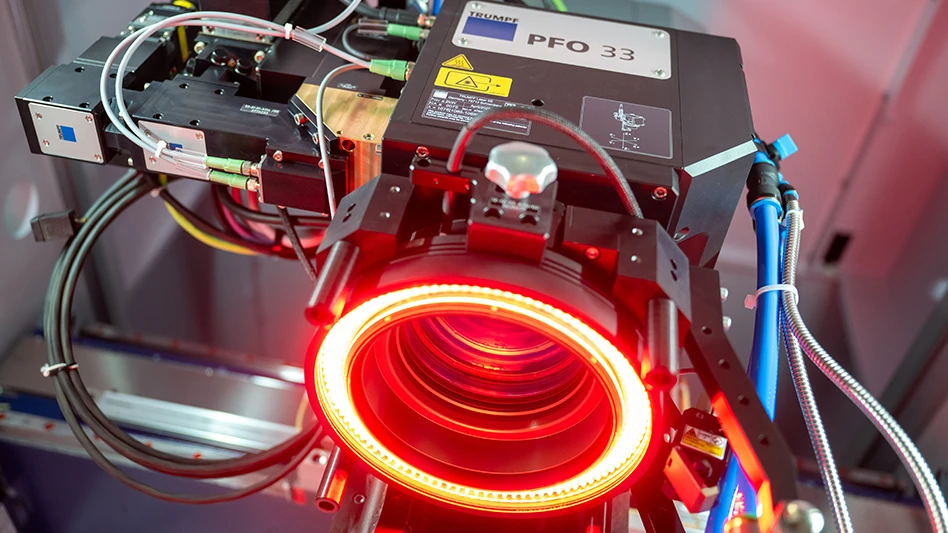
To process large surfaces, such as aluminum components, users employ the PFO33 scanner optics with a pulsed laser from TRUMPF's TruMicro Series 7000. The mirrors of the PFO33 move the laser pulses across the component at speeds of up to several meters per second.
“This enables short cycle times, which are ideal for series production in the automotive industry,” says Yavuz. Local extraction removes smoke, particles, and aerosols that are produced during laser processing and could interfere with the machining process.
Sustainable surface processing
Laser-based surface processing offers significant environmental advantages over conventional methods. The absence of chemicals reduces environmental impact and disposal costs. Contactless processing minimizes tool wear and material waste. In addition, energy-efficient, targeted laser processing reduces the CO₂ footprint in manufacturing.
Latest from EV Design & Manufacturing
- Powering homes with EV batteries could cut emissions, save thousands of dollars
- Meviy introduces stainless steel passivation option for CNC, sheet metal parts
- December Lunch + Learn webinar with Fagor Automation
- December Lunch + Learn webinar with LANG Technik + Metalcraft Automation Group
- EVIO makes public debut with hybrid-electric aircraft
- Redesigned pilot step drill triples performance
- Green Energy Origin expands battery electrolyte manufacturing in North America, Europe
- What’s next for the design and manufacturing industry in 2026?