CREDIT: SES AI
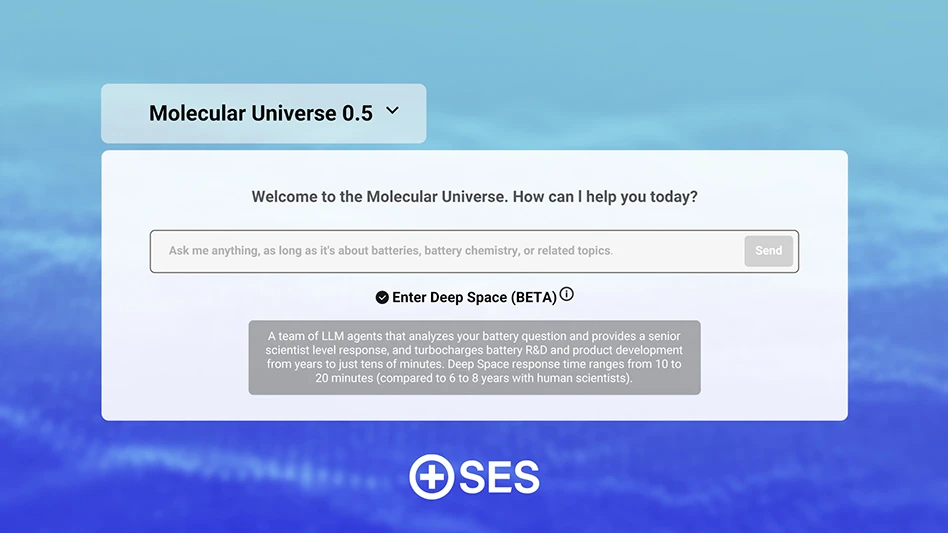
SES AI Corporation, developer and manufacturer of AI-enhanced high-performance Li-Metal and Li-ion batteries, released a new version of Molecular Universe, MU-0.5, that includes a new feature – Deep Space – to accelerate commercial product development and enhance SES AI’s first-mover advantage with R&D as a service in the global battery industry.
“Two months after its original release, Molecular Universe has quickly become a popular and powerful tool for battery researchers in companies, national labs, and universities around the world,” says Dr. Qichao Hu, founder and CEO. “The excitement the Molecular Universe has generated among current and potential customers is due to their early recognition of the speed of accessing relevant and abundant research insights, and significant cost savings potential due to avoided patent filings, material, and equipment in trial and errors, as well as reduced hiring for R&D. We continue to see increased customer interest and remain excited with the value proposition Molecular Universe is creating across the battery industry and with our OEM partners.
“Based on collaborative input we have received from the largest global battery manufacturers and OEMs that are using and testing Molecular Universe, we have introduced Deep Space, a new agentic capability that conducts in-depth senior scientist level battery research. Deep Space is intended for intense and focused deep research, where users want more than just answers to their curiosity but to actually develop a real commercial product. We believe Deep Space will further enhance our value proposition as it will be able to accelerate customers’ go-to-market strategies with new battery innovations. Due to the investment associated with running a multi-agent model required by customers, we anticipate the biggest users will be battery makers, electrolyte and cathode materials producers, and automakers, with more limited access for Research, Explorer and Team users,” continues Dr. Hu.
Deep Space is built off of Molecular Universe’s popular Ask feature. While Ask is powered by an advanced LLM specifically trained on battery domain expertise, Deep Space is powered by an even more powerful multi-agent model. Deep Space can recommend electrolyte formulations for different cell chemistries ranked by performance, novelty, cost, or whatever the user desires. It also reduces time in trial and error and accomplishes in less than one hour what would normally take a human senior scientist months or even years.
Users can select regular Ask or Deep Space. A regular Ask query typically returns an answer after 30 seconds, and a Deep Space query typically returns an answer after more than five minutes, sometimes as long as 20 minutes. Other new features launched in MU-0.5 include a molecule sketch pad to help users more intuitively find “friends" (molecules with similar properties), and language support for Mandarin and Korean in addition to English.