Whether electric drive, hybrid motor, or conventional drive, production planners face the great challenge of developing diverse manufacturing solutions for the future. They need new manufacturing solutions for a wide variety of components and costs must be reduced and production processes optimized.
EMAG is aware of this challenge and began investing in digital solutions and processing technologies. EMAG's customers now benefit from this investment in networked production, as the combination of highly productive manufacturing technology and data analysis opens completely new ways of production planning and thus opportunities for cost optimization. Edna IoT-Ready ex works: Vertical pick-up lathes make it easy to get started with data-optimized manufacturing EMAG is convinced that the future belongs to data-optimized production. Optimizing cycle times and unit costs is important, but EMAG goes one step further and focuses on overall equipment efficiency (OEE) and its optimization based on manufacturing data. Through data analysis, unnecessary downtimes, due to component wear or the failure of a machine, can be reduced or avoided altogether. Productivity increases of over 10% are the norm here. To make it as easy as possible for EMAG customers to enter the world of data-optimized production, the machines in the VL series are now delivered IoT-Ready and can be integrated directly into existing IoT networks with little effort. The machines are equipped with an EDNA IoT core (an IPC). This IPC is already installed and networked with the machine controller. The machines are equipped with the EDNA NEURON 3DG sensor technology (one or more acceleration sensors on the spindle and the Y-axis), enabling regular automatic monitoring of the machine's health. Data-optimized production can be started directly.
VL series vertical pick-up lathes with new HMI
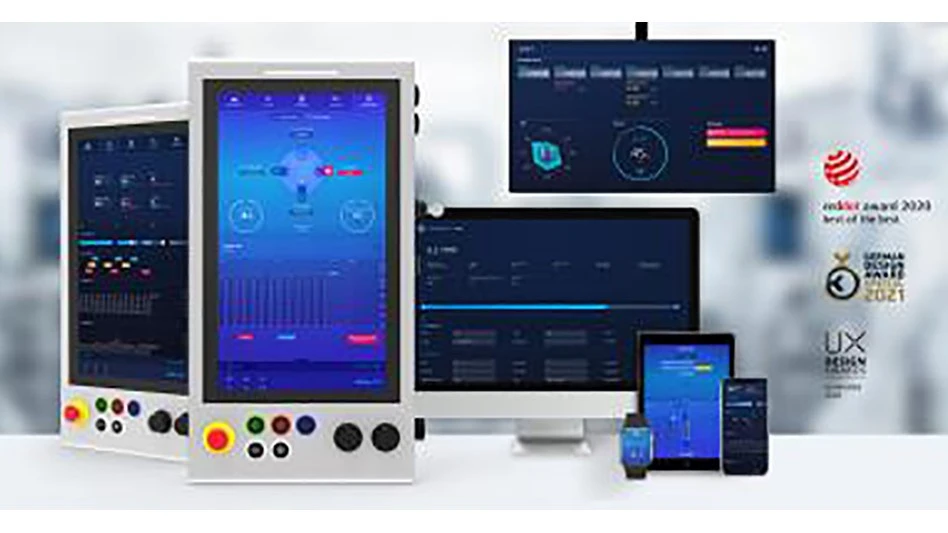
Three axes, a tool turret with up to twelve driven tools and integrated automation – these are the distinguishing features of all machines in the VL series. In addition to the standard Fanuc control, this series can now be equipped with the new EDNA HMI – a touch panel that can be configured to meet a wide variety of requirements.

With their integrated automation, VL lathes stand for maximum
performance and low unit costs in the smallest of spaces.
EMAG’s VL 4 has a new panel to see the innovative machine operation. Workpieces with a maximum diameter of up to 400mm and a workpiece length of 300mm can be machined on the vertical lathes of the VL series. Short chip-to-chip times are ensured by the integrated automation via pick-up spindle, automatically removing the components to be machined from the lateral conveyor belt and feeding them to the work area. The turret below the work spindle accommodates up to twelve turning or driven tools. The lathes can be equipped with a Y-axis in the turret to machine even more complex geometries.
Automated shaft production ensures short non-productive times
With the vertical, 4-axis VT 2 pick-up lathe, EMAG has a solution for 60 machining shafts up to 400mm in length and 100mm in diameter. The strength of the system is particularly evident with larger quantities, because its automation solution ensures very fast chip-to-chip times and low component costs. The raw parts are transported into the machine via workpiece grippers and removed again after processing. Depending on the workpiece, this changeover time only takes six to eight seconds. The actual turning process at a speed of 6,000rpm also takes place in extremely short cycles. The shaft is clamped vertically between the main spindle and tailstock and machined from two sides. Two tool turrets, each with twelve positions, are available for this, which are equipped with turning tools or driven tools (one 70 position is occupied by the gripper). The machine can be equipped with a Y-axis for milling keyways. The vertical arrangement of the component ensures long-term process reliability, the free fall of chips avoids chip nests in the machine room. The external dimensions of the machine are decisive for economic production planning. The basic body of the machine is small because the vertical arrangement takes up very little space. Production planners also don’t have to plan for additional raw and finished part dispensers, they are an integral part of the VT 2. The machines can be linked in a tight line arrangement to form a production system.
Horizontal hobbing machine K 160
EMAG’s K 160 horizontal gear hobbing machine has eight activated CNC axes and can be operated fully automatically. But to achieve optimal results, the machine base must also be rigid and stable. The development engineers at EMAG, as with the lathes in the VL series, opted for a machine bed made of MINERALIT, which has eight times better damping properties than a gray cast iron bed. The polymer concrete forms the statically, dynamically, and thermally stable base of the machines and thus ensures a long tool service life and a high surface quality. The base of the K 160 was designed as a closed frame construction, guaranteeing the greatest possible rigidity on the tailstock and main spindle, even with the highest clamping and machining forces. The maintenance-free direct drives in the tool and workpiece axes ensure the best possible gearing quality remaining constant over the service life of the machine. To ensure good chip removal for both wet and dry machining, the milling head on the K series was arranged at an angle on the machine bed. This allows the chips to flow downwards unhindered into the chip conveyor. Good accessibility and an ergonomically designed work area were also important to the developers. This offers the option of attaching further NC-controlled auxiliary tools, for example for deburring with a disc or steel, vibration dampers, sensor 100 carriers for automatic orientation or for special applications such as driven deburring tools.