CREDIT: VISUAL COMPONENTS
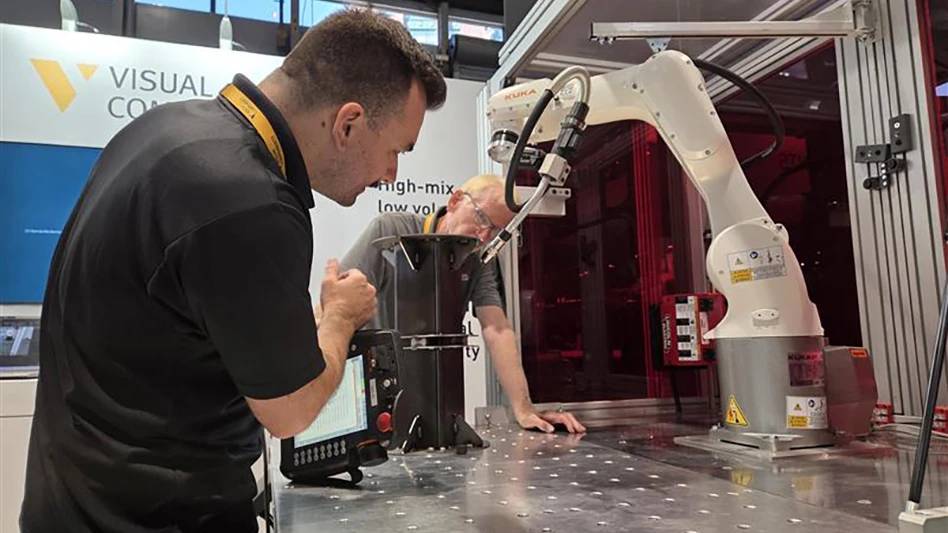
At FABTECH 2025, Visual Components highlighted its decades of software development, advanced 3D simulation expertise, and robotic offline programming (OLP) software with a robotic welding cell demonstration that showed manufacturers how to drastically reduce robot programming time and effort. Visitors to the company’s booth at McCormick Place in Chicago, Illinois, experienced a KR AGILUS industrial robot from KUKA Robotics performing a simulation weld of a complex part using Visual Components Robotics OLP software to program, simulate, and execute weld path and parameters.
Visual Components Robotics OLP software programmed the KR AGILUS’ complete weld path with just a few clicks. Attendees watched as the process was verified and validated offline on a screen then simulated within a KUKA Edu_ArcWelding mobile training cell. In addition to KUKA’s automation, built-in post-processors make OLP software compatible with a wide range of globally recognized brands and more than 40 robot controllers, eliminating the need to know multiple languages and protocols.
Visual Components’ OLP software allows manufacturers to reimagine new and efficient processes and systems without risk or loss of production for programming and commissioning. The software imports part data via a 3D CAD file directly to the robot, allowing engineers to program multiple robot paths and test performance without spending hours mapping and teaching repetitive movements.
In addition to reducing programming and commissioning time from days to hours, the software allows programmers to update and reprogram their system from anywhere and store process knowledge for future use, making it simple to reuse programs and preserve institutional information.
Attendees at FABTECH 2025 also learned more about the highly anticipated Visual Components 5.0 all-in-one manufacturing simulation that brings better performance, more customization options, and expanded support for virtual commissioning – all with greater flexibility and efficiency. This platform empowers manufacturers to fully leverage model-based engineering with its most advanced model yet and is expected to be released later this year.