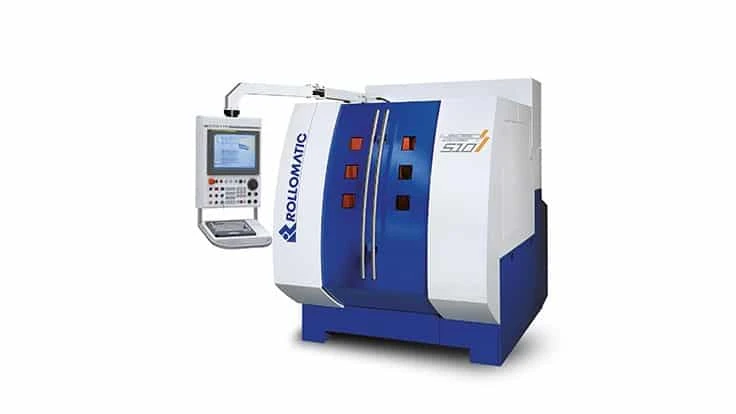
Rollomatic achieving the highest possible surface finishing in machining PCBN material. Rollomatic succeeded in producing a surface finish of Ra 48 nanometers (0.048 micrometer) on a primary relief of a profile insert in PCBN material.
The tests were performed on the LaserSmart LS510 cutting and ablation machine with 5 interpolating CNC axes. A “super-mirror” finish is generally known to be around 100 nanometers which Rollomatic was able to cut in half.
These tests were performed at the Rollomatic showroom facility in Mundelein, IL, USA, without sacrificing on feedrates or cycle times. In particular, the process ensured that the integrity of the edge quality was fully maintained without compromise.
The verification and measuring process was carried out by a Bruker-Alicona EdgeMaster Optical 3-Dimensional Metrology Unit.
This machine produces the sharpest corner radius in the PCD/CBN industry with a maximum radius on the cutting edge below 0.5 micron. In addition, a defined radius of 3, 6 and 9 microns can also be produced consistently. In addition to round-shaft tools, HSK63 shanks can also be accommodated on this machine.
The strategy for this machine is to offer a more cost-effective way and higher quality in the production of high-performance PCD polycrystalline diamond, CBN cubic boron nitride and CVD chemical vapor deposited cutting tools which traditionally require to be produced by a double process of spark erosion and polish grinding.
- Up to 4 times faster feedrates with identical edge and surface quality.
- 3D machining of drill points and endmill cutting geometries.
- Process to sharpen the cutting edge of CVD or thick-film diamond coated cutting tools.
- Fine-laser cutting achieves a superfine cutting edge with a surface finish that is unachievable by
grinding/EDM.
- Conventional grinding with diamond wheels will invariably “pull out” an entire PCD crystals, while laser cutting will “slice” through the crystal and leave a portion of the crystal in the matrix, thus providing a razor-sharp cutting edge, unattainable by EDM, EDG (electro-discharge) or grinding.
- Linear motion technology on all linear and rotary axes provides highly accurate trajectories for the complex cutting paths.
- Continuous field testing has shown that sharper cutting edges and superior surface quality on PCD tools deliver longer tool life and higher feed rates during machining.
- Laser ablation allows the freedom to optimize tool geometries.
- Manufacturing chip form geometries in PCD is easily performed by this machine using the ablation process as a cost-effective and powerful alternative to existing complicated and expensive conventional methods.