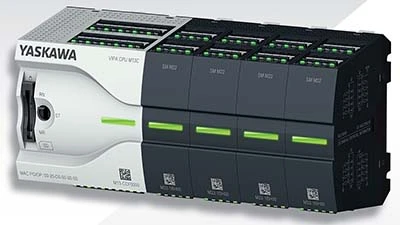
The Micro programmable logic control (PLC) VIPA is an ultra-compact, fast, stand-alone PLC that combines high performance and high channel density in a compact, modern design.
The Micro has a width of less than 72mm making it up to 50% smaller than typical micro controllers. Designed as a stand-alone PLC, the Micro replaces the System 100V and incorporates features such as a new display and an operating concept that enables users to see the essential control information at a glance.
It is based on the latest Speed 7 technology which ensures the highest clock rates and fast program processing for precise positioning and diverse control tasks. Additional speed benefits allow a fast backplane bus transmission of 48Mbit/s providing a performance similar to a large CPU, yet in an ultra-compact micro package.
Other features include high channel density thanks to the 30 integrated digital and analog I/O channels which provides users with multiple options as a stand-alone CPU. It can also be expanded with up to an additional 8 modules. The initial options available are digital modules 16Dl, 16DO, 16DIO, and 8DO relay which will be further extended with other types of modules. This provides the potential to expand the controller up to a maximum of 158 I/O channels and enable a multitude of automation tasks.
The connection plugs are individually detachable so are suited to pre-wiring. Convenient push-in technology helps to minimize downtime and speed maintenance because the plugs can be mounted and replaced without tools. The plugs have spring terminals so wiring is easier and can be completed without the need for re-tightening of screw connections whilst also ensuring superior vibration resistance.
The positioning of the I/O display LED’s directly on the appropriate plug connection provides users with a clear indication of the channel status to help with quick and clear diagnosis. Real-time diagnosis is also possible using smart phones and tablets via an optional Bluetooth adaptor.
The Micro communicates via Ethernet TCP/IP (open communication, Modbus TCP etc.) as standard and is prepared for future applications of PROFINET. There is also the option of using the PROFIBUS slave function, PtP, and MPI via an expansion module.