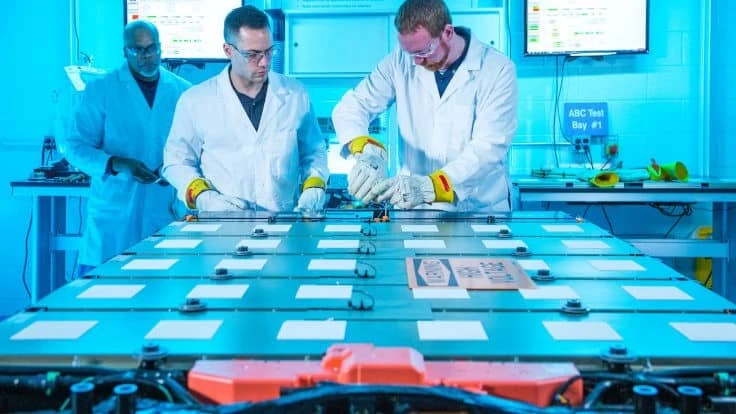
Detroit, Michigan – General Motors has developed an almost completely wireless battery management system (wBMS) for production electric vehicles (EVs) with Analog Devices Inc., making future batteries more modular and allowing the automaker to mix and match sizes and vehicle ranges using a common set of components.
The wBMS should speed GM’s Ultium-powered EVs to market faster, as time won’t be needed to develop specific communications systems or redesign complex wiring schemes for each new vehicle.
Much like the pack design of GM’s Ultium batteries, which is flexible enough to incorporate new chemistry over time as technology changes, the wBMS’ basic structure can easily receive new features as software becomes available. With expanded over-the-air updates, the system could even be upgraded new software-based features via smartphone-like updates.
“Scalability and complexity reduction are a theme with our Ultium batteries – the wireless battery management system is the critical enabler of this amazing flexibility,” said Kent Helfrich, GM executive director of Global Electrification and Battery Systems. “The wireless system represents the epitome of Ultium’s configurability and should help GM build profitable EVs at scale.”
The wBMS will balance chemistry within the individual battery cell groups for optimal performance. It can also conduct real-time battery pack health checks and refocus the network of modules and sensors as needed, safeguarding battery health throughout the vehicle’s lifespan.
Reducing wires within the batteries by up to 90% can extend charging range by creating lighter vehicles and opening extra room for more batteries. The space and flexibility created by this reduction enables a cleaner design and a simpler, more streamlined battery restructuring as needed and more robust manufacturing processes.
After the useful life of battery packs end and the wireless packs are capacity-reduced to the point where they are no longer ideal for optimum vehicle performance, they can be combined with other wireless battery packs to form clean power generators. This can be done without a redesign or overhaul of the battery management system traditionally required in second-life usage.
Greg Henderson, Analog Devices Inc. senior vice president of Automotive, Communications, and Aerospace & Defense, said, “Our collaboration is aimed at accelerating the transition to electric vehicles and a sustainable future.”
Latest from EV Design & Manufacturing
- Festo Didactic to highlight advanced manufacturing training solutions at ACTE CareerTech VISION 2025
- Multilayer ceramic capacitor enters mass production
- How US electric vehicle battery manufacturers can stay nimble amid uncertainty
- Threading tools line expanded for safety critical applications
- #55 Lunch + Learn Podcast with KINEXON
- Coperion, HPB eye industrial-scale production of solid-state batteries
- Machine tool geared toward automotive structural components
- Modular electric drive concept reduces dependence on critical minerals