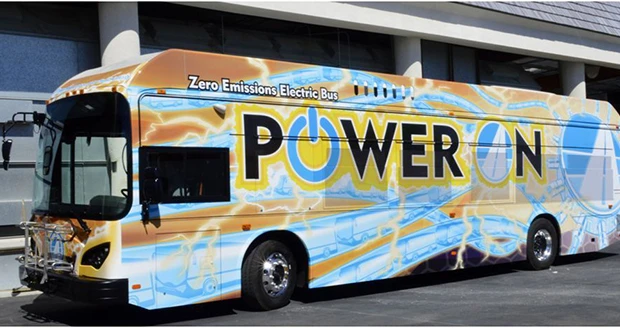
Altoona, Pennsylvania – The Altoona Bus Research and Testing Center under the Larson Institute and sponsored by the Federal Transit Administration (FTA), has completed the FTA’s “new model bus testing program” of the first 40-foot, all-electric bus.
The BYD Electric Bus has successfully completed the Altoona structural integrity testing program in 116 track days *with full reports published soon. This is the world’s only long-range battery electric transit bus in mass production and the only bus capable of driving continuously for up to 24 hours on-a-single-charge that has also received TVM approvals and qualified for FTA funded projects.
“The Altoona staff were professional and accommodating, guiding BYD through the process and ensuring all testing met the federal standards,” says BYD Motors President Stella Li. “BYD will commence shortly with the testing of the BYD 60-foot Bus-Rapid-Transit (BRT) style all-electric bus at Altoona.”
BYD’s electric bus has no transmission, clutches or drive train but has instead two robust in-wheel-drive motors powered by batteries on board the bus. BYD sees this recent accomplishment as the first of many, in what will be a long and productive relationship with the Altoona Bus Testing and Research Center. The 40 foot BYD Electric Bus is just the first of three different size options that will be offered to the United States for the 2014/2015 deliveries. Next at Altoona will be the 60-foot articulated BYD All-Electric bus.
Source: BYD Co. LTD
Latest from EV Design & Manufacturing
- Festo Didactic to highlight advanced manufacturing training solutions at ACTE CareerTech VISION 2025
- Multilayer ceramic capacitor enters mass production
- How US electric vehicle battery manufacturers can stay nimble amid uncertainty
- Threading tools line expanded for safety critical applications
- #55 Lunch + Learn Podcast with KINEXON
- Coperion, HPB eye industrial-scale production of solid-state batteries
- Machine tool geared toward automotive structural components
- Modular electric drive concept reduces dependence on critical minerals