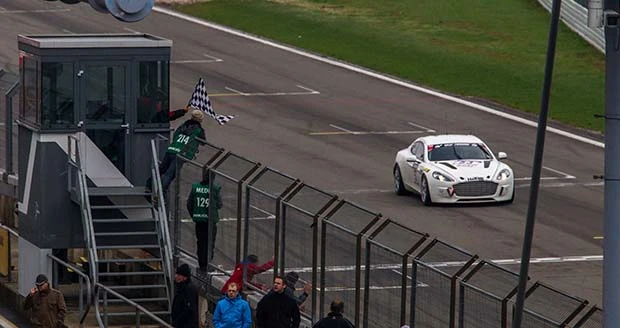
Syracuse, New York – Leak-detection equipment helped launch the world's first racecar equipped with a hydrogen combustion engine in 2014 and will play an important role in bringing hydrogen-powered engines to consumer markets in years to come.
Inficon hydrogen leak detectors were used to develop the Aston Martin Rapide S that completed last year's 24-hour race ADAC Zurich race, demonstrating the reliability of hydrogen powertrain technology, notes Thomas Parker, Inficon’s automotive sales manager for North America.
Austria-based Alset GmbH led a team of 35 systems and component suppliers to develop the Aston Martin Rapide S's hybrid engine that can be driven with any mixture of hydrogen or gasoline fuel.
When highly volatile gases such as hydrogen and oxygen are used in a vehicle's combustion system, it's essential to identify and eliminate any possibility of a leak. The Alset team selected Inficon leak detectors to test their system throughout the development process and on race day as well.
"Developing a functional hydrogen-hybrid drive system in principle is not all that difficult," explains Gonzalo Auil, a regional manager for Alset. "The challenge was in the details. Our goal was to achieve optimal combustion during every form of operation to obtain maximum performance from the fuels without putting a strain on the engine."
CO2 emissions were reduced significantly when the engine was operated in hybrid mode without a noticeable horsepower loss (521hp for hybrid operation compared to 578hp for gasoline). When powered purely by hydrogen, the engine provided 438hp with virtually no CO2 emissions.
"Modifications to the Aston Martin's engine were kept to a minimum and according to the development team could be transferred to production vehicles without considerable expense," Parker says. "Preventing leaks within the hydrogen engine system is essential and will result in additional testing and production requirements."
Conventional water or spray leak-detection methods would be too costly and time consuming for assembly-line hydrogen testing, especially for fuel lines, connecting parts or even the injection systems. Inficon's Sensistor Sentrac provides automakers and their suppliers with a cost-effective solution.
In order to conduct on-site leak tightness tests at the ADAC Zurich race at Germany's famous Nuerburgring, Alset used the mobile battery-operated version of the hydrogen leak detector.
"We checked all components for leak tightness," Auil adds. "Since stress levels are greater for the vehicle and its components than during normal traffic conditions, the development team needed a seamless, comprehensive documentation to demonstrate safety and suitability for series production.
"Many leak-detection devices take a long time before they are able to again deliver meaningful results. That was not the case with Inficon's system. If we pinpointed a leak, we continued the test in just a few seconds."
Source: Inficon
Latest from EV Design & Manufacturing
- Festo Didactic to highlight advanced manufacturing training solutions at ACTE CareerTech VISION 2025
- Multilayer ceramic capacitor enters mass production
- How US electric vehicle battery manufacturers can stay nimble amid uncertainty
- Threading tools line expanded for safety critical applications
- #55 Lunch + Learn Podcast with KINEXON
- Coperion, HPB eye industrial-scale production of solid-state batteries
- Machine tool geared toward automotive structural components
- Modular electric drive concept reduces dependence on critical minerals