Datwyler
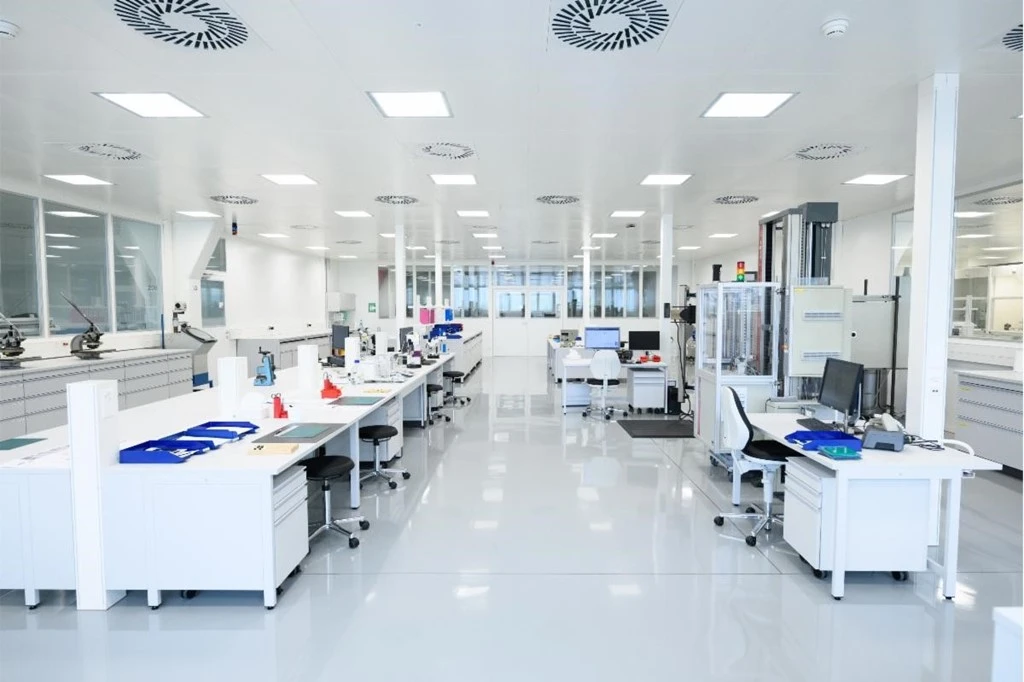
Datwyler launched dedicated technology and innovation (T&I) Labs in Schattdorf, Switzerland, comprising a series of specialist laboratories, to further support customers globally.
The T&I Labs feature equipment driving the development of breakthrough, innovative products, and the improvement of existing products through advanced root cause analysis. The interpretation of data is a challenge to customers. By combining Datwyler’s material expertise with the capabilities of the labs it’s possible to analyze the interaction between materials, to optimize their properties, and to control the processes for the highest quality outcomes.
“The T&I Labs offer customers the ability to use our expertise and equipment to find the ideal solution for their problem or co-engineer an entirely new product together with us,” said Dr. Luciane Klafke, Head of Mixing and Lab Technologies at Datwyler. “Since our T&I Labs are entirely in-house, we offer complete independence, transparency, and flexibility at every stage of the development process. This enables us to take total ownership of material quality, process control, and analysis. We can develop, together with our customers, the best functionality and material combination for their products, and because the labs are independent, we can do so without affecting production schedules in any way.”

Customers gain strategic advantages via advanced analytical methods
The ability to characterize and analyze surfaces and the contact between different materials provides a strategic advantage to Datwyler’s customers. From recipe development to advanced technologies, it is possible to start from scratch with new materials, combinations, and processes and then to go into how to implement them into production. Existing parts can also be used for experiments to develop new coatings and processes independently. This means, for example, when a new bonding agent is required, now the fine-tuning of the bonding agent application can be done in parallel without stopping production – offering much more flexibility to customers.
The labs also enhance the ability to analyze and optimize the manufacturing process and the functionality of a component within a system in a situation that is as close to reality as possible.
“What we have created at the T&I Labs that is truly unique is a cleanroom environment,” says Klafke. “We can recreate very similar conditions to the production environment, which allows us to prototype in these rooms, and we can do many iterations, tests, and experiments to achieve the highest quality solutions. This not only makes the integration time shorter, but it also means the feedback loop is much faster, enhancing speeds-to-market for our customers.”
The future of mobility requires advanced capabilities
As mobility applications continue to move forward, advanced technologies will require greater functionality in terms of materials and surface treatments. Sealing solutions must perform at the highest level but may be required to perform in other ways given their new environment, such as maintaining temperature stability. Highly advanced electroactive polymers (EAP) are also a good example. Their use in stacked actuation technologies for electrification and electric vehicles has led to advances such as haptic feedback and morphing buttons within the cabin interior, as well as lower energy consumption and reduced mechanical complexity when compared to today’s actuators
“Functionality is a core focus in terms of innovation, and there are many challenges we must address,” says Dr. Jakub Kadlcak, Head of Material Development Mobility and General Industry. “Certain coatings, for battery cells for example, will require a material that is thermally conductive and electrically insulating with EMI shielding, and these are qualities that are often contradictory. Improving conductivity increases shielding efficiency, but sometimes this is not required, and a coating must be added to counter the effects. Because the functionality of materials is not visible – you must make it visible through testing to achieve the desired results. The new Technology & Innovation Labs will be instrumental here in these instances and will, we are sure, become the go-to global competence resource for surface technologies and future-oriented material solutions.”
Latest from EV Design & Manufacturing
- Festo Didactic to highlight advanced manufacturing training solutions at ACTE CareerTech VISION 2025
- Multilayer ceramic capacitor enters mass production
- How US electric vehicle battery manufacturers can stay nimble amid uncertainty
- Threading tools line expanded for safety critical applications
- #55 Lunch + Learn Podcast with KINEXON
- Coperion, HPB eye industrial-scale production of solid-state batteries
- Machine tool geared toward automotive structural components
- Modular electric drive concept reduces dependence on critical minerals