GF Machining Solutions
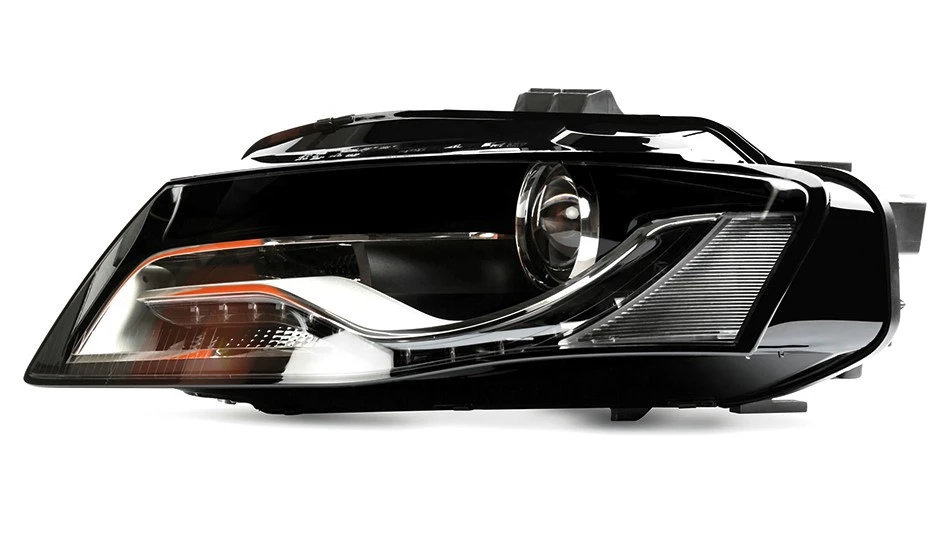
Automotive technology progresses at breakneck speed. “New Energy Vehicles” with all-electric, hybrid, or fuel cell powertrains are pushing aside traditional gasoline and diesel vehicles. Innovative driver assistance systems range from collision warning alerts to fully autonomous self-guided vehicles. Even automotive lighting systems are growing more complex and sophisticated. The round, simple, standardized (and inexpensive) sealed-beam tungsten-filament headlights of half a century ago have given way to a bewildering selection of LED/OLED, Xenon/HID, and laser lights in a vast array of compact and dramatic designs.
Structural automotive lighting components generally result from engineered plastics and manufacturers produce the parts in molds, milled from hardened steels. The molds feature acute angles and complex shapes as well as mirror-like surface finishes necessary to reflect and control the emitting light. This challenges machine tool builders to develop machines that can produce automotive lighting molds in a rapid, consistent, and cost-effective way.

Moldmakers customarily milled mold contours in machining centers then used slow, tedious manual polishing methods to generate critically precise surface finishes. To meet short development cycles and provide consistent fine finishes at the lowest cost possible, machine tool builders are providing machines that can produce molds with surface finishes in the general range of Ra 0.1?m - Ra 0.05?m and require minimal or no bench polishing.
The key to achieving this level of surface quality is maintaining uncompromising stability in the machine tool system overall. The machine itself must be a solid, vibration-free platform for the milling operations. The base of the machines used for this type of application from GF Machining Solutions are cast in polymer granite absorbing vibration approximately six to ten times more efficiently than cast iron.

When machining the part molds, the machine tool must possess sufficient thermal stability to prevent unwanted dimensional changes caused by fluctuating temperatures outside and inside the machine. The polymer granite bases of GF Machining Solutions machines respond to external temperature changes very slowly coupled with liquid internal cooling throughout the machine base provides even more thermal stability.
In addition to external temperature changes, a milling machine’s drive components themselves generate heat and the machine spindle is a major contributor. Based on the temperature and rpm at which the spindle is running, the Step-Tec spindles from GF Machining Solutions compensate in real time for Z-axis dimensional differences.
To maintain machine geometry, GF Machining Systems’ Opticool spindle system assures the spindle remains thermally stable and natural heat transfer to the Z-axis spindle support is limited to the lowest amount possible. When conventional stator cooling reaches its limit, the Step-Tec COOLCORE rotor cooling circuit regulates the temperature and minimizes temperature fluctuations in the spindle’s rotating shaft.
Precision milling automotive lighting mold surfaces that require little or no bench polishing calls for the use of very small cutting tools run in light cuts at high rpm. GF Machining Solutions Mikron MILL P 500 U and MILL P 800 U machines, for example, operate continuously and consistently between 36,000 and 42,000 rpm.
Despite high cutting speeds, cycle times with small cutting tools often run long, sometimes extending from about 36 to over 200 hours in some instances. Hard, long lasting CBN or PCD cutting tool materials help prolong tool life to complete an entire part when possible. Some moldmaking shops split finishing operations between two tools, one of which removes 5 or 8 microns of material followed by another tool that performs final micro finishing.

To overcome precision tool machining challenges, full 5-axis vertical milling machines from GF Machining Solutions provide moldmakers with a variety of benefits. Utilizing 5-axis strategies the machines enable short-overhang cutting tools to access multiple part surfaces, adding to machining accuracy and minimizing the need for refixturing to reach all a part’s features. Reduced fixturing time results in lower part production time overall, and some users report 60 percent fewer setups when five-axis machines replace several three-axis machines.
GF Machining Solutions engineers numerous features to boost overall machining productivity. For example, integrated smart modules such as the Operator Support System (OSS) allow users to selectively prioritize surface finish, speed, or accuracy to customize their process to their needs. Automated Machine Calibration (AMC) allows for confirmation or calibration of the machine with limited operator intervention, promoting the upmost machine tool accuracy. A variety of available systems can be tailored to the needs of an individual manufacturer including cooling, lubrication and chip handling systems, work piece measurement systems, integrated tool measurement, standardized robotic interfaces, and automation capabilities.
GF Machining Solutions machines provide rigidity and strong metal-removal performance as well as flexibility. For Tool and Die shops that also offer job-shop type services, GF Machining Solutions 5-axis machines can handle machining operations ranging from roughing billet workpieces to producing superfine mold finishes.
Holding or clamping parts is also critical in precision milling operations. For this reason, modular System 3R tooling from GF Machining Solutions provides accurate repeatability and minimizes setup times. The system permits untended and highly precise machining during the long cycle times that are necessary to produce finishes like those required in headlight component manufacturing.
Product testing requirements pose a further challenge in headlight mold production. Customers for the molds often require that the finished lighting assemblies be subjected to lighting evidence tests. Instead of simply assuring that the molds meet dimensional specifications, mold manufacturers must assemble the parts and prove their effectiveness in actual lighting performance. Typical tests can include determining a headlamp’s photometric performance using a goniometer that measures the headlight’s performance in a point-by-point method, or CCD-based imaging photometers that can measure millions of angles or points simultaneously, thus enable rapid and accurate evaluation of headlamp beam patterns.
To contend with accelerating advances in automotive technology, as well as other industrial manufacturing segments, manufacturers today should examine and acquire machining technology that will combine the accuracy, flexibility and productivity required now and in the future.
Latest from EV Design & Manufacturing
- Festo Didactic to highlight advanced manufacturing training solutions at ACTE CareerTech VISION 2025
- Multilayer ceramic capacitor enters mass production
- How US electric vehicle battery manufacturers can stay nimble amid uncertainty
- Threading tools line expanded for safety critical applications
- #55 Lunch + Learn Podcast with KINEXON
- Coperion, HPB eye industrial-scale production of solid-state batteries
- Machine tool geared toward automotive structural components
- Modular electric drive concept reduces dependence on critical minerals