CREDIT: PACIFIC GAS AND ELECTRIC CO.
Pacific Gas and Electric Company (PG&E), Nissan, and Fermata Energy are collaborating on a first-of-its-kind demonstration of automated frequency capabilities integrating electric vehicles (EVs) and bi-directional chargers with a multi-customer microgrid to provide grid support and enhance energy resilience.
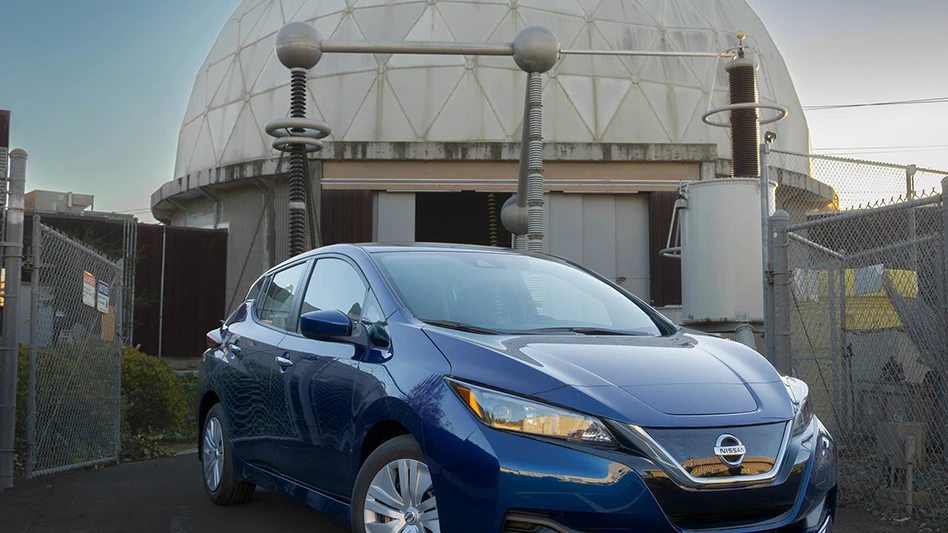
PG&E, Nissan, Fermata Energy, and the Schatz Energy Research Center at Cal Poly Humboldt, along with the Humboldt County Aviation Division, have implemented Fermata Energy's Vehicle-to-Everything (V2X) optimization platform integrated with two previous generation model year 2020-21 Nissan LEAF vehicles equipped with CHAdeMO quick charge ports and four bidirectional FE-20 charging stations at the Redwood Coast Airport Microgrid (RCAM) in McKinleyville, California.
"Integrating bidirectional chargers and EVs at the Redwood Coast Airport Microgrid is an innovative solution that will expand the capacity of the site, extending the capability for powering the airport during local grid outages and providing another clean energy resource for ensuring statewide grid stability," says Mike Delaney, vice president, Utility Partnerships and Innovation, PG&E. "The project showcases innovative Vehicle-to-Microgrid (V2M) technologies and demonstrates how EVs can support local energy needs and grid resilience."
RCAM is jointly operated by PG&E and the Redwood Coast Energy Authority, Humboldt County's local energy provider. The capacity and capabilities of the microgrid are enhanced to enable the advanced automated grid frequency response demonstration of Fermata Energy's V2X platform, an important part of PG&E's grid resilience efforts.
"At Fermata Energy, we see a real opportunity to transform electric vehicles from simple modes of transportation into critical energy assets. By integrating our intelligent V2X platform and bidirectional chargers, we are delivering measurable cost savings, valuable grid services, and enhanced local energy resilience. This pilot provides a scalable blueprint for communities, fleets, and utilities to harness EVs as distributed energy resources, accelerating the transition to a cleaner and more reliable grid in California and beyond," says Hamza Lemsaddek, chief operating officer of Fermata Energy.
The project also incorporates advanced microgrid control functionality developed by the Schatz Center, allowing the EVs to support the microgrid in balancing solar energy and battery energy storage in real time, enhancing both local resilience and broader grid stability.
"We are proud to have led the technical integration of this important pilot project that advances local resiliency and deep decarbonization and can play an important role in the community microgrids that are being developed across California's rural north coast and beyond," says David Carter, principal engineer at the Schatz Energy Research Center.
How the project works
The Humboldt County Aviation Division purchased one 2021 Nissan LEAF as a participant in this pilot project. Nissan provided a second 2020 Nissan LEAF under an agreement with Humboldt County.
Their batteries will offset grid usage and provide electric bill savings for Humboldt County.
"Nissan is proud to collaborate on innovative projects that explore how electric vehicles can contribute to energy resilience and sustainability. This pilot demonstrates the potential for EVs to support local energy needs and grid stability, and we look forward to continuing to work with partners like PG&E to explore these technologies," says Rich Miller, vice president, Vehicle Connected Services, Nissan U.S. and Canada.
The two-vehicle fleet is available to county staff for work activities. When not in use, the EVs are plugged into the bidirectional chargers, which can both charge and discharge the EV batteries. When discharging, the energy from the batteries is used for energy management, providing electric bill savings for Humboldt County.
Additionally, the vehicles respond to grid stress events, generating revenue by participating in California's Emergency Load Reduction Program (ELRP). When the statewide or regional grid is under stress, the V2X system will respond to signals from California's ELRP. This allows vehicle owners to voluntarily support the statewide electricity grid during periods of stress and earn revenue by sending electricity back to the grid.
When RCAM is islanded (i.e., not connected to the grid), the car-charger combinations will operate normally unless the microgrid's batteries are nearly full or empty. In those cases, the Schatz Center's new microgrid control functionality uses small changes in grid frequency to command available car-charger combinations to either inject power into the microgrid to prevent the microgrid battery from becoming depleted or absorb excess solar energy if the microgrid battery is full.
The project partners anticipate the project will yield valuable learnings and results for designing and implementing new grid architectures in support of California's goals of being 60% renewable by 2030 and 100% renewable and zero-carbon by 2045.
PG&E's V2X pilot offerings
Through its V2X pilots, PG&E is working with automakers such as Nissan and electric vehicle V2X platform service providers such as Fermata Energy to explore how light- and medium-duty EVs can help customers and the electric grid in various ways. These include providing backup power to critical infrastructure, optimizing EV charging and discharging to integrate more renewable resources, and aligning EV charging and discharging with the real-time energy procurement cost, which helps customers save money and reduce energy costs.
In addition to this microgrid project, PG&E has V2X pilot projects for its residential and commercial customers, offering financial incentives for participating customers and additional benefits for those in disadvantaged and priority communities, as identified in California Assembly Bill 841. The upfront incentives for the V2X pilots, along with performance-based incentives and enrollment in the ELRP, can provide additional savings to help offset the costs of purchasing and installing a bidirectional EV charger.
Latest from EV Design & Manufacturing
- How US electric vehicle battery manufacturers can stay nimble amid uncertainty
- Threading tools line expanded for safety critical applications
- #55 Lunch + Learn Podcast with KINEXON
- Coperion, HPB eye industrial-scale production of solid-state batteries
- Machine tool geared toward automotive structural components
- Modular electric drive concept reduces dependence on critical minerals
- EMCO presents Ecomill Plus HPC3 milling machine
- Discovery paves way for safer, higher-performance batteries