Photo courtesy of Joby Aviation
Joby Aviation, a company developing electric vertical take-off and landing (eVTOL) aircraft for commercial passenger service, announced it has successfully completed a series of air traffic simulations with NASA’s Ames Research Center that evaluated how air taxi operations can be integrated into today’s airspace, including at busy airports, using existing air traffic control (ATC) tools and procedures.
The simulations, jointly developed by Joby and NASA airspace engineers following a multi-year airspace study, tested scenarios with dozens of eVTOL aircraft per hour flying into and out of the complex, busy airspace in the Dallas-Fort Worth (DFW) region using today’s airspace system.
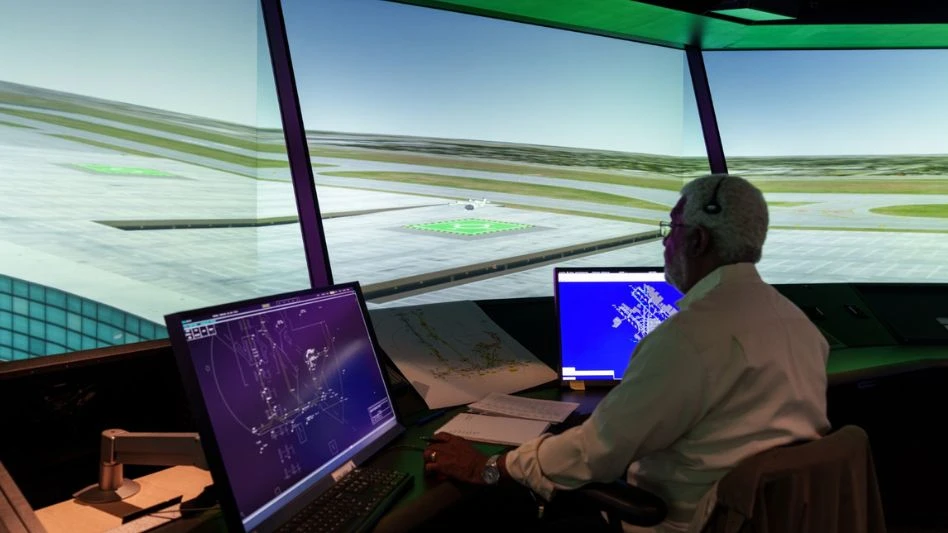
The activity took place at NASA’s Future Flight Central, a high-fidelity virtual tower facility offering a 360-degree view of a real-time simulation of an airport, where a team of NASA and Joby engineers, as well as pilots and air traffic controllers, simulated traffic patterns at Dallas Love Field (DAL) and DFW airports, representative of complex and busy airspace.
During the simulation, participating teams of controllers virtually tested the ability to integrate up to 120 eVTOL operations – arrivals or departures – per hour from DFW’s Central Terminal Area, alongside the airport’s existing traffic. Up to 45 simulated eVTOL aircraft were simultaneously aloft in DFW’s Class B airspace during the activity.
Latest from EV Design & Manufacturing
- Multilayer ceramic capacitor enters mass production
- How US electric vehicle battery manufacturers can stay nimble amid uncertainty
- Threading tools line expanded for safety critical applications
- #55 Lunch + Learn Podcast with KINEXON
- Coperion, HPB eye industrial-scale production of solid-state batteries
- Machine tool geared toward automotive structural components
- Modular electric drive concept reduces dependence on critical minerals
- EMCO presents Ecomill Plus HPC3 milling machine