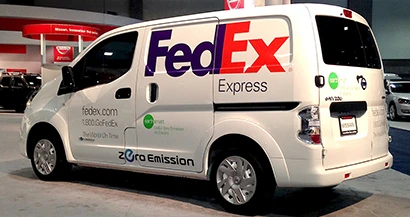
Nissan and FedEx are testing all-electric delivery vans in Washington, expanding tests of electric e-NV200 vehicles already on the roads in Japan, Singapore, Brazil, and the United Kingdom.
"As a global fleet operator serving 220 countries and territories worldwide, FedEx is committed to improving the efficiency of its vehicles as part of our EarthSmart initiatives," says Mitch Jackson, vice president of Environmental Affairs and Sustainability, FedEx Corporation. "We are pleased to continue our work with Nissan and bring the e-NV200 into test in North America."
Because delivery vehicles spend much of their time in start-stop traffic, delivery vehicles have long been considered ideal for hybrid and all-electric technologies. Most of such vehicles are already fueled in depots, so switching from gasoline to electricity for power isn’t a major limitation.
FedEx’s chief rival, UPS, has been using hybrid-electric vans using Eaton Corp. technology since 2009. And many automakers have arrangements with commercial up-fitters to offer hybrid options on vans and larger trucks.
The FedEx/Nissan test will be one of the largest tests of all-electric delivery vehicles in North America and could serve as a case study for alternative power sources in urban environments.
FedEx and Nissan are both committed to reducing the environmental impact of their operations worldwide. Rotating the Nissan e-NV200 into the delivery fleet is part of the FedEx EarthSmart program, a global sustainability platform designed to guide the company's environmental commitment in the communities where it operates.
For Nissan, this effort aligns with its "Blue Citizenship" corporate social responsibility program with a focus on increasing the number of vehicles that emit no greenhouse gases by exploring additional vehicle segments where its leading electric vehicle technology may be applied.
FedEx will deploy the Nissan e-NV200 in the Washington, D.C. area, where it will undergo field tests that subject it to the routine requirements of a delivery vehicle. The results will be used to help determine the viability of using an electric vehicle in this role in the U.S. Nissan e-NV200 is scheduled to begin mass production later this year in Europe.
"We're eager to work with FedEx and other companies to put the e-NV200 through its paces to continue to build awareness of the capability of electric vehicles and to evaluate how well it meets the needs of the commercial consumer," said Erik Gottfried, Nissan director of Electric Vehicle Sales and Marketing. "We'd also like to explore clever uses of EVs in work environments where carbon emissions of gas-powered vehicles make them impractical or impossible to use."
With front-wheel drive, the e-NV200 provides rapid and smooth acceleration and excellent handling with a high degree of maneuverability. The electric vehicle delivers immediate torque, which benefits acceleration with a heavy payload from a dead stop. The e-NV200 offers the low cost of ownership that EVs such as LEAF boast—based on fewer maintenance requirements and the reduced cost of charging versus fueling. The smart positioning of the battery ensures a larger cargo area, and the vehicle maintains a low load floor, key considerations for light commercial vehicles.
FedEx Express currently has 167 electric vehicles and 365 hybrid electric vehicles in the United States, France, Germany, Italy, Japan, and China, including the units that will be deployed in Brazil starting in January. By the end of this fiscal year (May 31, 2014), the company plans to increase these numbers to 222 and 393, respectively. From 2005 to 2012, the introduction of this type of vehicle in the fleet enabled the company to save nearly 2.4 million liters of fuel.
Source: Nissan, FedEx
Latest from EV Design & Manufacturing
- Festo Didactic to highlight advanced manufacturing training solutions at ACTE CareerTech VISION 2025
- Multilayer ceramic capacitor enters mass production
- How US electric vehicle battery manufacturers can stay nimble amid uncertainty
- Threading tools line expanded for safety critical applications
- #55 Lunch + Learn Podcast with KINEXON
- Coperion, HPB eye industrial-scale production of solid-state batteries
- Machine tool geared toward automotive structural components
- Modular electric drive concept reduces dependence on critical minerals