Rohde & Schwarz
Rohde & Schwarz supports research activities at 6G organizations, universities, and research institutes across Europe, Asia and in the US. The company’s test and measurement expertise and solutions help pave the way for the next generation of wireless communications 6G with commercial deployment expected around the year 2030. Sub-THz typically marks the frequency range from 100 into the 300GHz range and represents one potential building block of a future 6G wireless communication standard.
Sub-THz technology promises to be indispensable not only to achieve target requirements in terms of maximum throughput on the 1Tbps level and extremely low latencies. It is also the foundation for intriguing novel applications. The access to much wider bandwidths will enable very high-throughput short-range communication combined with a sense of the environment for object detection or the next generation of gesture recognition down to millimeter resolution. To fully exploit the technology’s potential, its crucial to understand the propagation characteristics of THz frequencies by performing channel sounding measurements.
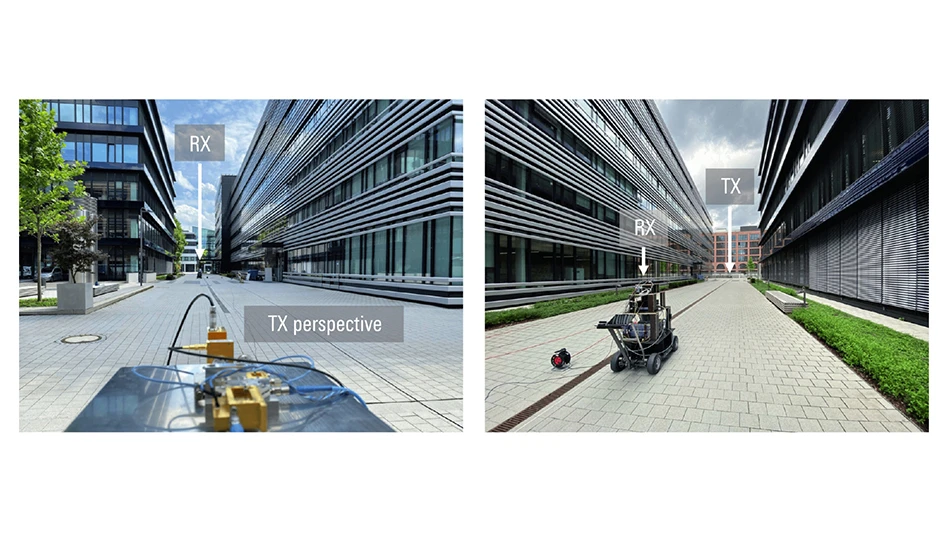
Rohde & Schwarz has conducted a channel sounding measurement campaign performed in an urban micro scenario as well as an indoor scenario at 158GHz and 300GHz on the Rohde & Schwarz campus in Munich, Germany. First results of this campaign have contributed to the ITU-R Working Party 5D (W5PD) report on “Technical feasibility of IMT in bands above 100GHz” with the objective to study and provide information on the technical feasibility of mobile cellular technologies in bands above 92GHz (IMT meaning International Mobile Telecommunications standards). The report will be consulted at the International Telecommunication Union (ITU) World Radio Conference 2023 (WRC23), where additional frequency bands beyond 100GHz are expected to be discussed and considered for allocation at the subsequent WRC27. The current 3GPP channel model is only validated up to 100GHz. A crucial first step for the standardization process for 6G is to extend this channel model to higher frequencies.
The recent measurement campaign is part of larger research activities with the goal to better understand the millimeter and sub-millimeter (sub-THz and THz) mobile radio channels, which cover various frequencies of relevance for the future 6G communication standard. To further pursue and extend these research activities, Rohde & Schwarz has been granted an experimental license by the Bundesnetzagentur, the German federal network agency. The license encompasses frequencies in the sub-THz region such as the D-band (110GHz - 170GHz) and H-band (220GHz - 330GHz), but also in the W-band (75GHz - 110GHz), FR2 (mmWave), FR3 (7GHz - 24GHz) and the industrial frequency band in Germany, 3.7GHz - 3.8GHz.
“We are proud to contribute our share in investigating THz technologies, further extending knowledge by applying our leading-edge test and measurement solutions to early application scenarios and fundamental research, joining our renowned partners such as the Fraunhofer Heinrich Hertz Institute (HHI) and the Technical University (TU) Berlin in collaborations," says Taro Eichler, technology manager at Rohde & Schwarz and responsible for the recent sub-THz measurement campaign. "With our current activities, we lay the foundation to support a critical step in the standardization process of 6G.”
Latest from EV Design & Manufacturing
- Festo Didactic to highlight advanced manufacturing training solutions at ACTE CareerTech VISION 2025
- Multilayer ceramic capacitor enters mass production
- How US electric vehicle battery manufacturers can stay nimble amid uncertainty
- Threading tools line expanded for safety critical applications
- #55 Lunch + Learn Podcast with KINEXON
- Coperion, HPB eye industrial-scale production of solid-state batteries
- Machine tool geared toward automotive structural components
- Modular electric drive concept reduces dependence on critical minerals